European Union Calls Houthi Attack on Saudi Oil Tanker Unacceptable and Illegal
 Yemen Herald News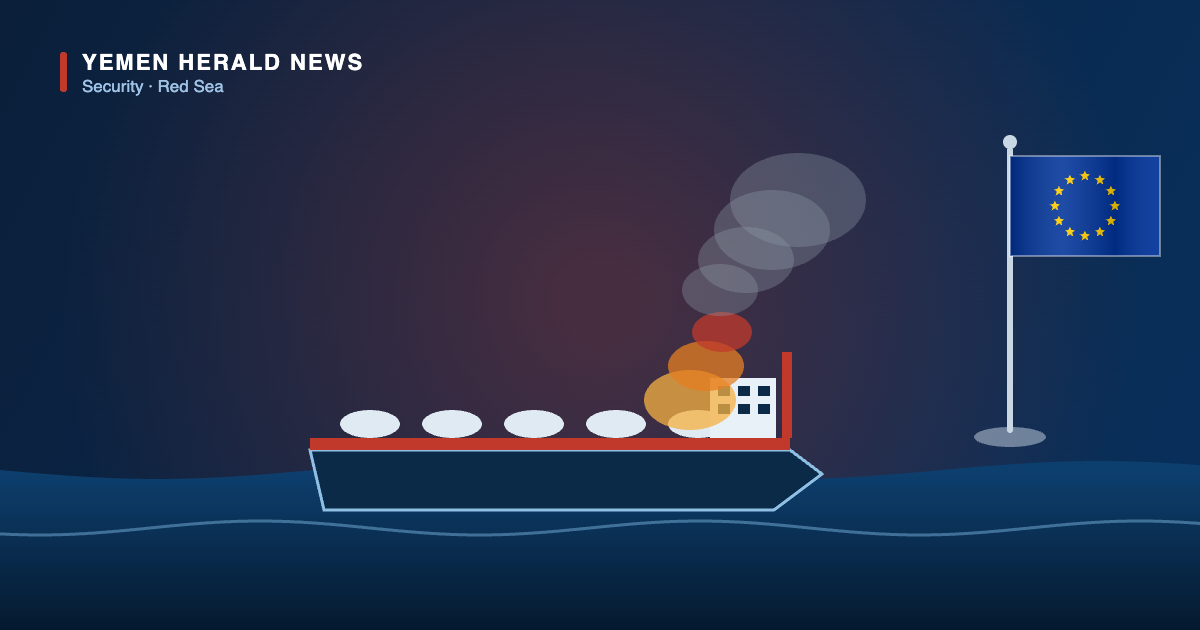
The European Union’s High Representative for Foreign Affairs and Security Policy, Kaja Kallas, has condemned the Houthi attack on an oil tanker in the Red Sea, calling it unacceptable and illegal. In a statement issued on 23 July she said the strike further inflames an already volatile situation in the region, and that the Houthis must cease all actions that endanger international shipping and the lives of seafarers.
Kallas also addressed the movement’s wider threat against Saudi Arabia, describing the Houthi declarations as a direct threat to regional stability that constitutes a dangerous escalation. She called on the group to comply with international law, including the United Nations Convention on the Law of the Sea and relevant resolutions of the UN Security Council, and said the European naval mission deployed in the Red Sea remains firmly committed to protecting freedom of navigation for all.
That mission is Operation Aspides, launched in February 2024 in response to the first Houthi campaign against merchant shipping. Its mandate is defensive: warships contributed by member states escort commercial vessels through the Red Sea, the Gulf of Aden and adjacent waters, intercept incoming drones and missiles, and provide situational awareness to shipowners, but they do not strike targets ashore. The operation has always been limited by the number of hulls member states are willing to commit, which has rarely matched the length of the corridor it is asked to cover.
Kallas has separately made clear that the European Union has no appetite to extend the mission into the Strait of Hormuz, where the confrontation between the United States and Iran is concentrated. That distinction matters. Brussels has positioned Aspides as a narrow protective measure for commercial traffic rather than a participant in the wider regional war, and expanding its geography would blur a line the bloc has worked to maintain.
The statement followed a rapid escalation off Yemen’s west coast. On 20 July the Houthis declared a maritime blockade of Saudi Arabia, telling shipping companies by email that vessels were banned from loading or unloading at Saudi ports. Two days later the group’s military spokesman, Yahya Saree, said its forces had struck two Saudi oil tankers, the Encelia and the Layla, with ballistic and cruise missiles and drones for violating that decision.
Saudi authorities confirmed that the Encelia, a products tanker that had sailed from Yanbu, caught fire after being hit, and said all crew members were safe. The United Kingdom Maritime Trade Operations agency placed the strike about 70 nautical miles southwest of the Saudi coastal city of Al Shuqaiq. No casualties or pollution were reported, but at least seven vessels changed course to avoid the Bab al-Mandab Strait in the hours that followed.
The group presented the blockade as retaliation for what it described as Saudi restrictions on Yemeni ports and for an airstrike on Sanaa International Airport that it attributed to the kingdom, accusations Riyadh rejects. Saudi Arabia has called the declared blockade a dangerous escalation, and condemnations have since come from Qatar, Bahrain, Kuwait, Lebanon, France and the African Union among others.
For Europe the commercial exposure is direct. The Red Sea and Suez corridor is the shortest route between Asian factories and European ports, and it carries an estimated 12 per cent of world commerce. When carriers divert around the Cape of Good Hope they add between ten days and two weeks to each voyage, along with fuel and charter costs and higher war-risk premiums for anyone still transiting the southern Red Sea. The earlier Houthi campaign cut Suez Canal traffic roughly in half, and traffic has recovered only partially since.
The attacks also mark a shift in the Houthis’ targeting. The 2023 and 2024 campaign was framed as pressure over the war in Gaza and struck vessels with a wide range of ownership and flags. The present blockade is aimed squarely at Saudi Arabia and its export lifelines, which changes the calculation for Gulf governments that had previously treated the maritime threat as an international rather than a national problem.
Iran’s role remains contested. The United States, European governments and United Nations experts have documented Iranian support for the Houthis’ drone and missile programmes, assistance Tehran denies providing. The group’s arsenal has nonetheless grown markedly over a decade of war, and its demonstrated ability to hit moving vessels at a distance of dozens of nautical miles is what makes a declared embargo credible enough to move insurance markets.
Behind the maritime crisis lies a humanitarian emergency that the escalation is likely to worsen. According to the United Nations 2026 Humanitarian Needs and Response Plan, more than 22 million people in Yemen require humanitarian assistance and protection this year, including 5.2 million internally displaced people. Some 18.3 million Yemenis are acutely food insecure, and aid agencies appealed in March for 2.16 billion dollars to reach 12 million of the most vulnerable. Yemen imports most of its food and fuel, so higher freight and insurance costs feed straight into prices in local markets.
Kallas offered no indication that the European Union intends to change the scale or rules of engagement of Aspides in response. That leaves Brussels in a familiar position: issuing legal and political condemnation, keeping a modest naval presence on station, and waiting to see whether the Houthis attempt to enforce the blockade they have announced against further vessels.
About the Author