Yemen’s ambassador to Japan presses Tokyo on Red Sea shipping security
 Yemen Herald News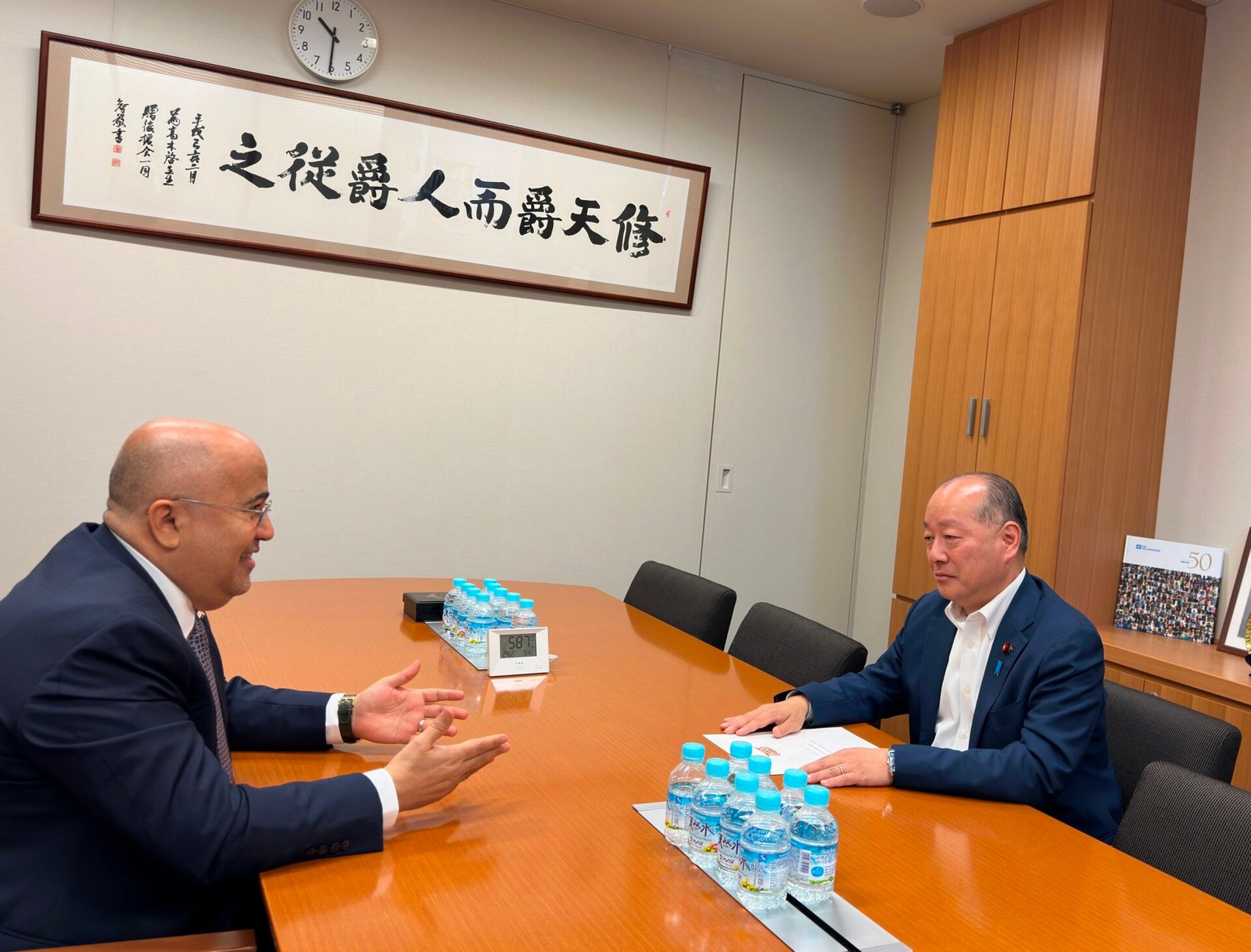
Yemen’s Ambassador to Japan, Adel al-Sunaini, has met Kei Takagi, a member of the Japanese House of Representatives and chairman of the Liberal Democratic Party’s Foreign Affairs Committee, for talks on bilateral relations and the latest developments in Yemen. The meeting was reported by the state news agency Saba, which did not indicate that any formal agreement was signed.
According to that account, al-Sunaini thanked Japan for its continued backing of the Presidential Leadership Council and the internationally recognised government, and for its stated support for Yemen’s unity and territorial integrity. Takagi, for his part, reaffirmed Japanese support for Yemen’s stability and territorial integrity and for efforts to reach a political settlement, and said Tokyo was open to broadening cooperation with Sanaa’s recognised authorities.
Maritime security ran through the discussion. The Yemeni government says the Houthi movement, which it describes as Iran-backed, continues to pose a threat to commercial shipping in the Red Sea, the Gulf of Aden and the Bab al-Mandab strait, and it has spent much of the past two years pressing foreign capitals to treat that threat as an international rather than a purely Yemeni problem. The Houthis have said their operations were tied to the war in Gaza and directed at vessels they linked to Israel and its allies.
For Japan the subject is not abstract. The country imports the overwhelming majority of its crude oil from the Gulf, and the Red Sea and Suez route is the shortest sea corridor between Asian ports and Europe. When attacks on shipping intensified from late 2023, a large share of container traffic was diverted around the Cape of Good Hope, adding roughly ten days and substantial cost to voyages between Asia and northern Europe. Japanese shippers, insurers and manufacturers were exposed to those costs alongside their European and Chinese counterparts.
Japan also has a direct experience of the campaign. In November 2023, Houthi forces seized the car carrier Galaxy Leader, a vessel operated by the Japanese shipping company Nippon Yusen and linked through its ownership to an Israeli businessman, and held its twenty-five crew members for more than a year before releasing them in January 2025. None of the crew were Japanese nationals, but the incident placed a Japanese-operated ship at the centre of the dispute and gave Tokyo a stake in how the shipping lanes are policed.
Beyond security, Japan has been one of the more consistent contributors to humanitarian work in Yemen, generally routing assistance through United Nations agencies and international organisations rather than running large bilateral programmes of its own. That approach has shaped the relationship: much of what Tokyo provides reaches Yemen through the World Food Programme, UNICEF, the refugee agency and similar bodies, which means Yemeni diplomats in Tokyo spend as much time arguing for sustained multilateral funding as for direct government-to-government projects.
Diplomatic relations between the two countries long predate the current war, and Japan maintained a development and technical cooperation presence in Yemen for decades before the conflict forced most foreign missions to relocate or suspend operations. Rebuilding that presence has been a stated Yemeni objective, though it depends on security conditions that are not in either government’s gift. In the meantime the embassy in Tokyo functions as the principal point of contact, handling consular work for Yemenis in Japan alongside its political brief.
The parliamentary track has been a recurring theme of al-Sunaini’s tenure. Yemeni diplomatic statements have previously described his efforts to establish a Yemeni-Japanese parliamentary friendship committee as a way of giving the relationship a channel that does not depend on ministerial visits, which are difficult to arrange while the Yemeni government operates from Aden and much of its administration remains dispersed.
It is worth being precise about what a meeting with a party committee chairman represents. The Liberal Democratic Party’s Foreign Affairs Committee is a party organ rather than a body of the Japanese state, and its chairman does not speak for the foreign ministry. In the Japanese system, however, party policy committees carry real weight in shaping positions that later become government policy, and access to their chairs is a standard objective for embassies seeking to influence Tokyo’s approach to a region.
The Presidential Leadership Council that al-Sunaini represents was formed in April 2022, when President Abd-Rabbu Mansour Hadi transferred his powers to an eight-member body, and it operates from Aden. It has since sought to consolidate international recognition while managing a fractious coalition of political and military factions, an economy under severe strain and a currency that has lost much of its value in government-held areas.
Neither side announced new commitments at the meeting. Saba’s report described an exchange of positions rather than a negotiation, which is the usual form of such encounters. Its significance lies less in any single outcome than in the maintenance of a diplomatic channel: Yemen’s recognised government relies heavily on the willingness of states such as Japan to keep treating it as the country’s legitimate authority.
That reliance is likely to continue. With the front lines largely frozen and United Nations-led mediation yet to produce a comprehensive settlement, the government’s international standing remains one of its more durable assets, and its embassies spend much of their effort protecting it. Meetings of this kind, individually modest, are the mechanism by which that work is done.
About the Author