Marib deputy governor launches three Korean-funded water projects worth $650,000
 Yemen Herald News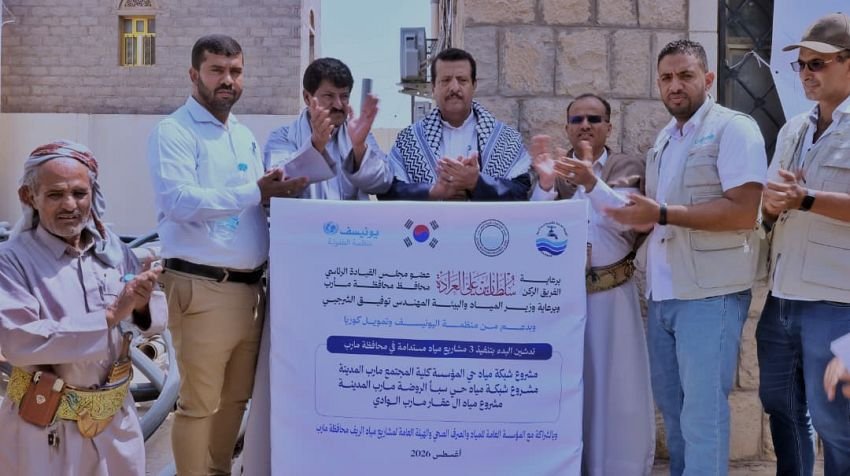
The Deputy Governor of Marib, Dr. Abd-Rabbo Meftah, has laid the foundation stone for three water projects in Marib city and the districts surrounding it, opening the first phase of a scheme budgeted at 650,000 US dollars. The money comes from South Korea and is being channelled through the United Nations Children’s Fund, according to the state news agency Saba.
The work will be carried out by the Marib branches of the General Authority for Water and Sanitation and the General Authority for Rural Water Projects, the two bodies that between them cover urban and rural supply in the governorate. Saba reported that the projects are intended to extend clean and safe drinking water into residential neighbourhoods that have grown up since the war began, many of them beyond the reach of the older municipal network.
Meftah presented the schemes as sustainable infrastructure rather than emergency relief, saying they would widen drinking water coverage in Marib city and ease the pressure on displaced families and on the communities hosting them. The governorate has taken in more than two million displaced people, a figure cited by the local authorities and by humanitarian agencies working in the area.
That influx has remade Marib. Before 2015 the city was a modest provincial centre in Yemen’s eastern desert, known mainly for the oil and gas fields nearby and for the ruins of the ancient Marib dam. It then became one of the few population centres to remain under continuous government control, and as fighting spread elsewhere it drew families from Sanaa, Hodeidah, al-Jawf and the western highlands. The informal settlements that now ring the city expanded far faster than any water or sewerage network could follow.
Water is the binding constraint. Marib sits in an arid basin where supply depends on groundwater drawn from wells, with no perennial river to fall back on. Adding boreholes, pumping stations and distribution lines is the only practical way to reach neighbourhoods that currently rely on tanker deliveries, an option that is both expensive and unreliable for households whose incomes have fallen sharply since the war began.
UNICEF has been among the largest providers of water, sanitation and hygiene support in Yemen throughout the conflict, paying for well rehabilitation, network extensions, fuel for pumping stations and operating support to local water corporations that would otherwise struggle to keep systems running. Its Yemen programme is funded almost entirely by donor contributions, and South Korea is one of the governments that has routed assistance to the country through United Nations agencies rather than through bilateral projects of its own.
The choice of implementing bodies is itself telling. Assigning the work jointly to the water and sanitation authority and to the rural water projects authority reflects the way Marib has grown outwards, with settlement patterns that no longer respect the old boundary between the serviced city and the villages beyond it. Coordinating both agencies on a single package of works is intended to avoid the overlaps and gaps that have complicated earlier interventions.
The public health case for the work is straightforward. Yemen has endured repeated cholera outbreaks since 2016, in what the World Health Organization has described as one of the largest epidemics of the disease recorded in modern times, and acute watery diarrhoea remains a recurring seasonal threat. Health officials have consistently linked flare-ups to contaminated or interrupted supply, which makes treated piped water in densely settled neighbourhoods a preventive health measure as much as a convenience.
The scale of the announcement should be kept in proportion. At 650,000 dollars spread across three schemes, this is district-level construction rather than a governorate-wide overhaul, and officials themselves described it as an opening phase. Yemen’s humanitarian response plans have been underfunded for several consecutive years, and aid agencies have repeatedly warned that water and sanitation programmes are among the first to be reduced when contributions fall short. Projects of this size carry weight partly because larger ones have become harder to finance.
For Marib’s administration there is also an argument about durability. Officials in the governorate have long maintained that continued investment in basic services is what allows the area to absorb displaced families without its own institutions collapsing, and that a city whose population has multiplied cannot be served indefinitely by networks designed for a fraction of that number. Presenting the projects as permanent assets rather than temporary relief fits that position.
Neither the governorate nor UNICEF has published a completion timetable for the three projects, and the number of households they are expected to serve has not been announced. What was set out at the ceremony was the budget, the donor, the implementing authorities and the general purpose of the work. Whether the schemes are delivered on time will depend on factors that have delayed comparable projects elsewhere in Yemen, including fuel costs, the availability of spare parts and the security situation along supply routes.
Marib’s requirements will outlast this phase. With no large-scale return of displaced families in prospect while front lines remain broadly static, the population the city has to serve is unlikely to shrink in the near term. Additional water capacity therefore addresses a permanent demand rather than a temporary surge, and the governorate has signalled that it will seek further funding for later stages once the current works are under way.
About the Author