Central Bank of Yemen signs UNDP deal to build a fintech lab in Aden
 Yemen Herald News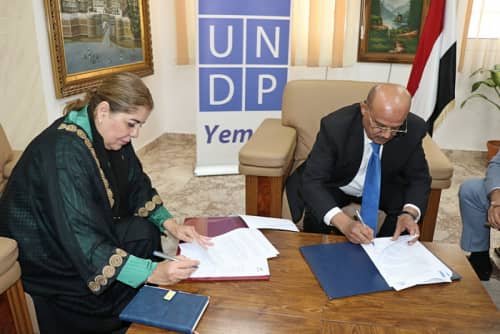
The Central Bank of Yemen has signed a memorandum of understanding with the United Nations Development Programme in Aden, setting out a framework for cooperation on financial technology and digital innovation. The agreement was signed by the bank’s governor, Ahmed Ghalib, and reported by the state news agency Saba.
Its central element is a financial technology laboratory to be established at the bank’s headquarters in Aden. The lab is intended to serve as a dedicated environment in which new financial products and technologies can be developed and tested before they reach the market, a function that comparable institutions elsewhere perform through regulatory sandboxes and innovation hubs.
Ghalib praised the development programme’s role in supporting the bank’s efforts to modernise financial infrastructure and widen financial inclusion. Neither institution announced a budget, a construction timetable or a date on which the facility is expected to begin work.
What such a laboratory does in practice varies by jurisdiction, but the common function is to let a regulator observe new products before deciding how to license them. Payment applications, digital identity checks and small lending platforms are tested against rules supervisors can adjust as they learn. For a central bank with limited enforcement capacity, that controlled approach has an obvious appeal.
The context makes the announcement more significant than its modest scale might suggest. Yemen remains an overwhelmingly cash-based economy in which formal banking reaches only a small minority of adults, and years of conflict have deepened that pattern rather than eased it. Households and businesses that once used bank accounts have reverted to cash and to informal exchange networks, and a substantial share of the money moving through the country travels through money-transfer agents rather than licensed banks.
The central bank itself has been divided since 2016, when its headquarters were relocated from Sanaa to Aden and the Houthi authorities retained control of the original institution and its staff. Two bodies have since issued conflicting instructions to the same commercial banks, each claiming national authority. Banks operating in both areas have had to navigate the resulting contradictions, and the split has complicated everything from bank supervision to the clearing of payments between the two zones.
The consequences are visible in the currency. The rial has traded at sharply different rates in government-held and Houthi-held areas since the Sanaa authorities barred newly printed Aden banknotes from circulation, producing what amounts to two separate currencies bearing the same name. In government-held areas the rate has moved a great deal, driven by the interruption of oil exports, the erosion of foreign exchange reserves and dependence on external deposits. Import prices and the cost of basic goods have followed.
Digital payments have grown in that environment, largely because physical cash has become difficult to handle. Mobile wallets and electronic transfer services have expanded their share of transactions, and aid organisations have moved a growing proportion of cash assistance onto digital channels, which are cheaper to distribute and easier to audit than envelopes of banknotes. A regulator that can set standards for those services is therefore addressing an activity that is already under way rather than creating a market from nothing.
The development programme has been among the more active international bodies in Yemen’s financial sector, running work on financial market infrastructure and inclusion alongside its larger portfolio of livelihoods, energy and local governance projects. Its involvement gives the Aden bank technical assistance it could not easily fund itself and, indirectly, a measure of international endorsement.
Financial inclusion is the stated objective behind much of this work. Yemen already recorded one of the region’s lowest rates of formal account ownership before the war, with rural households, women and the displaced furthest from the banking system. Services delivered over basic mobile phones are widely presented as the fastest way to narrow that gap.
Other institutions have moved in the same direction. In June 2025 the World Bank approved thirty million dollars to support financial inclusion and education in Yemen, part of a broader effort to keep basic financial services functioning through the conflict. Taken together, these initiatives reflect a judgement among donors that rebuilding payment and banking systems cannot wait for a political settlement.
There are limits worth stating plainly. A memorandum of understanding commits the parties to cooperate; it does not by itself build anything. Yemen’s electricity supply is unreliable in most cities, internet connectivity is expensive and intermittent, and the trained technical staff a laboratory of this kind requires are in short supply, many having left the country. Any facility established in Aden will operate under those constraints.
A further obstacle sits outside Yemen. Yemeni banks have struggled to retain correspondent banking relationships with foreign institutions, which have withdrawn from markets they regard as carrying high compliance risk. Without those relationships, domestic innovation in payments does little to reconnect Yemen to the international financial system. Restoring them depends on supervisory credibility and on sanctions and compliance questions that a technology laboratory cannot resolve.
For the Aden bank, the agreement nonetheless serves several purposes at once. It signals to international partners that the institution is functioning and reform-minded, it provides technical support at no direct cost, and it stakes a claim to authority over a fast-growing segment of the financial system. Whether the laboratory produces usable services will depend on what follows the signing, and neither party has yet said when the first results should be expected.
About the Author