Al-Aradah urges tighter military coordination against smuggling routes in al-Mahrah
 Yemen Herald News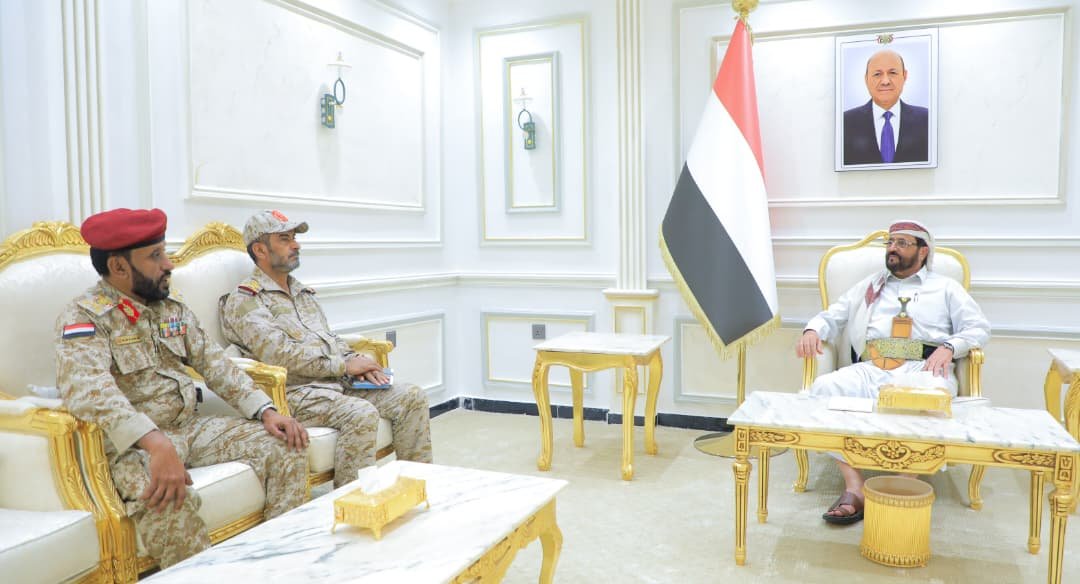
Presidential Leadership Council member Sultan al-Aradah chaired a security meeting in al-Mahrah on Monday that called for closer coordination between the army and the security services in the eastern governorate, with smuggling routes attributed to the Houthi movement identified as the main concern.
According to the official account of the meeting, al-Aradah was joined by Lieutenant General Sagheer bin Aziz, chief of the general staff and commander of joint operations, and by the commander of the al-Ghaydah military axis, named in the readout as Major General Salem Kaddah. Al-Mahrah’s governor, Mohammed Ali Yasser, who has held the post since 2020, also took part.
Al-Aradah described al-Mahrah as a strategic eastern gateway to the country and said securing its crossings was a matter of protecting national interests rather than a local policing question. He asked commanders to raise readiness, tighten control over entry points and treat the movement of contraband as a security threat rather than a customs problem.
Al-Mahrah is Yemen’s easternmost governorate. It borders Oman to the east and Saudi Arabia to the north, runs a long coastline along the Arabian Sea, and contains the Shahn land crossing with Oman and the port of Nishtun. Its population is small relative to its area, and much of the terrain between the coast and the desert interior is sparsely inhabited and lightly policed. That combination — long borders, few people, limited state presence — is what makes it useful to anyone moving goods without inspection.
The governorate has been largely spared the front-line fighting that has flattened parts of Taiz, Hodeidah and Marib. It has not been spared the war’s secondary effects. Yemeni officials and border security commanders have said repeatedly that arms, drugs and dual-use components are trafficked along the eastern routes, and that some of that traffic is organised by networks connected to the Houthi movement. A senior Yemeni border security official said this year that investigations had exposed drug smuggling networks with Houthi links.
Those claims are contested. The Houthi movement denies running smuggling operations and says the government uses the accusation to justify military deployments and outside involvement in the east. Independent verification is limited, and the routes in question are difficult for outside monitors to reach.
Concern about smuggling has sharpened over the past year as maritime and land interdictions have increased. In July, the Southern Transitional Council argued that a rise in Houthi smuggling had laid the groundwork for renewed pressure on Red Sea shipping, linking the flow of components across land routes to the movement’s ability to sustain long-range attacks. Weapons interdiction reports issued by the government and by international monitors have described missile parts, drone engines and guidance components arriving in shipments concealed among ordinary cargo.
Al-Aradah’s presence carries weight beyond the governorate. He is a member of the eight-man Presidential Leadership Council formed in April 2022 and has served as governor of Marib since 2012, a province that absorbed years of Houthi offensives and hosts one of the largest displaced populations in the country. Marib was struck again on 7 August, when missiles and drones hit displacement camps and residential districts, killing two people and wounding fourteen according to state media.
The meeting also came two days after the heaviest attack on Yemen’s west coast in months, when missiles and drones struck the port city of Mokha on 9 August, killing seven people and wounding around thirty according to the Yemeni military. Government officials have argued that the two theatres are connected, on the reasoning that sustained long-range attacks in the west depend on supply lines running through the country’s eastern approaches and along its coasts.
At the meeting he also thanked the local authority, and Governor Yasser in particular, for supporting security operations and helping keep state institutions functioning in the governorate. Both bin Aziz and the al-Ghaydah axis commander said their forces would maintain discipline and operational readiness, according to the readout.
Al-Mahrah’s politics complicate the security picture. The governorate has been the subject of competing outside interest for several years, with a Saudi military presence established after 2017 and periodic local protests against foreign deployments. Oman, which shares the border and hosts a substantial Mahri community, has generally favoured a light footprint and has acted as a channel for indirect contacts between the parties to the war. Any tightening of controls at the crossings therefore touches trade relationships that many families in the governorate depend on.
No operational detail accompanied Monday’s statements. The readout did not name specific routes, announce new deployments, set out a timetable, or describe how coordination between the army, the border guard, the coastguard and the security services would be structured in practice. Nor did it indicate whether additional resources would follow.
That gap matters, because coordination has been the recurring weakness. Yemen’s security forces answer through several chains of command reflecting the different armed groups folded into the state after 2015, and units in the east are funded and supplied unevenly. Officials have described the process of bringing formations under a single defence ministry structure as continuing rather than complete. Whether Monday’s meeting changes anything on the ground will depend on whether that structural work advances alongside the statements of intent.
About the Author