Oil Prices Swing Sharply as the Iran Conflict Puts the Strait of Hormuz in Doubt
 Yemen Herald News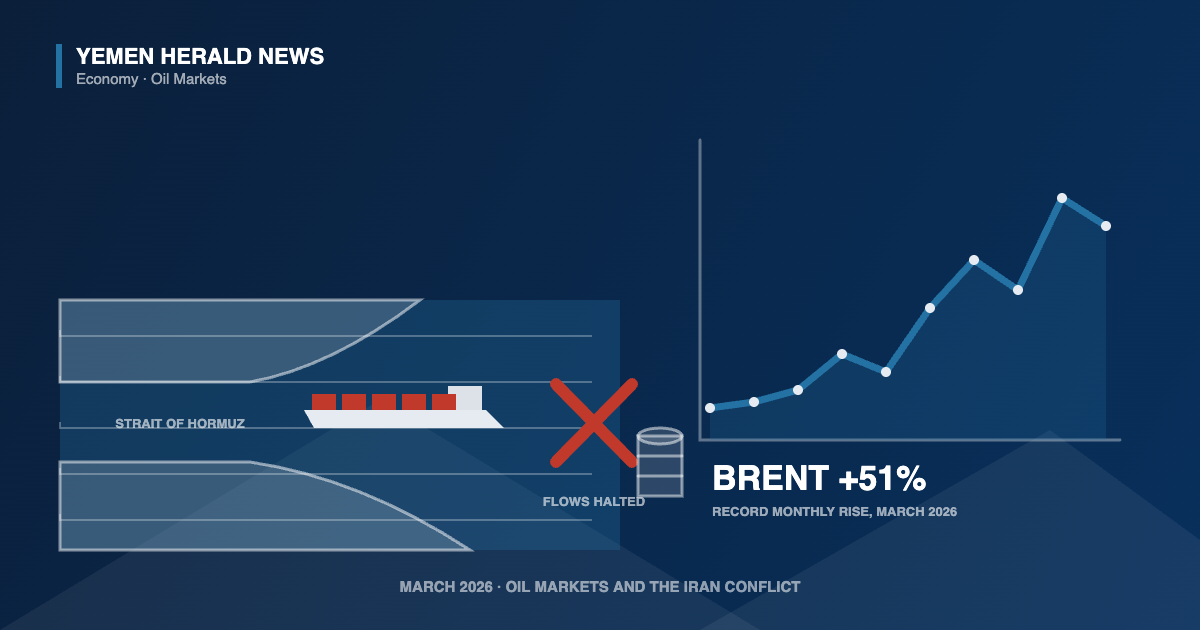
Oil prices moved sharply through the first half of March 2026 as fighting between Iran on one side and the United States and Israel on the other put the future of the Strait of Hormuz in question. Brent crude rose about 8 per cent in the two trading days either side of the start of the operation, from 71.32 dollars a barrel on 27 February to 77.24 dollars on 2 March, and continued climbing from there.
The move did not stop. Over the course of March, Brent gained more than half its value, the largest monthly rise the benchmark has recorded. Prices traded near 112 dollars a barrel late in the month and reached close to 120 dollars at their peak. For a market that had spent the previous year in the seventies, the repricing was abrupt enough to overwhelm most existing hedging positions.
What drove it was less an actual loss of barrels than the loss of certainty about the route they take. In normal conditions the Strait of Hormuz carries roughly a fifth of the world’s seaborne oil trade, and there is no alternative corridor of comparable capacity. A market that has to price the possibility of that corridor closing will pay a premium regardless of what is currently flowing.
By mid-March flows through the strait had in fact been halted, and Iraq and Kuwait had both cut production because they had nowhere to send it. Those cuts converted a risk premium into a genuine supply shortfall, which is why the March move proved larger and more durable than the spikes that have followed previous Gulf security incidents.
The effects reached consumers quickly. Petroleum prices in the United States rose roughly 17 per cent from the start of the conflict, and reporting at the time described several import-dependent countries, among them South Korea, Thailand, Bangladesh and Pakistan, introducing price caps or rationing measures to limit the pass-through to households. Import bills in those economies are denominated in dollars and paid at spot, which leaves very little room to absorb a move of that size.
President Donald Trump said the United States Navy could be deployed to keep the waterway open if that became necessary. Analysts were sceptical about how far that would help. A backlog of vessels had already accumulated in the region, and escorted convoys moving through a narrow channel remain exposed to drone and missile fire launched from Iranian territory a short distance away. Naval escort addresses piracy well and shore-based missile fire poorly.
The mine threat compounded the problem. American forces struck 16 Iranian mine-laying vessels near the strait after Trump warned Tehran against mining the channel. Mine clearance is slow work even in permissive conditions, and marine insurers price suspected mining far more heavily than they price the risk of a direct attack, because the uncertainty persists long after the shooting stops.
Official messaging did not settle the market. Trump said at one point that the war could conclude very soon, and at another that American action would continue until Iran was totally and decisively defeated. Traders were left pricing two incompatible scenarios at once.
Scale is the underlying difficulty. More than a hundred vessels transit Hormuz on a typical day, and escorting them individually is no substitute for normal commercial traffic.
Freight and insurance markets moved faster than the crude price. War-risk premiums for tankers operating in the Gulf rose steeply, and some owners declined charters into the region at any rate. Those costs sit on top of the barrel price and are paid by the importer, which is one reason the effect on retail fuel in Asian markets ran ahead of the headline benchmark.
Producers turned to what alternatives exist. Saudi Arabia pushed its East-West pipeline to the Red Sea to a record throughput of roughly seven million barrels a day in March 2026, loading crude at Yanbu instead of the Gulf terminals, and the United Arab Emirates has a pipeline running to Fujairah outside the strait. Both routes together fall well short of what Hormuz normally carries, and the Yanbu terminal was itself attacked later in the month.
For Yemen the episode had an uncomfortable familiarity. The Bab al-Mandab strait at the southern end of the Red Sea is the other chokepoint in the same trade, and attacks on commercial shipping there since 2023 had already pushed insurance costs up and diverted traffic around the Cape of Good Hope. With both ends of the route in question at the same time, vessels leaving the Gulf faced risk at every stage of the journey.
Analysts noted through this period that geopolitical risk, usually discussed in the abstract, had become something the market was pricing in concrete terms: not the probability of a conflict but the number of days a specific waterway might stay shut and the volume of barrels that would fail to arrive as a result. That is a harder calculation and it produces wider price swings.
The subsequent path was not a straight line. Prices fell roughly 20 per cent from the 2026 peak in late May, on optimism about ceasefire talks, before rising again in July when fighting resumed. The March move was the largest single episode, but the volatility it introduced outlasted it by months.
About the Author