Saudi Air Defences Destroyed Two Drones Over the Empty Quarter Heading Toward the Shaybah Oil Field
 Yemen Herald News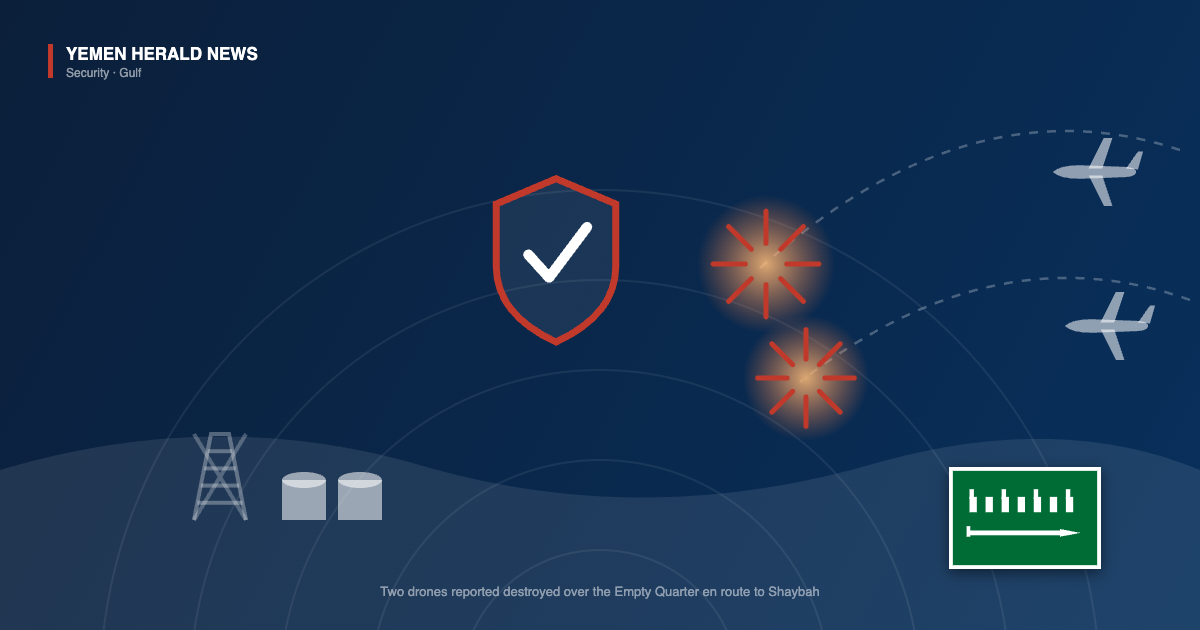
Saudi Arabia’s air defence forces intercepted and destroyed two drones over the Empty Quarter as they tracked toward the Shaybah oil field, the Ministry of Defence said in a statement carried by the Saudi Press Agency on 12 March 2026. The announcement was made by the ministry’s spokesman, Major General Turki al-Maliki, who framed the engagement as evidence that the kingdom’s layered air defences were succeeding in shielding critical infrastructure.
Shaybah sits deep in the Rub’ al-Khali, the vast sand sea straddling the Saudi border with the United Arab Emirates, and it is among the most isolated major production sites Saudi Aramco operates. That remoteness, once a form of protection, became a liability during the campaign: the field lies within comfortable range of drones launched from across the Gulf, and the long, empty approach offered few natural obstacles to low-flying aircraft. Defending it meant holding radar and interceptor coverage over hundreds of kilometres of uninhabited desert, an expensive proposition to sustain night after night, and one that had to be maintained continuously because a single leaker reaching the field could halt production far out of proportion to the cost of the munition used.
The two drones reported that day formed part of a sustained pattern rather than an isolated probe. On 7 March the ministry had announced that four drones bound for Shaybah were intercepted and destroyed over the Empty Quarter, and al-Maliki separately described a larger effort in which 21 drones directed at the field in several successive waves were brought down in the same airspace. The repetition of the target suggests a deliberate campaign against a single high-value asset rather than opportunistic targeting.
The same day brought the heaviest single day of Saudi air defence activity of the war to that point. The Ministry of Defence said its forces had intercepted and destroyed 31 drones and three ballistic missiles across the kingdom on 12 March, the largest one-day tally since the exchanges began on 28 February 2026. Reporting at the time described 24 hostile drones brought down in a coordinated wave, some crossing the Empty Quarter toward Shaybah and others aimed at the Eastern Province, where much of the country’s oil processing capacity is concentrated.
The campaign had opened when Iran began striking Gulf states hosting United States military assets, in retaliation for an American and Israeli military campaign against Iranian targets. Saudi Arabia was drawn in from the outset. Early in the conflict its defence ministry reported destroying two ballistic missiles fired toward Prince Sultan Air Base at al-Kharj, which houses American personnel, along with six drones heading for Shaybah.
Not every attempt was stopped. On 2 March an Aramco refinery at Ras Tanura on the Gulf coast was hit in a drone attack, an incident significant enough to be recorded separately from the daily interception counts. Ras Tanura is one of the largest crude oil terminals in the world, and a strike there carried implications for global energy markets that a downed drone over empty desert did not.
Interceptions continued through the month. On 22 March the ministry reported destroying seven drones over the Eastern Region. Across the border the Emirati defence ministry was issuing comparable statements almost nightly, reporting a cumulative 285 ballistic missiles and 1,567 drones engaged by 13 March, rising to 345 ballistic missiles and 1,773 drones by 22 March. Read together, the Saudi and Emirati counts describe an air defence effort operating at a volume neither state had previously faced.
The consistent focus on energy and industrial targets shaped how the conflict registered internationally. Attacks on oil infrastructure move prices and insurance rates in ways that attacks on military bases generally do not, and by late March the pattern had extended to heavy manufacturing: on 28 March, Emirates Global Aluminium reported significant damage at its Al Taweelah site in Abu Dhabi, and Aluminium Bahrain was struck in the same claimed operation, sending aluminium prices up around 6 per cent on the London Metal Exchange.
The interception statements themselves became a form of strategic communication. Issued through the Saudi Press Agency in a consistent format naming the spokesman, the target and the outcome, they served to reassure domestic audiences and international energy markets that production was protected, while stopping short of detailing which systems were used or what proportion of incoming munitions was getting through.
Gulf capitals also pressed a diplomatic case throughout. A joint statement issued in early March condemned the missile and drone attacks across the region, and Gulf representatives argued in international forums that states hosting foreign military infrastructure were absorbing the consequences of a confrontation between other powers rather than acting as parties to it.
Judged on its own, the destruction of two drones over an empty desert on 12 March 2026 was a minor engagement. Its significance lies in what it was defending and how often the same defence had to be mounted. Shaybah was targeted repeatedly across the month, and the accumulated record of those interceptions — four drones on 7 March, two on 12 March, 21 across several waves — traces a persistent effort against Saudi energy capacity that the kingdom’s air defences, by their own account, largely but not entirely contained.
About the Author