Iran Strikes Gulf States With Missiles and Drones as Oil Prices Surge
 Yemen Herald News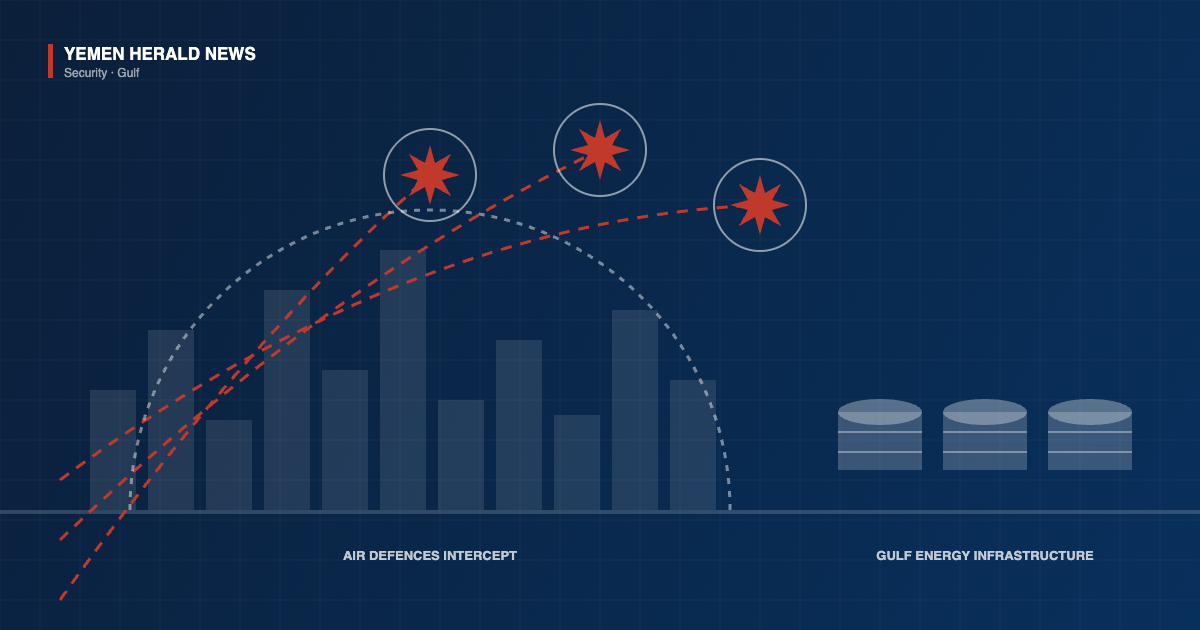
Iran fired waves of ballistic missiles and attack drones at Gulf Arab states in March 2026, striking fuel storage, power infrastructure and residential districts across several countries and pushing oil prices sharply higher. The barrages came during the wider confrontation between Iran on one side and the United States and Israel on the other, and marked the point at which the Gulf monarchies moved from bystanders to targets.
A joint statement issued at the time by the United States and regional partners described the attacks as indiscriminate and reckless, and listed strikes against Bahrain, Iraq, Jordan, Kuwait, Oman, Qatar, Saudi Arabia and the United Arab Emirates. The geographic spread was the striking feature: rather than concentrating fire on one adversary, Iran distributed it across almost every state hosting American forces or facilities.
Bahrain, which hosts the headquarters of the United States Navy’s Fifth Fleet, was among the most frequently hit. Authorities reported strikes on fuel tanks in Muharraq Governorate and advised residents in affected areas to stay indoors and keep windows closed. A desalination plant in the kingdom was also damaged, an unusually consequential target in a country that draws most of its drinking water from the sea.
Bahraini officials said their air defences intercepted 70 missiles and 59 drones aimed at the kingdom. Kuwait reported intercepting 97 ballistic missiles and 283 drones over the course of the campaign, and the United Arab Emirates Ministry of Defence reported bringing down nine ballistic missiles, six cruise missiles and 148 drones.
Taken together, Bahrain said in mid-March that Gulf Cooperation Council states had collectively intercepted more than 900 Iranian missiles, around 2,500 drones and 17 aircraft. Those totals, if accurate, describe an air campaign larger than anything the Gulf states had previously faced, and one that tested interceptor stocks as much as radar coverage.
Not everything was stopped. Fuel tanks at Kuwait’s international airport were hit, and Kuwaiti authorities reported injuries and damage after a drone struck a residential building. Debris from intercepted drones fell across six power transmission lines, though officials said at the time that electricity and water supplies were maintained. In Saudi Arabia, the defence ministry said seven drones aimed at the Shaybah oilfield and at a district housing foreign embassies were intercepted.
The pattern of targeting drew particular criticism. Alongside military and energy sites, the strikes hit residential buildings, food distribution facilities, airports and ports. Gulf governments framed this as deliberate pressure on civilian populations rather than a campaign confined to military objectives, and used it to build a common diplomatic position.
The timing was also read as significant. The wave of attacks began within hours of Mojtaba Khamenei being named Iran’s new supreme leader, a transition that removed whatever restraint the previous leadership had exercised over striking Arab neighbours directly. Analysts at the time treated the barrages as an early signal about how the new leadership intended to conduct the war.
Energy markets responded immediately. Crude prices rose on the combination of physical damage to Gulf infrastructure and the risk premium attached to shipping through the Strait of Hormuz, through which a substantial share of the world’s seaborne oil passes. Insurance costs for tankers and for regional aviation climbed alongside.
For the Gulf states the episode forced an uncomfortable calculation. Several had spent years cultivating a working relationship with Tehran, and Saudi Arabia and Iran had restored diplomatic ties under Chinese mediation in 2023 precisely to avoid this scenario. Being struck while hosting American bases exposed the limits of that hedging strategy.
It also concentrated attention on air defence. The interception figures reported by individual governments suggested high success rates, but the volume of incoming fire raised questions about how long stockpiles of interceptors could be sustained, and about the degree to which the Gulf states depend on American radar coverage and resupply to keep those rates up.
For Yemen the escalation carried a direct read-across. The Houthi movement had already demonstrated the reach of Iranian-designed missiles and drones against Saudi and Emirati targets in earlier years, and a region-wide exchange of that kind risked pulling Yemeni territory further into a confrontation whose principals sit elsewhere. Gulf states, meanwhile, faced the prospect of managing air defence across two fronts at once.
Civil defence arrangements were tested in parallel. Gulf governments issued shelter-in-place advisories, suspended flights at intervals and moved to reassure populations that water, power and fuel distribution would hold. In states with large expatriate workforces, the advisories had to be issued in several languages and delivered quickly enough to be useful during short warning windows.
The economic exposure ran wider than energy. The Gulf economies have spent a decade investing in aviation hubs, tourism, logistics and financial services, all of which depend on a reputation for physical security. Repeated strikes on airports and residential districts threaten that reputation in ways that damage to an oilfield does not, because they affect decisions made by airlines, insurers and visitors rather than by commodity traders alone.
Diplomatically, the attacks produced an unusually unified GCC response, with member states issuing joint condemnations and coordinating their accounts of what had been intercepted. That coordination had been inconsistent in previous regional crises, and the shift reflected a shared assessment that no individual state could deter Iran on its own.
About the Author