Aden residents queue for hours as cooking gas shortage stretches on
 Yemen Herald News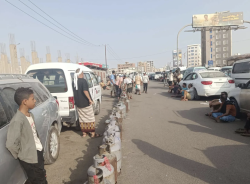
ADEN, Yemen — A cooking gas shortage has pushed residents of Yemen’s interim capital into day-long queues and driven some families to cook with firewood.
The shortage entered its third consecutive week in early August, the Xinhua news agency reported from the city on 4 August. It has continued since.
Saleh Hamid, 42, told the agency he had joined hundreds of residents at one of the few filling stations still operating.
“Sometimes we wait for 12 hours, but the gas runs out before we get our turn,” Hamid said. “Then we have to come back the next day and start all over again.”
Rows of empty cylinders mark places in the queues, each standing in for a household waiting on fuel to cook with.
Most filling stations across Aden remain closed for lack of supply, according to local sources cited by Xinhua. Those still receiving deliveries often run for a few hours before their stocks are gone.
Filling stations that do receive supply serve only part of the queue before closing, residents told Xinhua.
Word of a delivery draws residents to distribution points with empty cylinders, and queues form quickly.
Ahmed Mihdhar, 35, an employee at a company in the city, said securing gas often means missing work.
“If I wait until I finish work, there may be nothing left,” Mihdhar said.
Hours spent searching and queuing cut into work and other responsibilities, and those who go home empty-handed repeat the process the next day.
Households have adjusted. Some cook with firewood and other makeshift fuels. Others buy ready-made meals when a cylinder runs out, at a cost they were not previously carrying.
Um Zainab, a housewife, said her family bought prepared food for several days after running out of gas but could not keep it up, “especially when our salaries haven’t been paid.”
Residents said scarce supply has fed a black market, with cylinders sold well above official rates.
Akram Hadi, a researcher at the Faculty of Economic and Political Sciences at Aden University, said supply disruptions triggered the shortage and that distribution management deepened it.
“Overlapping responsibilities, disagreements among authorities, and weak oversight had hindered an effective response,” Hadi said.
Accounts of the cause differ. Yemen Press Agency, which is aligned with the Houthi authorities in Sanaa, reported that the Safer company in Marib cut domestic gas output by 6,000 barrels a day after its CPU-2 central processing unit was shut down.
The same agency described the Marib facility’s output as feeding supply to Aden and to southern governorates.
Yemen Press Agency also reported that authorities aligned with the internationally recognised government attributed the shortage to tribal gunmen detaining gas tankers travelling from Marib.
Neither account has been independently confirmed, and the two sides have not published a joint explanation.
Yemen Press Agency separately reported the domestic gas crisis in Aden entering a third week, matching the timing in Xinhua’s account.
The same agency reported cylinder prices in Aden passing 17,000 riyals, with residents sleeping outside filling stations to hold their place.
Aden is the temporary seat of the internationally recognised government. The city is also contending with prolonged electricity blackouts, delayed public salaries and rising prices.
Yemen Monitor has described Aden as facing a combination of power outages, water shortages and gas scarcity.
The same outlet has reported residents praying in the street during the city’s utility crisis.
Those pressures compound one another. Money spent on prepared meals or black-market gas comes out of budgets already stretched by food and transport.
Vehicular liquefied petroleum gas has been in short supply alongside household cylinders, and transport and commercial services in the city have been disrupted.
Cooking gas is the main household fuel in Yemeni cities, used for daily meals and for heating water.
Aden’s gas comes largely from fields and processing facilities in Marib, hundreds of kilometres to the north, and reaches the city by road.
Similar shortages have been reported elsewhere. In Hadramawt, an official moved to address a cooking gas shortfall and increase supplies, Yemen Monitor reported.
Household gas supplies have also tightened in Sanaa, according to Yemen Online.
The conditions in Aden trace back to more than a decade of conflict. Fighting began in late 2014, when the Houthi group seized Sanaa and much of northern Yemen.
A Saudi-led coalition intervened the following year in support of the internationally recognised government.
Large-scale fighting has eased in recent years. The country remains divided, and years of war have weakened infrastructure, public services and household purchasing power.
The humanitarian caseload remains large. The UN response plan issued in March 2026 counts more than 22 million people in need across Yemen and 18.3 million as acutely food insecure.
It records more than 2.2 million children under five as acutely malnourished, 516,157 of them severely, and 5.2 million people internally displaced.
The plan seeks 2.16 billion dollars to reach 12 million people.
Xinhua’s account was filed from Aden on 4 August and drew on interviews with residents at filling stations and with an academic in the city.
Xinhua is a Chinese state news agency and reported the account from Aden under its own byline.
Hamid was still beside his empty cylinder when the agency left the station.
About the Author