Yemeni Ambassador Salem Balfaqih meets Indonesia’s consular affairs chief in Jakarta
 Yemen Herald News
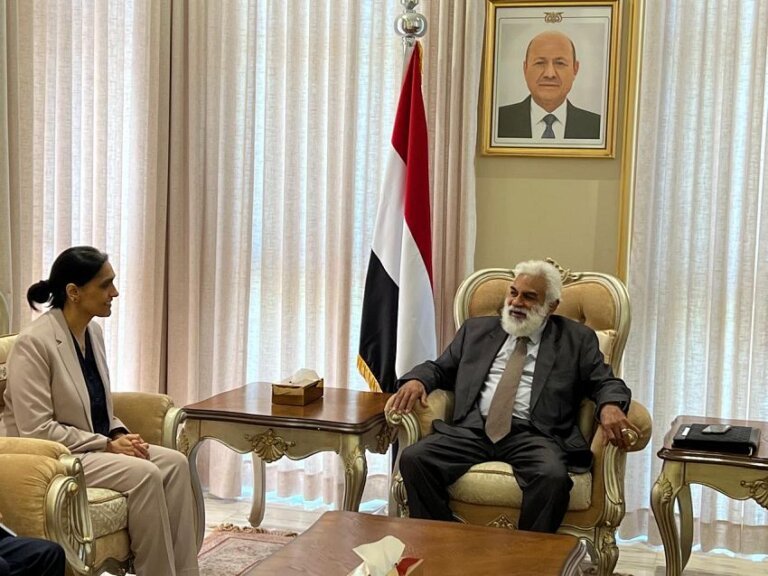
JAKARTA, Indonesia — Yemen’s ambassador to Indonesia met the Indonesian foreign ministry’s protocol and consular affairs chief on Tuesday to discuss coordination on Yemeni citizens’ affairs.
Salem Balfaqih met Saud Purwanto Krisnawan, director general of protocol and consular affairs and chief of state protocol at Indonesia’s Ministry of Foreign Affairs, the Yemeni state news agency Saba reported.
The two discussed bilateral relations and ways to strengthen and develop them, according to Saba.
The meeting addressed developments in Yemen and the region, the agency said.
It also covered coordination between the Yemeni embassy and the Indonesian foreign ministry on the concerns of Yemeni citizens and the protection of their interests, Saba reported.
Balfaqih reviewed the Yemeni government’s efforts on security and stability and its economic recovery process, according to the agency.
The account of the meeting rests on Saba, the Yemeni government’s official news agency, which named no other source. No independent confirmation of the talks has been published, and Yemen Herald could not verify the account separately.
Saba rendered the Indonesian official’s surname as Krisnuan. Indonesian records give it as Krisnawan. He was installed as director general of protocol and consular affairs on April 9.
Indonesia and Yemen established diplomatic relations on April 21, 1962.
Yemen’s embassy in Jakarta is its only mission in Indonesia. It is also accredited to Australia and Singapore, so its consular workload runs well beyond Indonesian territory.
Indonesia does not maintain an embassy or a consulate in Yemen.
The consular relationship rests in part on a sizeable Indonesian student population in Yemen. Around 8,000 Indonesians have studied there, at Darul Mustafa, in Tarim and Seiyun, and at Al-Ahqaf University, according to accounts of the community.
Tarim is the religious centre of Hadhramaut and draws students to its ribats, zawiyas and scholarly institutions. Seiyun and Tarim both lie in Hadhramaut governorate, in Yemen’s east. Tarim sits on UNESCO’s tentative list of world heritage sites.
Indonesia has pulled citizens out of Yemen before. In April 2015 the Indonesian Air Force sent a Boeing 737-400 and a chartered aircraft to bring people home.
About 600 people were evacuated to Malaysia that month, among them 85 Indonesians. Indonesians remained in Tarim, Mukalla, Aden, Sanaa and Hudaydah.
Balfaqih has pursued several strands of cooperation with Jakarta. Saba has reported his meetings with Indonesia’s deputy foreign minister, Armanatha Nasir, on advancing bilateral relations.
He has discussed a memorandum of understanding on political consultations between the two foreign ministries with Indonesia’s director for Middle East affairs, according to Saba.
He met Indonesia’s higher education minister on cooperation in higher education, scientific research and technology, the agency reported.
He has also sought Indonesian development cooperation through the Indonesian AID agency, according to Saba.
Balfaqih has courted Indonesian civil society as well. He met Muhammadiyah, one of the country’s largest Muslim organisations, which runs schools, universities and hospitals across the country, and called for student exchanges and cultural diplomacy.
The Presidential Leadership Council, formed in April 2022, is the executive body recognised internationally as Yemen’s government. Balfaqih represents it in Jakarta.
Trade between the two countries runs heavily one way. Indonesia exported about $120.9 million of goods to Yemen in 2022, down from about $129.8 million a year earlier, according to Indonesian trade statistics.
Indonesian exports to Yemen have ranged between roughly $88.7 million and $157.9 million over the past decade, according to the same data. Imports from Yemen came to about $680,000 in 2021.
Indonesia’s largest export category to Yemen was animal, vegetable and microbial fats and oils, the trade data show.
Yemen sits on the Bab al-Mandab strait, which carries Asian trade towards the Suez Canal. Oil shipments through the strait fell from 9.3 million barrels a day in 2023 to 4.1 million in 2024, after Houthi attacks on vessels.
The strait links the Red Sea to the Gulf of Aden and narrows to about 20 miles between Yemen and the Horn of Africa.
Those attacks have largely paused since Israel and Hamas reached a ceasefire in Gaza in late 2025.
The government has said it wants to move from dependence on humanitarian relief towards development finance. Its ministers made the same argument this week in Riyadh and in Kuwait City, according to Saba.
The UN Office for the Coordination of Humanitarian Affairs sought $2.16 billion for Yemen in its response plan for 2026, published in March, to reach 12 million people.
The plan counted more than 22 million people in need of assistance and 18.3 million who are acutely food insecure. It recorded 5.2 million internally displaced people.
More than 2.2 million children under five are acutely malnourished, of whom 516,157 are severely malnourished, according to the plan.
Indonesia is the world’s most populous Muslim-majority country.
Arab Indonesians trace their ancestry largely to Hadhramaut in eastern Yemen. Arab traders frequented the archipelago from as early as the 8th century and intermarried with local populations.
Yemeni songs are widely sung by Indonesian Muslims, and the two countries share similarities in food and tradition, according to accounts of the relationship.
Several royal dynasties in the archipelago were founded by Arabs or by people of mixed Arab descent. The Alkadrie dynasty of the Sultanate of Pontianak was founded by a Hadhrami explorer.
About the Author