Drone Strike Damages Radar System at Kuwait International Airport
 Yemen Herald News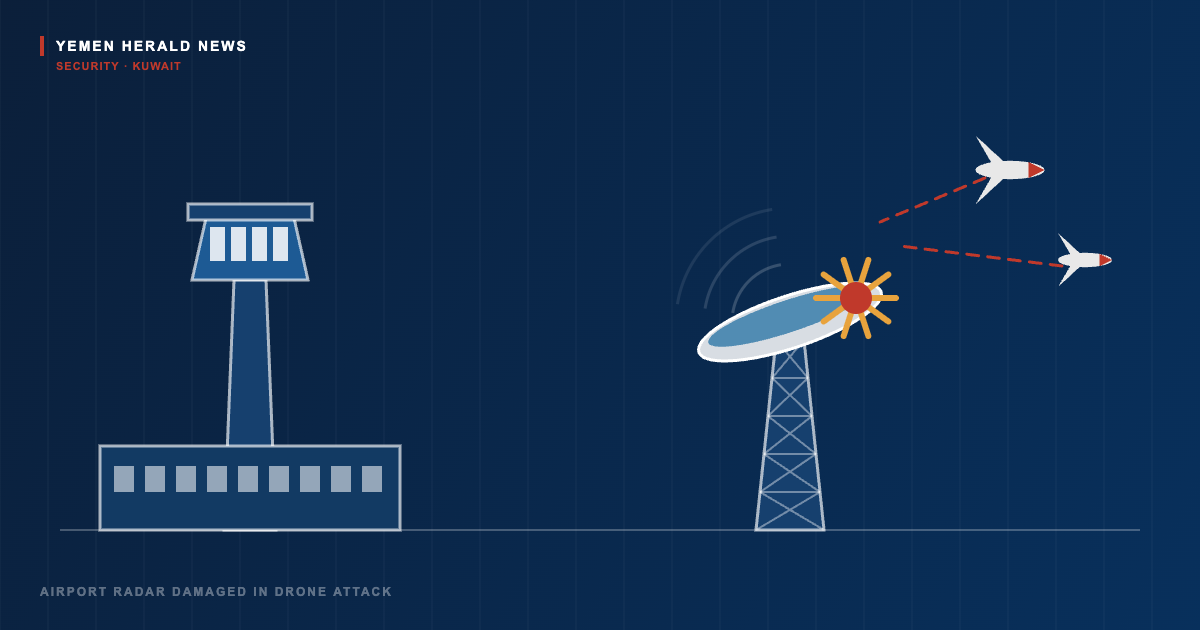
Kuwait’s Directorate General of Civil Aviation said on Saturday that the radar system at Kuwait International Airport had been damaged in an attack involving several drones. The strike came in the evening and prompted an immediate response from airport authorities, who said no one was hurt.
Abdullah Al-Rajhi, a spokesman for the directorate, confirmed at the time that no casualties had been recorded. He said the authority had activated the emergency plan it had kept in place since the onset of the crisis, coordinating its response with other state agencies. The directorate reiterated its commitment to the measures needed to protect the security and safety of civil aviation in Kuwait, and said the immediate priority was restoring the radar and maintaining operational integrity at the airport.
Damage to a radar installation is a more consequential event than the phrase suggests. Air traffic controllers rely on primary and secondary surveillance radar to track aircraft positions continuously and to keep them safely separated. When that picture is degraded or lost, controllers fall back on procedural separation, spacing aircraft by time and reported position rather than by live returns. That method is safe but far less efficient, and it sharply reduces the number of movements an airport can handle in an hour. For a single-hub country, a functioning radar picture is not a convenience but the basis of the whole operation.
The attack was not an isolated incident. Kuwait International Airport had been struck repeatedly since the end of February 2026, when the wider confrontation between Iran on one side and the United States and Israel on the other began. Reporting at the time recorded drones hitting fuel tanks at the airport earlier in March, and an earlier strike on a passenger terminal that left several people with minor injuries and caused structural damage. Taken together, the incidents pointed to a sustained effort against the airport rather than a single opportunistic hit.
Kuwaiti authorities attributed the attacks to Iran. Tehran has generally declined to confirm individual strikes of this kind, and the attribution rested on the accounts given by Kuwaiti officials and regional media rather than on any independent adjudication. That pattern held across the Gulf through the spring, with governments naming Iran as the source of drone and missile launches while Iranian officials neither confirmed nor detailed specific operations.
The choice of target reflected the airport’s position in Kuwaiti life. Kuwait International is the country’s principal civil aviation gateway, handling effectively all scheduled international passenger traffic. Unlike states with several large airports able to absorb one another’s traffic, Kuwait has no comparable alternative, so disruption at a single site propagates immediately through the national air transport system. Airlines facing degraded surveillance coverage typically respond by thinning schedules, adding fuel reserves for holding, or suspending services altogether, and insurers reprice cover for the airspace concerned.
The airport was also one node in a broader pattern. Kuwait reported attacks on other logistics infrastructure during the same period, and by late March both Shuwaikh Port and the Mubarak Al-Kabeer Port project had been struck. Elsewhere in the Gulf, Bahrain’s Defence Force reported intercepting scores of missiles and hundreds of drones over the campaign’s opening weeks, and the United Arab Emirates reported its own interceptions. The common thread was pressure on transport, energy and logistics nodes rather than on conventional military targets alone.
Part of the difficulty for defenders is economic. Small drones and loitering munitions of the type described by Gulf officials are comparatively cheap, and they circle over an area before diving onto a target. Intercepting them often costs many times what they cost to build, an asymmetry that favours the attacker even when most launches are stopped. Gulf states have invested heavily in layered air defence while continuing to report leakage through it, and the Kuwaiti airport strikes were an illustration of what that leakage looks like when it reaches a civilian site.
Gulf governments consistently framed attacks of this kind as violations of international law and as a direct threat to the safety of civil aviation, language that appeared across official statements from several capitals during the campaign. Civil aviation infrastructure occupies a particular place in that argument, because damage to navigation and surveillance systems endangers aircraft that have no connection to the conflict.
The timing also mattered for the wider economy. Kuwait depends on air links for business travellers, expatriate labour and time-sensitive freight, and uncertainty over the reliability of its main airport carries costs that outlast the repair of any single installation.
For Yemen, the episode had a familiar shape. Yemen’s own war, running since 2015, has made drone and missile attacks on airports, ports and energy facilities a recurring feature of the region’s security landscape, and Gulf governments have repeatedly cited that record when describing the current campaign as part of a longer pattern. The technologies and tactics that appeared over Kuwait City in March had been used against targets across the Arabian Peninsula for years.
The directorate said at the time that work to restore the damaged radar was under way and that it would provide further information as the assessment continued. It did not publish a timetable for full restoration, and the statement stopped short of describing how much of the surveillance picture had been lost.
About the Author