Yemen’s Presidential Leadership Council orders crackdown on smuggling networks
 Yemen Herald News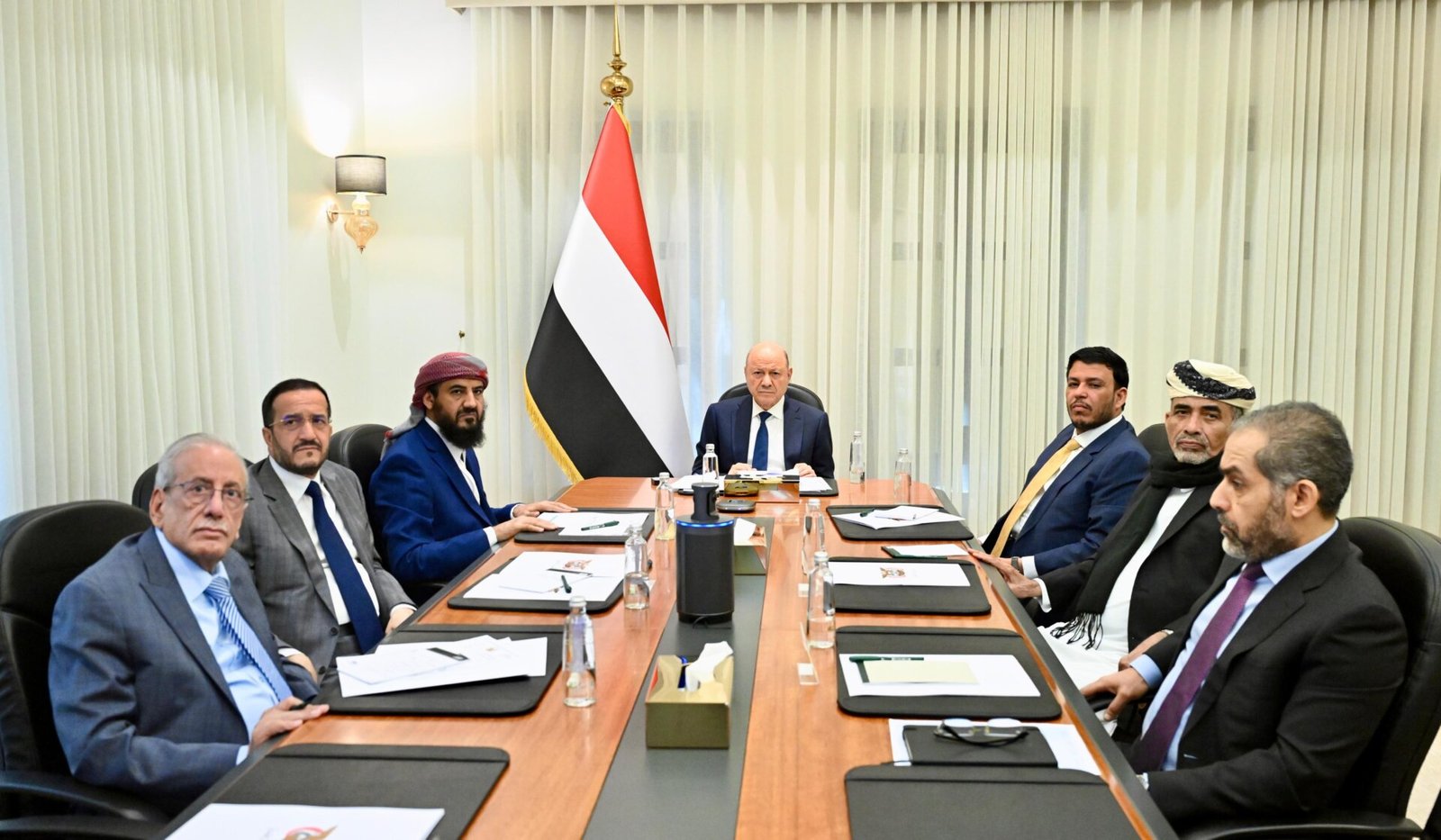
RIYADH, Saudi Arabia — Yemen’s Presidential Leadership Council and its government met jointly on Wednesday and ordered a crackdown on smuggling networks the council says finance the Houthi movement.
Council chairman Rashad al-Alimi chaired the meeting, the state news agency Saba reported.
Council members Tareq Saleh, Abdulrahman al-Mahrami, Abdullah al-Alimi, Othman Mujalli, Mahmoud al-Subaihi and Salem al-Khanbashi attended, along with Prime Minister Shaya Zindani, according to the agency.
Saba filed its report from Riyadh, where al-Alimi is based.
The agenda covered political, economic and service conditions, together with what the council described as continued escalation by the Houthis on the ground.
Zindani, the governor of the Central Bank of Yemen, Ahmed Ghaleb al-Mabaqi, and the finance minister presented reports on financial, economic and service performance, Saba said.
Those reports set out measures to curb smuggling, tighten oversight and police land and sea entry points, the agency reported. The stated aim is to cut off funding and arms reaching the Houthis.
The meeting then directed the government to apply those measures strictly, and to extend them to air entry points.
It called for closer coordination between central government agencies and local authorities.
The council said smuggling had become a direct threat to national security and a drain on state resources.
It called for smugglers and their networks to be prosecuted, along with anyone protecting or facilitating them, whatever their position.
Wednesday’s directive follows an earlier order from al-Alimi on smuggling and the war economy, also reported by Saba.
Saba’s account gave no figures for smuggling volumes, seizures or prosecutions.
The defence and interior ministers presented separate reports on field developments and on readiness across the fronts, according to the agency.
The meeting also reviewed the killing of Abu Hudhaifah al-Ansari, the Islamic State group’s spokesman. Saba said Yemeni counterterrorism forces and joint special forces of the Saudi-led coalition carried out the operation.
That part of the account is corroborated independently. Yemen’s counterterrorism unit, Task Force 22, raided a house in Seiyun in Hadramout province early on Tuesday with coalition support, according to separate reporting by Xinhua, FDD’s Long War Journal and The Jerusalem Post.
Al-Ansari and a bodyguard exchanged fire with the raiding party, those reports said. Al-Ansari was killed.
Islamic State named him its chief spokesman in August 2023, and he had held the post for three years. The group’s official media has not confirmed or denied his death.
Reports of the raid also described al-Ansari as the head of the group’s cells in Yemen.
Saba is the only original source for the account of Wednesday’s meeting itself. Yemen Monitor carried a report of it the same day but attributed the proceedings to the agency. Yemen Herald found no independent confirmation of what was said in the room.
The meeting praised the government’s handling of what it called a difficult phase, and the regularity of cabinet sessions in the temporary capital, Aden, Saba reported.
It also cited progress on reforms, on financial and monetary stability, and on correcting imbalances in public revenue collection.
The council thanked Saudi Arabia for what it called generous and continuous support, naming King Salman bin Abdulaziz and Crown Prince Mohammed bin Salman.
That backing had helped the government pay public salaries, improve basic services and ease humanitarian pressure, the meeting said.
The council said the state remained determined to reclaim its sovereign instruments and to strengthen compliance with the sanctions regime.
It listed protection of citizens, the private sector, food and medicine supplies, savings and legitimate transfers among its priorities.
The Houthi movement, which holds Sanaa and much of northern Yemen, rejects the Aden-based government’s authority and disputes its account of the war economy. Houthi officials did not comment on the meeting.
The Presidential Leadership Council was formed in April 2022, when Abd Rabbu Mansour Hadi transferred his powers to an eight-member body chaired by al-Alimi. It has governed from Aden and from Riyadh since.
Its members were drawn from rival factions opposed to the Houthis, and the transfer gave the body full executive authority. Aden has served as the temporary capital since 2015, after the Houthis took Sanaa the previous year.
Currency stability has been a recurring concern for the council. The riyal traded at about 2,900 to the dollar before recovering to roughly 1,500 by April 2026, Al Jazeera reported.
The central bank in Aden fixed the Saudi riyal at 410 for buying and 413 for selling in February 2026, and capped purchases at 2,000 Saudi riyals per customer for each transaction.
It has also closed unlicensed exchange firms and centralised internal remittances under a controlled system.
The bank has also formed a committee to oversee imports and to supply traders with hard currency.
Humanitarian need across the country remains high. More than 22 million people require assistance and 18.3 million are acutely food insecure, according to the United Nations humanitarian needs and response plan published in March 2026.
The same plan counts 5.2 million internally displaced people and seeks 2.16 billion dollars to reach 12 million of those in need.
It records more than 2.2 million children under five as acutely malnourished, of whom 516,157 are severely malnourished.
Saba did not report a date for the next joint meeting.
About the Author