UAE Air Defences Intercept Three Ballistic Missiles and Eight Drones Launched From Iran
 Yemen Herald News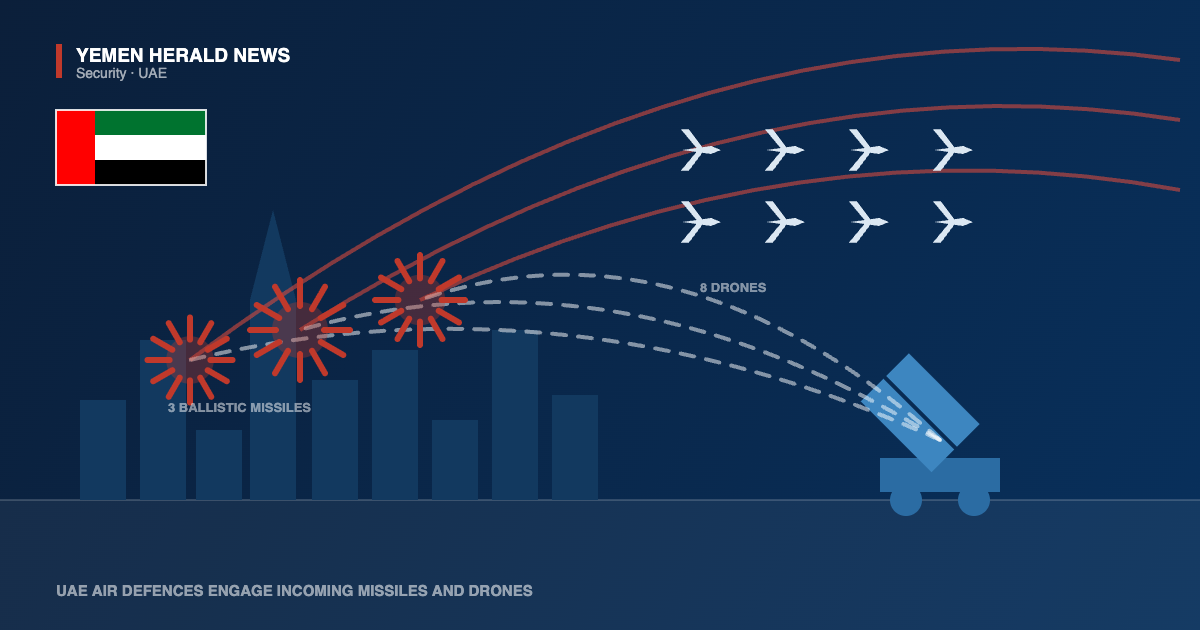
The United Arab Emirates’ Ministry of Defence said its air defence systems intercepted a fresh wave of ballistic missiles and drones launched from Iran on Saturday 21 March 2026, announcing the engagement through its official account on X as residents in several parts of the country reported hearing the interceptions overhead.
The ministry put the day’s figures at three ballistic missiles and eight unmanned aerial vehicles brought down. It said the engagement formed part of a continuing effort to counter what it described as blatant threats to the country, and that both ballistic missile defence systems and fighter aircraft had been used, the latter against drones and cruise missiles flying at lower altitudes.
That division of tasks between interceptor batteries and manned aircraft had become routine by late March. Ballistic missiles follow steep, fast trajectories that leave only seconds for engagement and are handled by dedicated interceptor systems. Drones and cruise missiles travel far more slowly and can be engaged by fighters, which is cheaper and preserves interceptor stocks for the faster threats.
The UAE’s exposure is partly geographic. It faces Iran directly across the Gulf, at a range that gives very little warning time, and its population and industry are concentrated in a narrow coastal strip along that same shore. Abu Dhabi and Dubai sit within reach of weapons that need not travel far, which is why the country invested heavily in layered air defence well before the 2026 conflict began.
The ministry also published a running total. Since the start of what it called the Iranian aggression, UAE air defences had engaged 341 ballistic missiles, 15 cruise missiles and 1,748 drones. Those cumulative figures, released alongside the daily counts through March, gave an unusually detailed public picture of the volume of fire directed at a single Gulf state over a matter of weeks.
The human cost recorded at that point was smaller than the number of launches might suggest, but it was not nil. The ministry said two members of the UAE armed forces had been killed performing their duties, and that six other people had died as a result of the attacks: nationals of Pakistan, Nepal, Bangladesh and Palestine. A total of 160 people had been injured, with wounds ranging from minor to severe.
The UAE foreign ministry had named the six civilians killed in a statement days earlier: Alaa Nader Awni of Palestine; Murib Zaman Nizar, Muzaffar Ali Ghulam and Ismail Salim Khan of Pakistan; Ahmed Ali of Bangladesh; and Dibas Shrestha of Nepal. The list reflected the composition of the UAE’s workforce, in which expatriate labour from South Asia predominates and which therefore bore much of the risk from debris and from strikes that got through.
Sheikh Abdullah bin Zayed Al Nahyan, the deputy prime minister and minister of foreign affairs, condemned the attacks and offered condolences to the victims’ families. The foreign ministry described the strikes as terrorist attacks on the UAE and said they violated international law. Counterparts across the region telephoned to offer condolences over the deaths of the two Emirati service members, among them the foreign ministers of Jordan and Qatar.
The pattern of official communication during this period was consistent. The defence ministry issued a statement after each significant engagement, usually within hours, giving a count of what had been detected and what had been destroyed, and occasionally acknowledging where a missile had fallen inside the country rather than being intercepted. The National Emergency Crisis and Disasters Management Authority issued parallel advisories, at times clarifying that a particular threat had passed outside UAE borders.
That transparency was not maintained indefinitely. Defence trade reporting in March noted that the UAE, which was absorbing a disproportionate share of the launches directed at Gulf states, had begun to scale back publication of its interception rates. Detailed figures on how many incoming weapons were stopped and how many were not carry obvious value for an adversary assessing the performance of a defensive network.
Debris also had commercial consequences beyond the injury figures. Falling fragments from interceptions forced temporary suspensions at industrial sites, and airspace over the Gulf was repeatedly closed or rerouted during engagements, with knock-on effects for the airline hubs at Dubai and Abu Dhabi that carry a large share of traffic between Europe and Asia.
For residents, the practical experience was the sound of the engagements themselves. Interceptions produce audible detonations at altitude and scatter debris across populated areas, and much of the injury toll through the campaign came from falling fragments rather than from direct hits. Authorities repeatedly asked the public to treat such sounds as air defence activity, to keep away from debris and to rely on official statements rather than circulating footage.
The daily figures released either side of 21 March give a sense of the tempo. The ministry reported nine ballistic missiles and 33 drones downed on 14 March, and four ballistic missiles and 25 drones on 22 March, with substantially heavier days recorded in early March and again in early April. The Saturday count of three and eight sat at the lower end of that range rather than marking any lull.
None of the statements issued at the time indicated a change in the UAE’s posture beyond air defence and diplomatic protest. The country continued to describe itself as defending its sovereignty against attacks it had not initiated.
About the Author