Yemen’s ambassador to Prague urges Czech Republic and EU to designate the Houthis
 Yemen Herald News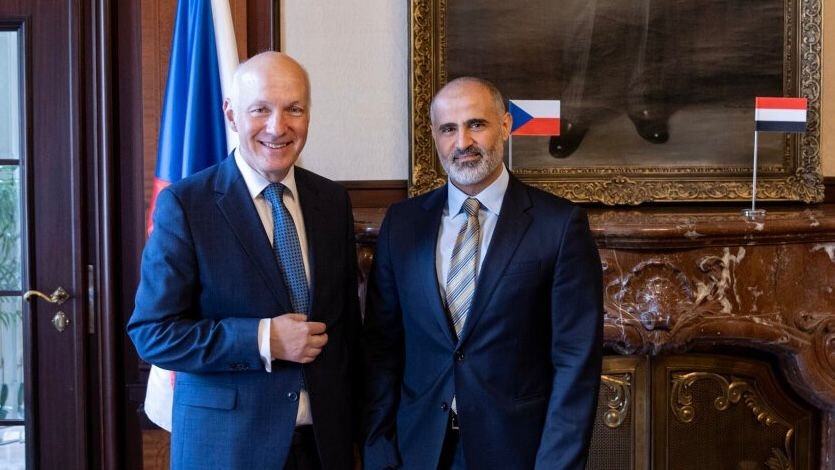
PRAGUE, Czech Republic — Yemen’s ambassador to the Czech Republic urged Prague and the European Union to designate the Houthi movement a terrorist organisation, the state news agency Saba reported.
Ambassador Mohammed al-Hadrami made the call in talks with Senator Pavel Fischer, who chairs the Czech Senate’s Committee on Foreign Affairs, Defence and Security.
Al-Hadrami said such a designation would help curb the group’s threat, cut off its funding and counter its links to other armed organisations, according to the agency.
He said Yemen’s security was directly tied to the security of the global economy and of Europe’s economy in particular, Saba reported.
The ambassador said Iran continued to supply the Houthis with weapons and expertise, according to the agency.
He pointed to what he described as the group’s growing ties with other organisations in the region.
The Houthis reject the characterisation and describe their Red Sea campaign as pressure tied to the war in Gaza.
The account of the meeting rests on Saba, the news agency of Yemen’s internationally recognised government. No independent confirmation of the meeting or of what was said has been published, and Yemen Herald could not verify the agency’s summary.
Saba did not report any response from Fischer.
The European Union has not designated the Houthis a terrorist organisation.
EU officials have argued that such a step risks complicating United Nations-led efforts to reach a settlement in Yemen and the diplomatic contacts those efforts require.
The United States took the opposite course. Washington designated the Houthis a foreign terrorist organisation with effect from March 4, 2025.
It was the second time the United States applied that label to the group.
The European Union has instead responded to attacks on shipping through a naval mission.
The bloc established EUNAVFOR Aspides in February 2024 as a defensive operation after repeated attacks on merchant vessels.
The Council of the European Union extended the mission’s mandate until February 2027, saying the aim was to protect freedom of navigation and maritime security.
Aspides has escorted more than 265 commercial ships and destroyed 17 uncrewed aerial vehicles, two uncrewed surface vessels and four anti-ship ballistic missiles, according to figures published on the operation.
Al-Hadrami presented his credentials to the Czech president after taking the constitutional oath before Rashad al-Alimi, chairman of the Presidential Leadership Council, alongside Yemen’s ambassador to Indonesia.
He previously served as Yemen’s foreign minister.
Fischer has chaired the Czech Senate’s foreign affairs, defence and security committee and was formerly the Czech ambassador to France.
He stood in the Czech presidential election in 2018.
The Czech Senate committee he chairs reviews foreign policy and defence matters and issues resolutions, though it does not set sanctions policy, which is decided at EU level and by the government.
Traffic through the Bab al-Mandab strait has not returned to earlier levels.
Lloyd’s List Intelligence reported in its Red Sea briefings in July and August 2026 that transits were running far below normal volumes, at one point about 38 per cent down.
Suez Canal traffic in early 2026 stood roughly 60 per cent below the level recorded before carriers began routing around southern Africa, according to shipping analysts.
Rerouting adds days to voyages between Asia and Europe and raises fuel and insurance costs, a burden that falls heavily on European importers.
The United Nations Office for the Coordination of Humanitarian Affairs said in its March 2026 humanitarian needs and response plan that more than 22 million people in Yemen need assistance.
The plan recorded 18.3 million people as acutely food insecure.
It counted more than 2.2 million children under five as acutely malnourished, including 516,157 with severe acute malnutrition.
OCHA put the number of internally displaced people at 5.2 million and appealed for $2.16 billion to reach 12 million of those in need.
Aid agencies have said designation decisions can affect the licensing arrangements humanitarian organisations rely on to operate in areas the Houthis control.
Yemen has been divided since 2014, when the Houthis took Sanaa. The internationally recognised government has been seated in Aden since 2015.
The campaign the ambassador referred to has a documented record.
The Houthis targeted more than 100 merchant vessels between November 2023 and early 2025, sank two ships, seized another and killed at least four seafarers, according to compilations of the attacks.
The Greek-registered tanker Sounion, carrying 150,000 tonnes of crude oil, was struck by missiles and drones and caught fire in August 2024.
The bulk carrier Magic Seas sank in July 2025 after being hit by gunfire, missiles, drones and remote-controlled explosive boats.
Human Rights Watch said in July 2025 that Houthi attacks on cargo ships amounted to apparent war crimes.
The group has said it targets vessels it links to Israel, the United States or the United Kingdom. Shipowners have said many of the vessels struck had no such connection.
The Czech Republic holds a seat in the European Council and votes on the bloc’s sanctions decisions, which require unanimity among member states.
The European Union maintains a separate Yemen sanctions regime that lists individuals and entities, distinct from any terrorist designation of the movement as a whole.
Yemeni envoys have raised Houthi escalation and Red Sea security with other European governments in recent weeks, including in Berlin.
Saba did not say whether the two men discussed a further meeting.
About the Author