Yemen asks Arab states for a joint strategy to protect trade routes
 Yemen Herald News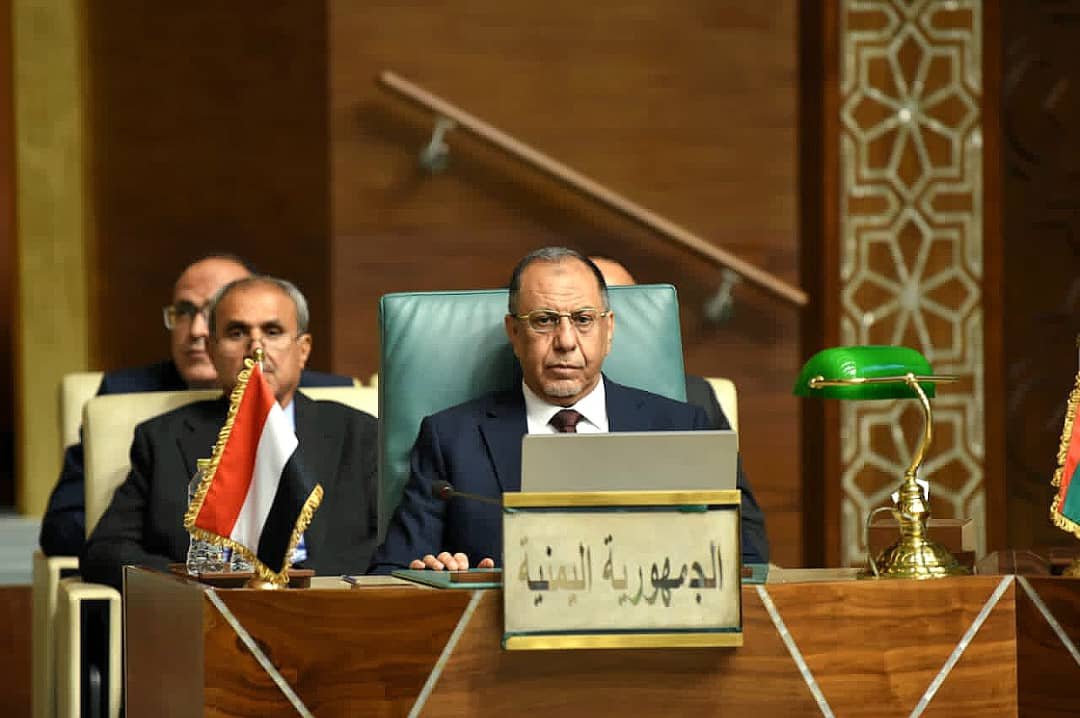
CAIRO, Egypt — Yemen asked Arab states to adopt a single strategy against trade wars and threats to international shipping routes, the state news agency Saba reported on Sept. 3.
Industry and Trade Minister Mohammed al-Ashwal made the call at the 118th ministerial session of the Arab Economic and Social Council, the agency said.
The council is an organ of the League of Arab States.
Al-Ashwal said Iran and militias aligned with it pose risks to Arab economic and food security, according to Saba.
He said Houthi missile and drone attacks on the city and port of Mokha threaten the security of the Red Sea and the Bab al-Mandab Strait, the agency reported.
Those attacks also endanger international navigation and trade, he said.
The account of the session rests on Saba, the news agency of Yemen’s internationally recognised government. No independent confirmation of the minister’s remarks has been published, and Yemen Herald could not verify the agency’s summary.
The Houthis reject the government’s description of their operations. They have not published a response to the minister’s remarks.
Delegates also discussed Arab economic integration, food security and trade cooperation, Saba said.
The session addressed support for Yemen’s industrial and commercial institute to strengthen exports, the agency reported. The government frames that work as part of reconstruction and economic recovery.
Senior Arab officials had met in Cairo on Tuesday to prepare recommendations for the ministerial session.
Yemen’s delegation at that meeting was led by Mohammed al-Humaidi, undersecretary for foreign trade at the Ministry of Industry and Trade, Saba said.
Their agenda covered regional trade integration, investment, food security, supply chains and logistics.
Officials reviewed progress on the Greater Arab Free Trade Area and plans for an Arab Customs Union, according to the agency.
Other items included digital transformation, sustainable and green finance, economic diversification, artificial intelligence and the development of workforce skills.
Al-Ashwal has raised maritime security at the council before. He led Yemen’s delegation to its 115th session in Cairo in February 2025, Yemen’s Ministry of Foreign Affairs said at the time.
At that session he pointed to Houthi attacks in the Red Sea and Bab al-Mandab, and to Houthi control of the port of Hodeidah, the ministry said.
Mokha lies on Yemen’s Red Sea coast near Bab al-Mandab, the strait linking the Red Sea to the Gulf of Aden.
The port has been out of service since August.
Houthi forces launched more than 40 drones and missiles at Mokha and its port on Aug. 10, killing seven people, Al Jazeera and France 24 reported.
Yemen’s government said a further attack on the town on Aug. 14 killed at least four people, Al Jazeera reported.
Abdul Malik al-Shara’bi, director of Mokha seaport, announced a complete suspension of operations on Aug. 15, Arab News reported.
Al-Shara’bi told a news conference in Mokha that the attacks had killed four security personnel and three port workers.
He said the Houthis fired 25 missiles at the port, damaging six wooden vessels and a drilling rig being used in an expansion project, and causing heavy damage to the dock and other facilities.
Initial losses were estimated at more than 16 million dollars, he said.
The shutdown left about 1,300 workers without their livelihoods, according to the same account.
A commercial vessel was sunk during the same week of attacks, Arab News reported.
The Houthis said their strikes on Mokha targeted concentrations of government troops and military equipment.
Yemeni officials and military analysts dispute that account and say the city is being targeted for its position on the coast.
Col. Abdul Basit al-Baher, a Yemeni army officer and military analyst, told Arab News that Mokha was once the second-most important port in northern Yemen after Hodeidah.
He said control of the city would give the Houthis wider access to the Red Sea and to international shipping lanes, and could open another route for weapons smuggling.
The coastline around Mokha carries dense palm groves that could conceal missiles and artillery, al-Baher said.
The Houthis also launched a ground push toward Mokha from al-Barah, on the edge of Mokha district, al-Baher said.
Government forces have answered with strikes of their own. Army spokesman Majed al-Nuzaily said on Aug. 16 that they had carried out 181 operations using drones, artillery and missile launchers over the previous 24 hours.
Those operations covered front lines in Taiz, Marib, Hodeidah, Dhale and Abyan, al-Nuzaily said. His tally of Houthi losses has not been independently confirmed.
Six ballistic missiles and four drones struck residential areas of Marib during the same escalation, damaging homes, vehicles and businesses, Saba reported.
The wider war has run since 2014, when Houthi forces took Sanaa and the government moved south and later into exile.
More than 22 million people in Yemen require assistance, the UN Office for the Coordination of Humanitarian Affairs said in its March 2026 response plan.
The plan put the number of acutely food insecure people at 18.3 million and counted 5.2 million internally displaced people.
It recorded more than 2.2 million children under five as acutely malnourished, including 516,157 severe cases, and sought 2.16 billion dollars to reach 12 million people.
Marib, another government-held city struck during the August escalation, hosts more than 2 million displaced people, according to international aid organisations.
The preparatory meeting on Tuesday also considered proposals on regional cooperation and on economic, environmental and technological challenges, Saba reported.
About the Author