UK Confirms Iran Fired Missiles at Diego Garcia as US Campaign Presses On
 Yemen Herald News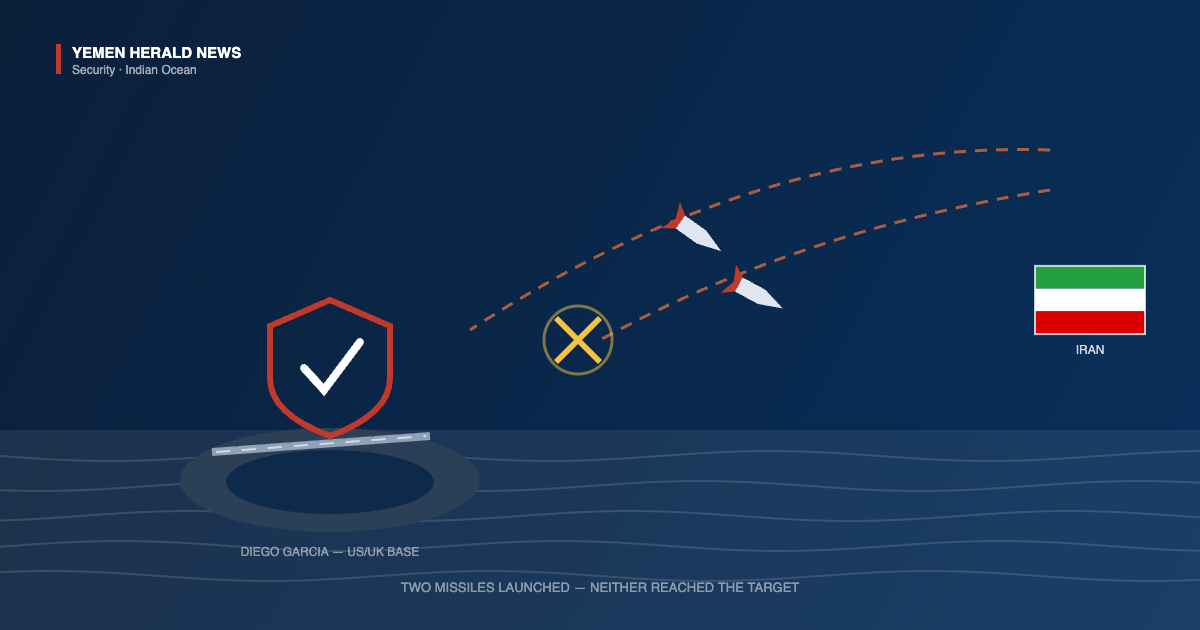
Iran fired ballistic missiles at the United States and British military base on Diego Garcia in the Indian Ocean in late March 2026, an attack that failed to reach its target but that fundamentally altered assessments of the range of Tehran’s arsenal.
The British government confirmed that two missiles had been launched at the atoll on 20 March 2026 and that neither had struck. Accounts published at the time, citing Pentagon sources, said one missile failed in flight while the second was intercepted by an SM-3 interceptor fired from a US warship. Iran denied responsibility, describing the episode as a false-flag operation.
What made the launch significant was not the damage, of which there was none, but the distance. Diego Garcia lies roughly 4,000 kilometres from Iranian territory, well beyond the range Tehran had publicly acknowledged. Iran’s foreign minister, Abbas Araghchi, had previously said the country deliberately kept its missiles below a 2,000-kilometre range and had no wish to acquire a longer reach. The weapons used were identified in reporting at the time as Khorramshahr-4 missiles, and their employment against a target that far away was read across Western capitals as a deliberate demonstration that the constraint Araghchi described no longer applied.
The British foreign secretary condemned the attack, and London subsequently broadened the permissions under which American aircraft could operate from British-controlled facilities, a decision that carried practical consequences for the tempo of the air campaign.
The launch came in the fourth week of Operation Epic Fury, the name Washington gave to the campaign it began alongside Israel on 28 February 2026. The White House set out four objectives for the operation: destroying Iran’s missile stocks and the industry that produces them, eliminating the Iranian navy, severing Tehran’s support for allied armed groups across the region, and preventing it from acquiring a nuclear weapon. Press Secretary Karoline Leavitt had been restating those goals in briefings since early March, and the Department of Defence published a fact sheet on the operation on 16 March.
By the third week of March the administration’s public messaging had begun to shift in tone. President Donald Trump and his officials were describing the campaign’s core objectives as approaching completion, while at the same time additional American forces were being moved into the region and the administration sought further funding from Congress for continuing operations. That combination, of talk of imminent success alongside visible reinforcement, drew comment at the time for the mixed signal it sent about how long the campaign would run.
On the ground, the fighting had not slowed. US and Israeli aircraft continued to strike Iranian targets including sites in and around Tehran, and casualties among civilians were reported in several provinces. Iran’s response ran through missile and drone launches against Israel, attacks on shipping in the Gulf and the Strait of Hormuz, and operations by allied groups in Lebanon and Iraq.
The stated rationale for the war varied depending on who was describing it. American and Israeli officials at different points framed the campaign as an effort to dismantle Iran’s nuclear and missile programmes, to degrade its capacity to arm proxies, and in some formulations to encourage Iranians to move against their own government. The lack of a single consistent objective became one of the more frequently raised criticisms of the operation.
Iran’s own leadership had changed in the opening days of the war. Ayatollah Ali Khamenei was killed in the initial US-Israeli strikes, and on 8 March the Assembly of Experts named his son, Mojtaba Khamenei, as supreme leader. The new leader remained almost entirely out of public view, issuing his first message in writing, in which he called for continued military resistance and said the Strait of Hormuz should be retained as a source of leverage.
For Yemen, a war fought across the Gulf and the wider Indian Ocean carried direct consequences. The country imports the great majority of its food and fuel by sea, and the routes those cargoes travel run through the same waters in which shipping was being attacked and insurance premiums were climbing. Aid agencies operating in Yemen depend on the same corridors, and any sustained rise in freight or war-risk costs feeds through to the price of basic goods in a country where most of the population already relies on humanitarian assistance.
The Diego Garcia launch also reframed a longer-running argument about how far Iran’s missile programme had progressed. Analysts who had argued that Tehran was constraining itself for political reasons now had to account for a demonstrated capability at intercontinental distance, while those who had warned that the declared limits were a matter of choice rather than engineering treated the attack as confirmation. Either reading pointed to the same conclusion: the assumptions underpinning regional missile defence planning would need revisiting.
The campaign would continue for several more weeks before a ceasefire took hold. At the time of this report, however, the picture was one of an administration signalling that the end was in sight while simultaneously preparing for more fighting, and of an Iranian government demonstrating that its reach extended considerably further than it had ever admitted.
About the Author