Yemen’s public works minister asks China for engineering help on roads and bridges
 Yemen Herald News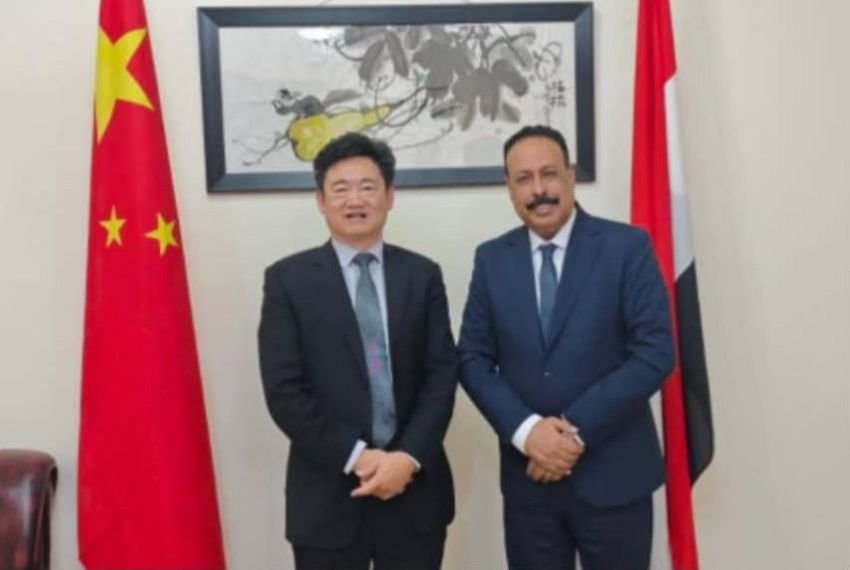
RIYADH, Saudi Arabia — Yemen’s public works minister asked China for technical and engineering help rebuilding the country’s roads and bridges at a meeting with Beijing’s top envoy on Thursday.
Hussein al-Aqrabi, the minister of public works and roads, met Shao Cheng, the Chinese chargé d’affaires to Yemen, the state news agency Saba reported.
The two discussed joint cooperation in public works and roads, the agency said.
Al-Aqrabi said China had helped develop Yemen’s road and bridge network, according to Saba.
He called for wider bilateral cooperation on road and bridge construction.
The minister sought Chinese technical and engineering expertise for implementing and rehabilitating what the agency described as a number of vital projects.
Both sides stressed the importance of resuming and reactivating cooperation on joint projects, Saba said.
They also discussed completing the procedures for signing a memorandum of understanding between the ministry and the Chinese side.
The agency did not say what the memorandum would cover, when it might be signed, or what it would be worth.
Shao said his government was interested in continuing cooperation with the ministry to serve mutual interests, according to Saba.
The account of the meeting rests on Saba, the news agency of the internationally recognised government. No independent confirmation of the talks has been published, and Yemen Herald could not verify the exchange separately.
The agency filed its report from Riyadh, where much of Yemen’s senior government leadership operates.
Al-Aqrabi and Shao held a similar discussion a month earlier. Saba reported on Aug. 9 that the minister had thanked Beijing for decades of support to the Yemeni people during a virtual meeting with the envoy.
China’s road building in Yemen predates the current war by more than six decades.
Beijing agreed in 1958 to build the first asphalt road in what was then north Yemen, linking Sanaa to the Red Sea port of Hodeidah.
Work on the 231-kilometre route began in February 1959 and finished in January 1962.
More than 1,100 Chinese labourers were employed on Yemeni road projects by 1960.
Sixty Chinese workers died over the course of the project. Their graves lie on a hill west of Sanaa.
The road became the main overland link between Yemen’s northern highlands and the port at Hodeidah. It was later the subject of a World Bank rehabilitation project.
The 1958 agreement followed a visit to China by Crown Prince Mohammed al-Badr. It produced the People’s Republic’s first friendship treaty with an Arab state.
China extended an interest-free loan of $16 million at the same time, repayable over 10 years, alongside an accord on scientific, technical and cultural cooperation.
The network the two men discussed rebuilding has been heavily damaged since the war began in 2015.
Yemen’s Ministry of Planning and International Cooperation estimated in June 2019 that more than 6,000 kilometres of urban and inter-governorate paved roads and more than 100 bridges had been destroyed in the conflict.
Authorities in Sanaa and in Aden have separately put the share of the country’s paved roads destroyed at about one third.
The World Bank assessed damage across 16 Yemeni cities in January 2020 at between $6.9 billion and $8.5 billion. It listed major roads and bridges, and municipal roads in Sanaa, Aden, Ibb, Taiz, Hodeidah, Saada and Amran, among the worst affected.
Repair work has continued mainly through multilateral channels rather than bilateral ones. The World Bank’s Yemen Integrated Urban Services Emergency Project has rehabilitated 234 kilometres of urban roads across eight cities.
Chinese diplomatic representation in Yemen has been disrupted since 2015, when the consulate general in Aden closed.
Shao met Faraj al-Bahsani, a member of the Presidential Leadership Council, in October 2025. Yemeni media reported at the time that the two discussed the possibility of reopening the Chinese embassy in Aden to allow direct communication.
Saba did not say whether the embassy question was raised on Thursday.
The agency named no specific road or bridge project under consideration.
That project restored access to critical services for more than three million people, the World Bank said. The bank approved a further $50 million for it in June 2021.
Beijing has said it intends to take part in Yemen’s postwar reconstruction. China announced tariff exemptions for Yemeni products in 2025 and said it was ready to resume more than 100 Chinese projects in the country once the conflict ends.
Yemen’s foreign ministry has said the country was invited to join China’s Global Security Initiative, a framework Beijing launched to set out its approach to regional security.
China and Yemen have marked the 70th anniversary of diplomatic relations. Beijing used the occasion to restate its support for Yemen’s unity and sovereignty and for the Presidential Leadership Council, Yemeni media reported.
The ministry’s work sits within a wider relief effort. The United Nations assessed more than 22 million people in Yemen as needing humanitarian assistance in its March 2026 response plan, and sought $2.16 billion to reach 12 million of them.
The plan recorded 18.3 million people as acutely food insecure and 5.2 million as internally displaced.
Al-Aqrabi has held the public works and roads portfolio in the cabinet seated in Aden.
Saba gave no date for a further meeting.
About the Author