GCC Condemns Attack on the UAE’s Habshan Gas Complex and Bab Oil Field
 Yemen Herald News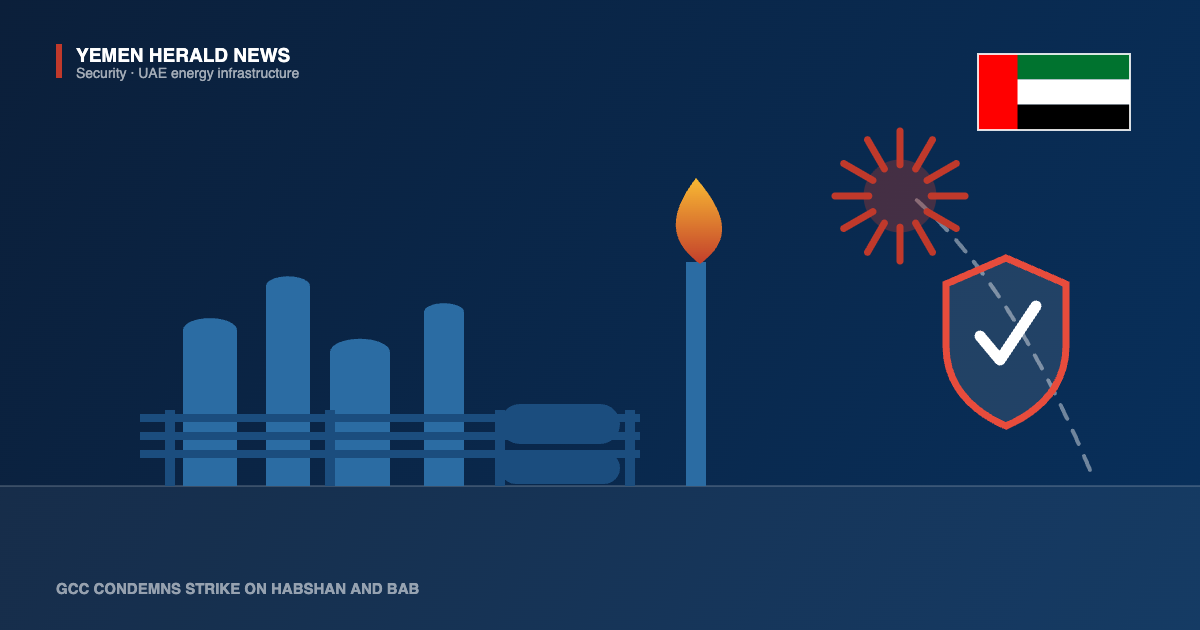
The Gulf Cooperation Council condemned the attack on the Habshan gas processing complex and the Bab oil field in the United Arab Emirates, with the bloc’s secretary-general describing it at the time as an act of terrorism that undermined regional stability. The statement followed the UAE’s own account of the strike, which Abu Dhabi attributed to Iran and said its air defences had intercepted.
Jasem Mohamed Albudaiwi, the GCC secretary-general, said the assault showed a disregard for international conventions and for the principles of good neighbourliness. He argued that the escalation threatened not only the security of the Gulf but global economic interests, given the scale of the facilities involved. Albudaiwi reaffirmed the council’s solidarity with the UAE and its support for any measures Abu Dhabi took to protect its sovereignty, security and stability.
The UAE Ministry of Foreign Affairs had issued its own condemnation, calling the strike a terrorist attack on the Habshan facility and the Bab field and describing it as a dangerous escalation and a violation of international law. The ministry said at the time that the attack was intercepted and that no injuries were reported. It framed the targeting of critical energy infrastructure as a direct threat to regional stability and to global energy security, a formulation the GCC statement echoed.
The choice of target explains much of the reaction. Habshan is one of the largest gas processing complexes in the UAE and in the wider Middle East and North Africa region. Operated by the Abu Dhabi National Oil Company’s gas arm, it has a processing capacity of about 6.1 billion cubic feet a day across five trains and fourteen processing units, drawing feedstock from onshore and offshore fields across the emirate. It sits at the centre of the country’s domestic gas supply rather than at its periphery.
The Bab field is older still. Located roughly 84 kilometres south-west of Abu Dhabi city, it has been in production since 1960 and was the emirate’s first oil-producing asset. It remains one of the UAE’s largest onshore fields, with a production capacity above 250,000 barrels a day, and it is part of ADNOC’s stated objective of reaching five million barrels a day of oil production capacity by 2027.
Striking both in a single operation therefore reached past military installations and into the machinery of the UAE’s energy economy. That distinction shaped the language Gulf governments used through the period, which separated attacks on armed forces from attacks on civilian and commercial infrastructure and treated the latter as a category of escalation in its own right.
The GCC’s condemnation did not stand alone. Foreign ministers of the GCC and the European Union had held an extraordinary meeting on 5 March 2026 to discuss the escalation, with the GCC side headed by Bahrain’s foreign minister, Dr Abdullatif bin Rashid Al Zayani, as chair of the council’s ministerial session, and Albudaiwi taking part. The ministers strongly condemned the Iranian attacks on GCC states and called on Tehran to halt them immediately.
Albudaiwi went on to issue a series of similar statements as the conflict continued, covering attacks on Kuwait, Bahrain and Jordan and on UAE oil tankers. The Habshan statement was one entry in a sequence rather than an isolated intervention, and the wording changed little from one to the next: condemnation, an appeal to international law, and an assertion of collective solidarity.
What the GCC could not offer was enforcement. The council has no mechanism to compel a non-member state to stop, and its practical contribution during the campaign was confined to coordination, diplomatic pressure and the mutual reinforcement of member states’ air defences. Condemnation was the instrument available, and the bloc used it consistently.
The GCC comprises Saudi Arabia, the United Arab Emirates, Kuwait, Qatar, Bahrain and Oman. Albudaiwi, a Kuwaiti diplomat who previously served as his country’s ambassador to the United States, took up the secretary-general’s post on 1 February 2023 and had his mandate renewed for a further three years from February 2026. The secretariat in Riyadh acts as the bloc’s collective voice on security questions, which is why its statements followed each national condemnation rather than replacing it.
Domestic gas supply was largely maintained through the disruption, according to industry reporting, but the episode showed that a single processing complex could absorb months of remedial work after an attack that produced no casualties on the day. The gap between immediate harm and eventual cost is a recurring feature of strikes on energy infrastructure, and it is one reason governments in the region treated such attacks as more serious than the casualty figures alone suggested.
Domestic gas supply was largely maintained through the disruption, according to industry reporting, but the episode demonstrated that a single processing complex could absorb months of remedial work after an attack that produced no casualties on the day. The gap between immediate harm and long-term cost is a recurring feature of strikes on energy infrastructure.
At the point the GCC issued its statement, the immediate outcome was an interception and no injuries. The significance lay elsewhere: in the shift of the target set towards facilities whose disruption is measured in processing capacity and repair schedules rather than casualties, and in the readiness of the Gulf bloc to treat an attack on one member’s energy infrastructure as a matter for collective response.
About the Author