Foreign Minister Afrah al-Zouba asks Japan to help build up Yemen’s coast guard and navy
 Yemen Herald News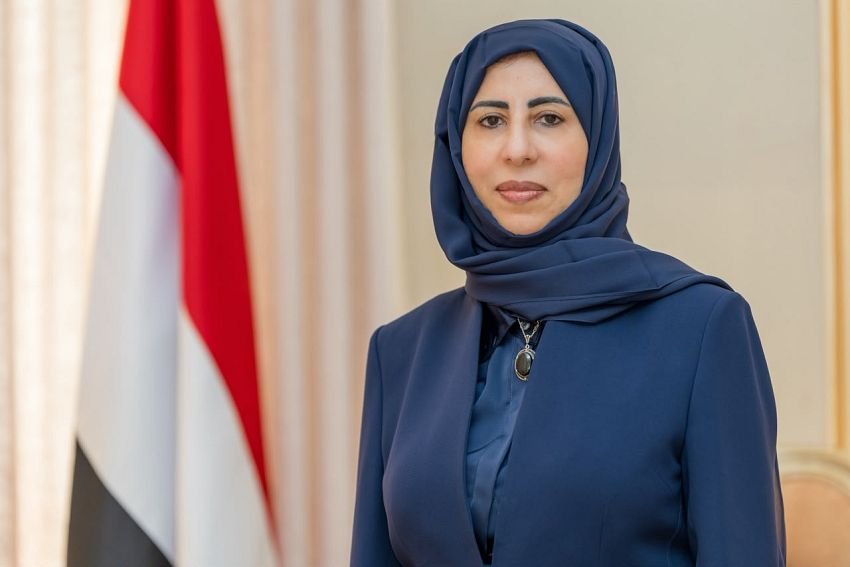
ADEN, Yemen — Yemen’s foreign minister asked Japan for help building up the country’s coast guard and navy in a phone call with her Japanese counterpart on Monday.
Afrah al-Zouba spoke with Toshimitsu Motegi about maritime security, capacity building and humanitarian and development support, the state news agency Saba reported.
She asked for training and maritime surveillance for the two forces, Saba said.
Al-Zouba also urged efforts to stop what she described as the flow of Iranian weapons and expertise to the Houthis.
Motegi said the Houthis pose a threat to free and safe navigation, according to Jiji Press, which reported the call from Tokyo.
Japan will provide support to Yemen’s government, including for strengthening its coast guard, Motegi said.
Saba said he reaffirmed Japan’s condemnation of Houthi attacks and its support for protecting navigation in the Red Sea and the Gulf of Aden.
Al-Zouba briefed Motegi on Houthi advances along Yemen’s west coast, at Bab al-Mandab and in the Red Sea, Saba said.
She said the government was responsible for protecting its territory and territorial waters and for safeguarding international shipping.
The Houthis, who hold Yemen’s northwest, have not commented on the call.
Japan has a direct stake in the waterway. The Galaxy Leader, a Japanese-operated vehicles carrier owned by a British company and registered in the Bahamas, was seized by the Houthis in November 2023.
Its 25 crew members were held for more than a year, according to Human Rights Watch. The group still holds the ship.
The call came as fighting on the Red Sea coast widened.
Houthi forces took the port of Mokha on Sept. 10 and Perim Island, inside the Bab al-Mandab strait, the following day.
They took the Greater and Lesser Hanish islands on Monday after government-allied troops withdrew, government and Houthi officials told The Associated Press.
Bab al-Mandab links the Indian Ocean to the Red Sea and carries cargo bound for the Suez Canal.
The strait has drawn closer attention since the Strait of Hormuz came under United States and Iranian blockades during the Iran war.
Human Rights Watch said Tuesday that recent Houthi attacks on commercial ships in the Red Sea and Gulf of Aden likely amount to war crimes in at least three cases.
Two rescuers from the Yemeni Coast Guard were among those killed in the deadliest of those attacks, on the cargo ship Tihamah in the Bab al-Mandab strait on Aug. 11, the organisation said. At least four crew members also died.
Yemen’s Transport Ministry said the vessel was struck by three consecutive ballistic missiles. The Houthis said it carried Saudi military equipment. Human Rights Watch said it could not confirm the cargo.
The Houthis announced a maritime embargo on Saudi Arabia on July 20, describing it as a response to what they called a Saudi sea and air blockade of Yemen.
The International Organisation for Migration said Tuesday that 93,864 people had been newly displaced across Yemen by fighting and flooding.
More than 2,000 of those displaced in the past two weeks crossed by boat to Djibouti, according to United Nations estimates.
Sultan al-Arada, a member of the Presidential Leadership Council, called the collapse of government forces at Mokha and elsewhere on the west coast “painful and regrettable” in a televised interview aired late Saturday. He said the forces were regrouping.
The United Nations humanitarian plan for Yemen published in March estimated that more than 22 million people needed assistance and that 18.3 million were acutely food insecure.
It counted 5.2 million people already displaced by the war and more than 2.2 million children under five who were acutely malnourished, 516,157 of them severely. The plan sought 2.16 billion dollars to reach 12 million people.
Al-Zouba took office on July 23, when a republican decree appointed her minister of foreign affairs and expatriates. She is the first woman to hold the post.
She had been minister of planning and international cooperation since February.
Al-Zouba worked for more than 25 years in development and peacebuilding before entering government, and served as first deputy secretary general of the National Dialogue Conference, the body set up to draft a new constitution after the removal of Ali Abdullah Saleh.
She trained as a pharmacist at Sanaa University, then took a master’s degree in community health and health economics in Malaysia and an MBA at the University of Science and Technology in Yemen.
Since taking office she has held calls with counterparts in Egypt, Sudan, Djibouti, Somalia, Germany and Tunisia, according to Saba.
She briefed European Union ambassadors in Riyadh last week on the Houthi push toward Bab al-Mandab.
She also asked the United Nations human rights chief to document Houthi violations.
Motegi has served as Japan’s foreign minister since October 2025. He held the post previously from 2019 to 2021.
Japan has funded humanitarian and development work in Yemen through United Nations agencies for much of the war.
The internationally recognised government holds the south and east of the country, including Aden, where the foreign ministry sits.
Sanaa has been under Houthi control since late 2014.
Saba said the two ministers also discussed humanitarian and development cooperation.
The agency gave no timetable for any Japanese assistance to the coast guard, and neither ministry published one.
About the Author