UN Security Council meets on Houthi control of Bab al-Mandab at France’s request
 Yemen Herald News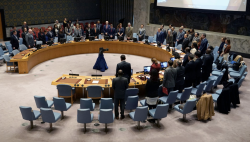
NEW YORK, United States — The UN Security Council met Tuesday on Houthi control of Yemen’s Bab al-Mandab Strait, a session requested by France, the news agencies Reuters and AFP reported.
France holds the Council presidency this month. It asked for the meeting to begin at 3 p.m. in New York, or 1900 GMT, AFP reported, citing diplomatic sources.
Reuters reported that the Council convened on Tuesday afternoon, US eastern time, to discuss the situation in the strait. Saudi Arabia and Yemen were expected to take part.
The UN had not published an announcement of the session at the time of writing, and both agency reports rested on diplomats who were not named.
The meeting followed the Houthi seizure of Yemen’s Red Sea coastline over the past week.
Houthi fighters took the port of Mocha on Sept. 10, Al Jazeera reported. They overran the island of Mayyun, also known as Perim, the following day. Mayyun sits in the middle of the waterway and divides it into two shipping lanes.
Bab al-Mandab connects the Red Sea to the Gulf of Aden and carries traffic between Europe and Asia.
The route has drawn closer attention since fighting around the Strait of Hormuz disrupted regional energy and shipping flows, AFP reported. Saudi Arabia has come to rely more on the Red Sea to move oil as Hormuz traffic has been interrupted, The New York Times reported.
It was the Council’s second emergency meeting on Yemen in under a week.
Members met on Sept. 10 at the request of Bahrain and the United Kingdom, the penholder on Yemen, after Houthi attacks on Saudi Arabia, Security Council Report said. Hans Grundberg, the UN special envoy for Yemen, briefed them. Saudi Arabia and Yemen joined that session under rule 37 of the Council’s provisional rules of procedure.
The Houthis fired missiles and drones at several sites in southern Saudi Arabia on Sept. 8, Security Council Report said, citing The Associated Press. The group described the targets as oil and economic facilities and a military air base.
The attacks injured 73 people and started fires at energy sites, including a refinery at Jazan, according to the same account.
The Houthis said the strikes answered a Saudi raid on a prison in al-Jawf governorate that they said killed seven people, including a child. Saudi Arabia has not confirmed that account.
Saudi Arabia condemned the attacks and said it had the right to defend its sovereignty, the Saudi Press Agency reported. It asked the international community to apply Council resolutions on Yemen.
Those include resolution 2216 of April 14, 2015, which imposed a targeted arms embargo on the Houthis, and resolution 2722 of Jan. 10, 2024, which demanded that the group stop attacking commercial shipping.
Maj. Gen. Turki al-Maliki, spokesman for the Saudi-led coalition, said its forces would take “all necessary operational measures” against further attacks on Saudi territory, the agency reported.
Fighting resumed in July, after the coalition stopped an Iranian aircraft from landing in Houthi-held Sanaa. The plane had not been cleared by the Yemeni government.
The Houthis then declared a naval blockade on Saudi-linked shipping in the Red Sea and struck commercial vessels in the strait. At least six people were killed aboard a Tanzanian-flagged ship on Aug. 11, The New York Times reported.
Ground fighting has widened since. The World Health Organization reported 194 people killed and 884 injured between Aug. 24 and Sept. 6 in the Maqbanah and Jabal Habashi districts of Taiz and along the Hodeidah and Taiz coasts.
Yemeni government forces have mounted a counteroffensive in western and northern Yemen, Al Jazeera reported on Sept. 8. Government officials have said the aim is to retake Sanaa.
The UN said Houthi fighters seized eight of its vehicles from an aid hub at the Red Sea port they captured.
The UN said on Sept. 8 that more than 5,600 households had left Taiz and southern Hodeidah since the latest round of fighting began on Sept. 3. It said humanitarian access remained difficult.
More than 22 million people in Yemen need assistance this year and 18.3 million are acutely food insecure, according to the UN humanitarian needs and response plan published in March.
Grundberg asked the parties to stop fighting in a statement on Sept. 7. He urged them to use the Military Coordination Committee, a UN-backed body that carries messages between Houthi and government forces.
A truce brokered by the UN in 2022 had largely held until this summer.
The wider regional conflict began with US and Israeli strikes on Iran in February. The Houthis have tied their operations to events in Gaza, Lebanon and around the Strait of Hormuz.
The US mission for Yemen has accused the group of starting the current escalation and of letting Iran use Yemen to undermine regional security.
Council members have differed over how to describe the conflict. Bahrain, France, the UK and the US have pointed to Iran’s support for the Houthis. China and Russia have avoided assigning blame and have said stability depends on the interests of all Yemeni parties.
The Houthi administration had not published an account of Tuesday’s session at the time of writing.
France’s presidency of the Council runs to the end of September.
About the Author