UNHCR seeks $14 million for Yemen as Djibouti camp nears capacity
 Yemen Herald News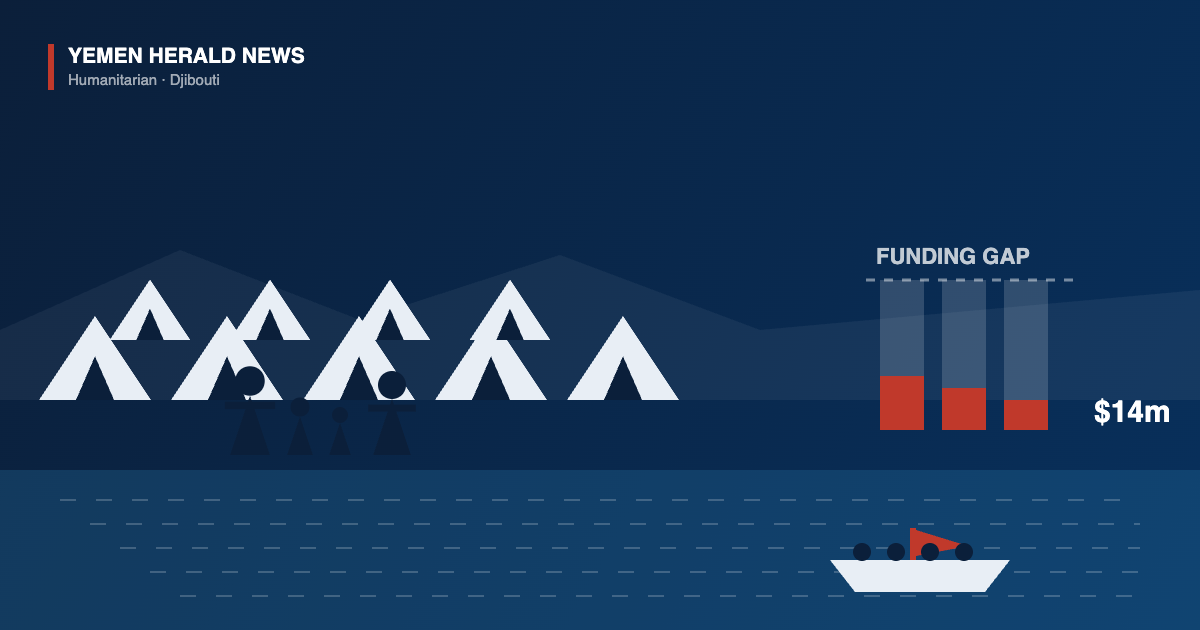
GENEVA, Switzerland — The UN refugee agency asked donors for $14 million on Tuesday to help Yemenis displaced by fighting along the country’s western coast.
UNHCR said the money would cover immediate needs inside Yemen, where it put the number of newly displaced at more than 100,000.
The agency said more than 2,400 people had crossed the Bab el-Mandeb Strait to Djibouti over the previous four days.
They came ashore mainly at Obock, Khor Angar, Moulhoule and Godoria, according to the statement, issued in Geneva on 15 September.
More than 60 percent were women, children and older people, UNHCR said.
Fuel shortages inside Yemen were hampering some of those trying to reach the crossing points, news reports said.
Sandrine Desamours, the agency’s representative in Djibouti, said reception capacity was close to exhausted.
“Markazi only has room for around 5,000 more refugees, while we are preparing for more than 10,000 arrivals,” she said.
Markazi refugee village, near Obock, is where new arrivals are taken from coastal landing points for registration. UNHCR teams are deployed at Obock.
Desamours said most of the new arrivals were children and adolescents, and that UNHCR was working with the Djiboutian government to place them in existing schools.
“Djiboutian families and the Yemeni refugee community are opening their doors and sharing what little they have, but the humanitarian response, already facing a dire funding crisis, is being stretched fast,” she said.
“People are arriving after a difficult sea journey, many exhausted, distressed and carrying what little they could take with them,” she said.
Inside Yemen, UNHCR said fighting had uprooted families across Al Hodeidah, Ta’iz, Lahj, Aden, Abyan, Marib, Al Dhaleh and Shabwah.
Many left at short notice with few belongings, it said. It listed shelter, food, clean water, health care and protection among the most urgent needs.
Receiving communities and displacement sites have become overstretched, according to the agency.
UNHCR said it had activated emergency response capacity in Yemen. Planned assistance covers cash for 1,000 households, emergency shelter cash for 500 households and shelter repair kits for a further 1,000 households.
The agency said it was preparing 3,000 additional relief item kits, subject to funding and access.
It said it was leading the inter-agency response for protection, shelter and site coordination.
Access has been constrained by insecurity, damaged roads, telecommunications disruptions and movement restrictions, UNHCR said, particularly along the west coast and between Ta’iz, At Turbah and Aden.
Damage to Al Makha port has further limited humanitarian logistics, according to the statement.
UNHCR said it was also concerned for more than 65,000 registered refugees and asylum-seekers inside Yemen, most of them Somali and Ethiopian.
The agency said it was monitoring possible movements toward Somalia and had begun contingency planning.
The arrival figures rest on UNHCR’s own reporting. Yemen Herald could not independently verify its tally of crossings to Djibouti.
A separate count by the International Organization for Migration put displacement inside Yemen in September at 85,818 people as of 14 September, with more than 2,000 having reached Djibouti. The two agencies use different methods and reporting periods.
The sea route between Yemen and Djibouti is more often travelled in the opposite direction. IOM said 1,628 Ethiopian migrants returned from Yemen to Djibouti in August.
The displacement followed a Houthi advance along Yemen’s Red Sea coast earlier in the month.
Houthi forces took the port of Mocha on 10 September and moved south the following day, according to news reports and analysts tracking the offensive. They also took Perim Island in the Bab el-Mandeb and the Hanish Islands in the southern Red Sea.
Government forces withdrew from the Hanish islands, according to accounts of the fighting reported at the time.
A UN-brokered truce in April 2022 had largely halted Houthi attacks on Saudi Arabia. Hostilities escalated after the group declared a blockade on Saudi shipping in July.
The UN Security Council met on 15 September at France’s request.
Khaled Khiari, an assistant secretary-general in the UN Department of Political and Peacebuilding Affairs, told the council that the Houthi advance toward the chokepoint raised the risk of a wider conflict.
Khiari put the share of global trade passing through the strait at roughly 12 percent.
UNHCR said continued insecurity in the strait could affect humanitarian and commercial shipping serving Yemen, Sudan and other emergencies in the region.
The agency said emergency supplies were already en route to Sudan, and that it could ship overland from stockpiles in Dubai and Nairobi.
Further deterioration could force rerouting around the Cape of Good Hope, adding 25 to 30 days to shipping times, UNHCR said.
The agency described Djibouti as a long-standing refugee host and thanked it for keeping its borders open.
Djibouti has hosted Yemeni refugees since the war began in 2015. UNHCR said it was supporting the government and the national refugee authority with reception, registration and protection work.
UNHCR said additional international support would be needed in Djibouti for reception, protection and essential services.
Yemen’s humanitarian plan for 2026 identified more than 22 million people in need, according to the UN Office for the Coordination of Humanitarian Affairs.
OCHA put the number of acutely food insecure at 18.3 million and recorded 5.2 million people already displaced before the latest fighting. It sought $2.16 billion for the year to reach 12 million people.
About the Author