Trump Invokes Pearl Harbor to Explain Iran Strikes as Takaichi Sits Beside Him
 Yemen Herald News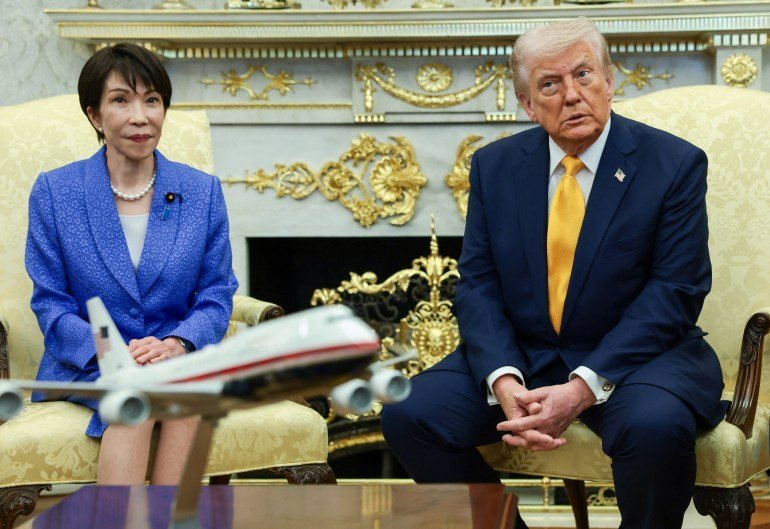
An off-the-cuff remark by United States President Donald Trump about the 1941 attack on Pearl Harbor unsettled relations with Japan in March 2026, after he used the comparison to explain why Washington had not warned allies before striking Iran. The exchange took place during a bilateral meeting at the White House with Japanese Prime Minister Sanae Takaichi on 19 March, and was carried live by broadcasters in both countries.
Asked by a reporter why the United States had not informed Japan or its European partners in advance of the joint American and Israeli operation against Iran, Trump replied that the attack had been launched hard and without notice because surprise was the objective, then turned to his guest and asked who knew more about surprise than Japan, adding a pointed question about why Tokyo had not told him about Pearl Harbor. Takaichi, seated beside him, was reported to have widened her eyes and shifted in her chair before letting the remark pass without response.
The context sharpened the discomfort. The United States and Israel had begun strikes on Iran on 28 February 2026, opening a conflict that spread rapidly across the Gulf. Takaichi was among the first allied leaders to meet Trump in person after the campaign began, and the meeting followed public comments in which the president suggested that Japan had been slow to answer his call for help in securing shipping through the Strait of Hormuz — a waterway through which a substantial share of Japan’s imported crude oil passes.
Reaction in Japan was immediate and mixed. On social media, users accused the president of insensitivity toward an event that carries a specific and painful place in the two countries’ shared history, and of treating a wartime attack as material for a joke in front of a sitting Japanese leader. Others argued that the remark said more about Trump’s improvisational style at press events than about American policy toward Japan, and cautioned against reading a durable shift into a single sentence.
Tsuneo Watanabe, a senior fellow at the Sasakawa Peace Foundation, set out the more serious objection in a commentary for the Nikkei newspaper. He argued that the remark signalled a disregard for the diplomatic conventions that have governed the alliance, and read it as an attempt to implicate Japan rhetorically in a military operation Tokyo had neither been consulted about nor endorsed. Watanabe noted that an unspoken understanding has long existed between American and Japanese leaders to handle the war years with care, precisely because the alliance was built on top of that history rather than around it.
Takaichi’s own handling of the moment divided commentators. Supporters credited her with composure, arguing that a visible reaction would have handed the exchange a longer life in the news cycle and complicated a meeting with a substantive agenda. Critics, including the former senior diplomat Hitoshi Tanaka, took the opposite view, arguing on social media that genuine equality between allies requires leaders to answer each other directly rather than absorb slights in the interest of atmosphere.
Calls followed for the Japanese government to lodge a formal protest. Officials in Tokyo were reported to have judged that a protest would magnify the incident rather than settle it, and no formal complaint was made public in the days after the meeting. That calculation reflects a familiar asymmetry: Japan’s room to escalate a dispute over tone is constrained by the same security dependence that makes the tone matter.
That dependence is concrete rather than abstract. The United States maintains its largest overseas troop presence in Japan, and Japan in turn relies on American extended deterrence in a neighbourhood that includes North Korea’s missile programme and an increasingly assertive China. The bases are the alliance’s load-bearing structure, and also, in Japanese domestic politics, its most persistent source of friction.
Takaichi came to office as a hardline conservative associated with efforts to loosen the constraints of Japan’s post-war constitution on the use of military force, and with sharp increases in defence spending. Her position makes her a natural partner for an American administration that has pressed allies to carry more of the burden of regional security. It also raises the political cost of appearing to be treated as a junior partner, particularly before a domestic audience that has been asked to accept higher defence budgets on the argument that Japan is becoming a more equal one.
The immediate policy question left by the meeting was not the Pearl Harbor line but the consultation failure behind it. Allied governments in Europe and Asia learned of the strikes on Iran as they happened. For Japan, which sits at the far end of the tanker routes running out of the Gulf and which had no advance notice that those routes were about to become a war zone, the omission carried practical consequences for energy planning and for the safety of Japanese shipping and nationals in the region.
By the end of March the episode had receded from the front pages in Washington, displaced by the widening conflict in the Gulf. In Tokyo it lingered longer, feeding an existing debate about how much influence Japan actually exercises over decisions that affect its security and its economy. The alliance was not put in doubt by a single remark, but the remark gave plain expression to a question Japanese policymakers had been asking privately since 28 February.
About the Author