RIYADH, Saudi Arabia — Yemen’s Presidential Leadership Council chairman Rashad al-Alimi re
 Yemen Herald News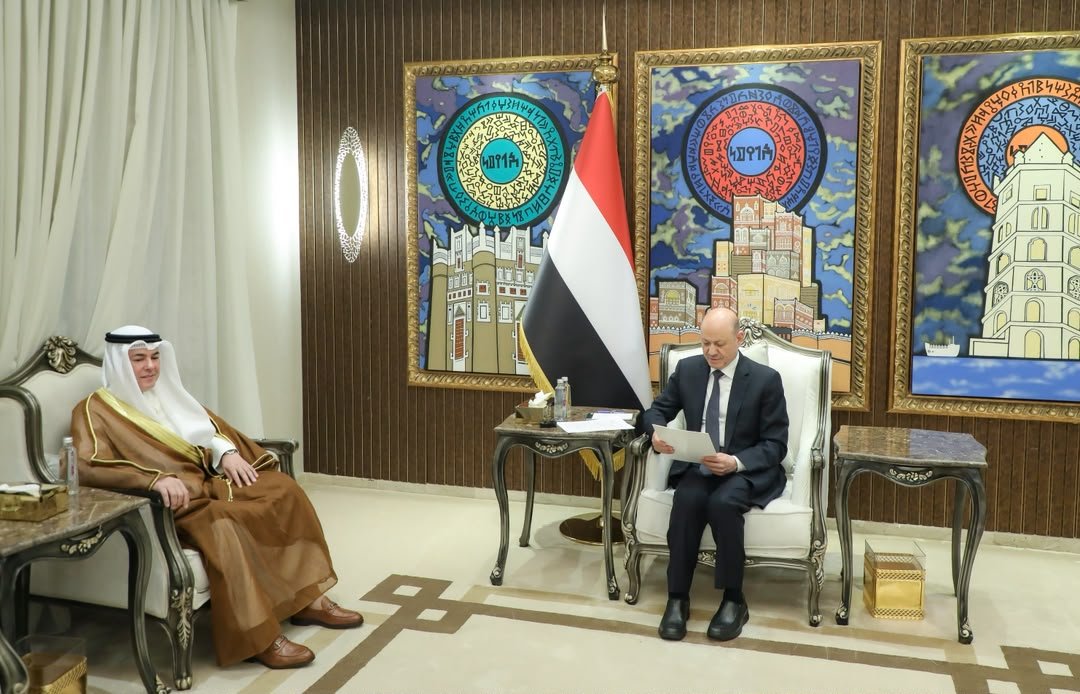
RIYADH, Saudi Arabia — Yemen’s Presidential Leadership Council chairman Rashad al-Alimi received a reply message from Kuwait’s emir on Tuesday, the state news agency Saba said.
Kuwait’s ambassador to Yemen, Falah al-Mutairi, handed the message to al-Alimi at a meeting in the Saudi capital.
It came from Sheikh Mishal al-Ahmad al-Jaber al-Sabah, the emir of Kuwait.
The message answered one al-Alimi had sent earlier. Foreign Minister Afrah al-Zouba carried that first letter to Kuwait, according to the agency.
Saba did not publish the text of either message. It did not say what the emir wrote in reply.
Yemen Herald could not independently confirm the account. It rests on Saba, the government’s own news agency, and no independent report of the meeting has been published.
Al-Alimi praised what he called Kuwait’s steadfast stance in support of Yemen, its people, its political leadership and its national institutions, Saba said.
He said Kuwait had backed Yemen’s security, stability, unity and territorial sovereignty.
The council chairman also credited Kuwait with supporting the Yemeni government in regional and international forums, the agency reported.
He referred to Kuwaiti humanitarian and development work carried out in Yemen over several decades.
Al-Alimi then turned to the fighting. He described what he called ongoing military escalation by Houthi forces inside Yemen and across the border with Saudi Arabia, according to Saba.
He said the group was threatening shipping lanes in the Red Sea and the Bab al-Mandab strait.
The agency quoted al-Alimi as calling the Houthis a terrorist militia. The group rejects that description and says it is defending Yemen against foreign intervention.
He said the government remained committed to restoring national institutions and ending what he termed the Houthi coup.
Al-Alimi framed that effort as part of a wider contest to protect regional security from what he called chaos projects backed by Iran, the agency said. Tehran denies arming or directing the Houthis.
The council chairman repeated Yemen’s condemnation of Iranian attacks on Kuwait. He said Kuwait’s security was an integral part of Yemen’s and the region’s, according to Saba.
Iran struck several Arab states this year during its war with the United States and Israel.
Kuwait’s foreign ministry said at the time that some of the strikes had targeted Kuwait International Airport, along with electrical infrastructure and residential buildings.
The Islamic Revolutionary Guard Corps said it had carried out a combined missile and drone attack on Ali Al Salem Air Base in Kuwait.
Yemen’s foreign ministry condemned those attacks earlier and said it stood with Kuwait and supported the measures Kuwait had taken.
Kuwait has said that backing the Yemeni state and the Presidential Leadership Council is a joint Yemeni and Gulf interest, and a pillar of regional stability.
The council was formed in April 2022, when President Abd Rabbu Mansour Hadi transferred his powers to it. Al-Alimi has chaired it since.
Its members are based largely in Riyadh. Aden serves as the government’s temporary capital.
The meeting followed a reversal on Yemen’s western coast.
Houthi forces seized the Red Sea port of Mokha on 10 September, according to reporting by NPR, CNBC and The National.
They took Perim Island, also known as Mayun, the following day, Euronews reported.
The island sits at the narrowest point of the Bab al-Mandab strait and overlooks both of its shipping channels.
With the Hanish Islands and the coastline, the advance left the group astride one of the world’s main energy routes.
Government forces have counterattacked in Taiz and Lahj in the weeks since. They have not retaken Mokha or Perim.
Kuwait has a longer diplomatic record in the war than most of its neighbours.
It hosted the last full round of United Nations-mediated talks between the Yemeni government and the Houthis, which opened in April 2016.
Those negotiations ran for more than 90 days in Kuwait City and closed in August that year without an agreement.
No comparable round has been convened since.
The Houthis have held Sanaa since September 2014. A Saudi-led coalition intervened on the government’s side in March 2015.
Iran has denied supplying the group with weapons throughout the war.
The humanitarian file has widened in the years between. The United Nations said in its March 2026 response plan that more than 22 million Yemenis need assistance.
It put the number facing acute food insecurity at 18.3 million and the displaced population at 5.2 million.
The plan sought 2.16 billion dollars to reach 12 million people.
Fighting on the western coast has added to those totals. United Nations agencies said this month that about 112,000 people were displaced in two weeks.
The International Organization for Migration has warned that the rate of displacement is rising.
A member of the Presidential Leadership Council arrived in New York this week for United Nations meetings.
Group of Seven foreign ministers said this week that developments in Yemen and the Red Sea threaten regional stability and freedom of navigation.
Kuwait is one of several Gulf states that have kept their embassies to Yemen operating outside the country during the war.
Saba published a photograph of the two men seated in a reception room. It did not say who else attended.
About the Author