Aden governor discusses ICRC support for hospitals treating Yemen’s war wounded
 Yemen Herald News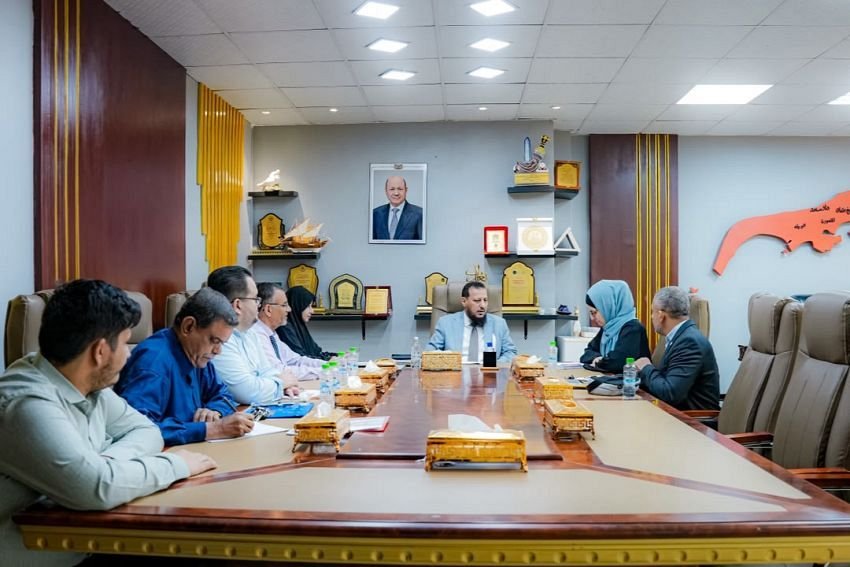
ADEN, Yemen — Aden’s governor discussed possible Red Cross support for hospitals treating people wounded in Yemen’s September fighting at a meeting on Wednesday.
State Minister and Aden Governor Abdulrahman Sheikh al-Yafei met Amira Kdeir, head of the International Committee of the Red Cross mission, the state news agency Saba reported. The committee’s political adviser, Baha Hassan, also attended.
The two sides talked about the health and humanitarian situation in Aden. They also discussed the conditions of those wounded in what the government describes as the Houthi escalation across several front lines, according to Saba.
The account of the meeting rests on Saba. No independent confirmation of it has been published, and the ICRC has not issued its own statement on the talks.
The meeting covered ways to strengthen cooperation between the local authority and the committee, Saba said. That included the possibility of the ICRC supporting hospitals and health facilities receiving the wounded.
Discussions also covered the supply of available medical material. Other forms of assistance that could improve the standard of care were raised, according to the agency.
Al-Yafei praised the committee’s humanitarian and medical work. He cited its contributions to the health sector and its efforts to monitor the conditions of people wounded in the war, Saba reported.
He said the local authority was committed to closer cooperation with the ICRC. He added that it was ready to provide facilities for the committee’s medical teams and programmes.
Kdeir stressed the importance of continued coordination with local authorities and health institutions in Aden, according to the agency. She said the committee would explore possible areas of intervention in line with its mandate and the needs of the health sector.
Neither side announced a funding figure. No timetable for any new ICRC programme was given.
Al-Yafei was appointed governor of Aden in January by the Presidential Leadership Council, which dismissed his predecessor, Ahmed Hamed Lamlas. He is a founding member of the Southern Transitional Council and previously served as deputy governor of the city. He was sworn in before the council’s chairman, Rashad al-Alimi.
Aden serves as the temporary capital of the internationally recognised government. It houses the Central Bank of Yemen and the seat of the Presidential Leadership Council.
The Presidential Leadership Council was formed in April 2022 and took the seat of government to Aden. The Central Bank of Yemen moved its headquarters to the city from Sanaa in September 2016.
The meeting follows a month of fighting that has pushed wounded people toward hospitals in the south. Houthi forces launched an offensive on 3 September, with clashes beginning in Taiz governorate.
The group took control of Yemen’s Red Sea coastline in early September, Al Jazeera reported on 11 September. It seized the port city of Mokha during the same advance.
The health system closest to the fighting has come under direct strain. Nine health facilities have been damaged, closed or directly attacked in Taiz, Lahj and Hodeidah, according to the UN Office for the Coordination of Humanitarian Affairs.
Hospitals treating the wounded are running short of blood, anaesthesia and surgical supplies, OCHA said.
Ambulances were attacked in Lahj governorate on Friday. A driver and an emergency medical responder were killed, according to the office.
More than 2,700 pregnant women are among those displaced by the fighting, OCHA said. At least 500 of them need emergency obstetric or newborn care.
Emergency obstetric facilities have closed in Taiz. Displaced women have given birth in the open without skilled medical care, according to the office.
Displacement from the September fighting passed 130,000 people, the United Nations said on 21 September.
Taiz hosts the largest number of the displaced at 73,494, according to figures from the International Organization for Migration. Lahj follows with 33,828, then Aden with 8,946 and Hodeidah with 8,244.
The fighting has also reached Lahj, the governorate immediately north of Aden. It holds the second largest group of people displaced by the September offensive.
Some 21,000 households have been displaced across the country since 1 August, most of them in Taiz and Lahj, the organisation said.
The UN refugee agency said this week that nearly 100,000 more Yemenis could be displaced within three months if the fighting continues.
The pressure lands on a health system that was already short of capacity before September. Nearly 20 million people in Yemen need health assistance, the World Health Organization said this month.
The wider humanitarian picture is set out in the UN humanitarian needs and response plan published in March. It records more than 22 million people in need of assistance across the country.
The plan puts the number of acutely food insecure people at 18.3 million. More than 2.2 million children under five are acutely malnourished, of whom 516,157 are severely malnourished.
It counts 5.2 million internally displaced people, a figure that predates the September fighting. The appeal seeks 2.16 billion dollars to reach 12 million people.
The ICRC has operated in Yemen throughout the war. Its mandate covers the treatment of the wounded, visits to detainees and support to medical facilities on both sides of the front lines.
The committee does not publish a breakdown of its spending by governorate. It has not said what support, if any, will follow Wednesday’s talks.
About the Author