Saudi Arabia Opens Taif Air Base to US Forces as Iran War Widens
 Yemen Herald News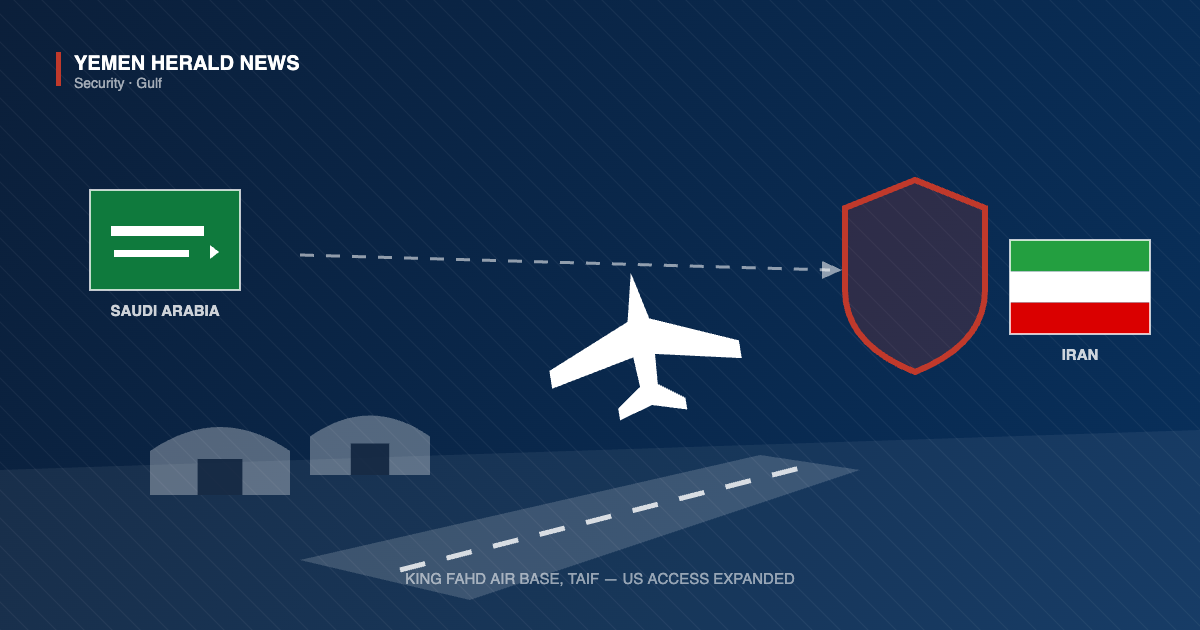
Saudi Arabia agreed in March 2026 to give United States forces expanded access to King Fahd Air Base at Taif, in the west of the kingdom, in support of American operations against Iran. The arrangement was reported on 20 March by Middle East Eye, citing United States and Western officials, and was subsequently picked up by other outlets including the Wall Street Journal. Neither Riyadh nor Washington confirmed the arrangement publicly at the time, and the reporting rested on unnamed officials rather than an announced agreement.
If accurate, the decision marked a meaningful change in posture. Since the American and Israeli strikes on Iran that began on 28 February 2026, Saudi Arabia had positioned itself as a state hosting American forces rather than as a participant in the campaign — a distinction Riyadh had worked to preserve while Iranian missiles and drones fell on the UAE, Kuwait and Bahrain. Opening a base for operations directed at Iran erodes that distinction, whatever the technical description of the activity conducted there.
Geography explains the choice of Taif. The base sits in the Hejaz, near Mecca in the kingdom’s west, several hundred kilometres from the Gulf coast and outside the effective reach of most of the Iranian drones and shorter-range ballistic missiles that had been striking facilities closer to the water. Basing aircraft, tankers and support functions there gives American planners depth without the exposure that comes with the eastern Saudi installations built around the oil industry.
The agreement was reported to have followed discussions between Elbridge Colby, a senior official in the United States defence establishment, and Saudi Defence Minister Khalid bin Salman, brother of Crown Prince Mohammed bin Salman and one of his closest advisers. Western officials cited in the coverage pointed to mounting security pressure on the kingdom as the driver, rather than any enthusiasm in Riyadh for a wider war.
Analysts quoted in the reporting cautioned against reading the arrangement as an offensive commitment. The likelier uses of Taif, on their assessment, are logistical: refuelling and tanker operations, repositioning of aircraft away from vulnerable Gulf airfields, maintenance, and intelligence and surveillance support. That is materially different from launching strike sorties into Iranian airspace from Saudi soil, and Riyadh has an obvious interest in the distinction being understood in Tehran.
Whether Tehran accepts it is another matter. Iranian doctrine through the opening weeks of the war treated the presence of American forces as sufficient grounds for targeting, and Kuwait, Bahrain and the UAE were struck largely on that basis. Should Iran classify Saudi Arabia as a co-belligerent, the kingdom’s exposure is considerable: oil processing facilities, export terminals, desalination plants and airports, most of them concentrated in the Eastern Province within comfortable range of Iranian systems.
Saudi Arabia has been here before. The September 2019 attack on the Abqaiq processing facility and the Khurais oil field, claimed by Yemen’s Houthi movement but attributed by Riyadh and Washington to Iran, briefly removed around half of the kingdom’s crude output and demonstrated how much economic damage a small number of drones and cruise missiles can inflict on concentrated infrastructure. That episode remains the reference point for Saudi planners weighing how much visible alignment with Washington the kingdom can afford.
The economic calculation runs deeper than damage to installations. The Vision 2030 programme rests on attracting foreign capital, tourism and corporate relocation to a country marketed as stable, and on the giga-projects in the north-west of the kingdom that are meant to demonstrate that stability. A war risk premium attached to Saudi Arabia would raise the cost of every part of that programme, and would do so at a moment when oil revenues are already being consumed by the projects themselves.
Riyadh has also spent the past several years reducing friction with Tehran rather than adding to it. The March 2023 agreement brokered in Beijing restored diplomatic relations between the two states after a seven-year rupture, and the détente that followed was accompanied by a marked de-escalation on Saudi Arabia’s southern border with Yemen. Basing decisions that read as alignment with an American campaign against Iran put that arrangement under strain.
The kingdom’s rhetoric shifted noticeably over the same weeks, moving away from the studied neutrality of the war’s opening days. Saudi officials continued to call for de-escalation and for a negotiated end to the fighting, but the language grew firmer about attacks on Gulf territory and about the responsibility of the party conducting them. Statements of that kind are cheap; base access is not, and the gap between the two is where Riyadh’s actual position sits.
Nothing in the reporting from March 2026 indicated that Saudi Arabia had joined the war, and no Saudi forces were described as taking part in operations against Iran. What the Taif arrangement did indicate was a narrowing of the space between hosting and participating — a space Riyadh had used deliberately, and which the pressure of a regional war was making harder to hold. The unresolved question at the time was not whether Saudi Arabia wanted a war with Iran, but whether it would still be able to avoid one on its own terms.
About the Author