Saudi Arabia Expels Iranian Military Attache and Four Embassy Staff Over Attacks
 Yemen Herald News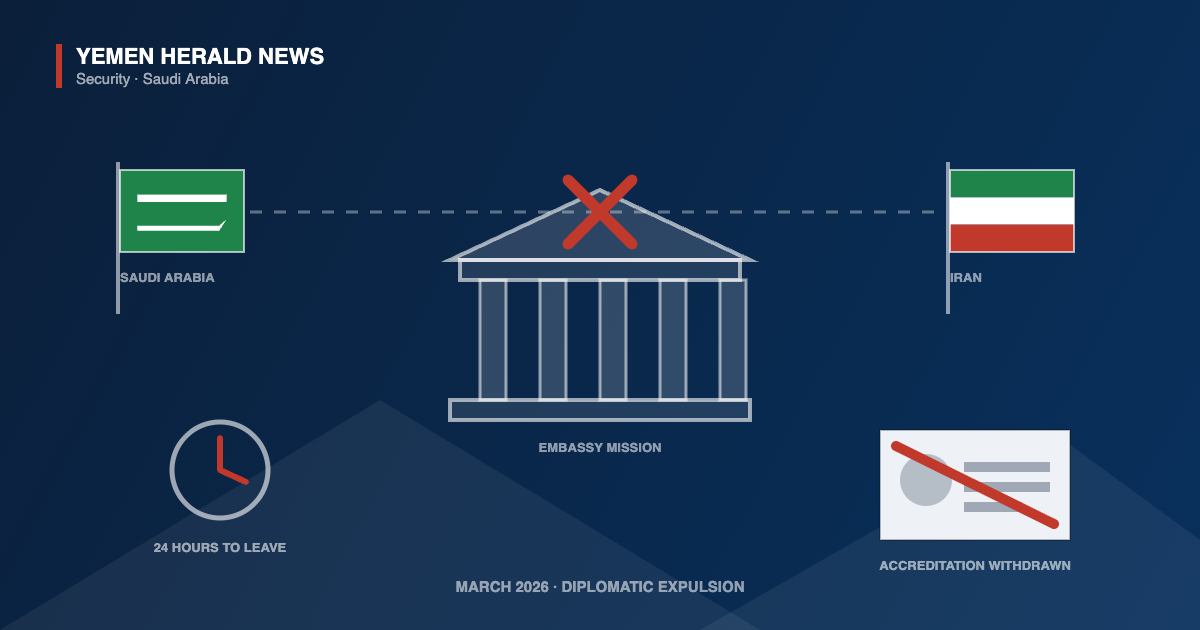
Saudi Arabia expelled Iran’s military attache and four embassy staff in March 2026, declaring them persona non grata and giving them 24 hours to leave the kingdom. The foreign ministry announced the decision on 21 March, citing what it described as repeated Iranian attacks on Saudi territory, among them a ballistic missile intercepted over Riyadh and drones brought down over the Eastern Province. The measure was reported at the time by international news agencies and by Saudi state media.
Qatar had taken a comparable step days earlier, declaring the security and military attache at Iran’s embassy in Doha persona non grata. The two decisions, coming within a week of each other, marked the first time since the 2023 restoration of relations that Gulf states had moved directly against accredited Iranian personnel, and they were read across the region as a coordinated signal rather than two isolated national responses.
Prince Faisal bin Farhan, the Saudi foreign minister, said that trust in Iran had been shattered and that the kingdom reserved the right to respond militarily. He spoke in the days around a consultative meeting of Arab and Islamic foreign ministers convened in Riyadh on 18 and 19 March, which had been called specifically to address the wave of Iranian strikes on Gulf states, Jordan, Azerbaijan and Turkiye and to seek a route towards de-escalation.
The confrontation had begun with a joint American and Israeli military operation against Iran on 28 February 2026. Tehran responded with successive rounds of drone and missile launches directed at what it described as American and Israeli interests across the region. Gulf governments rejected that characterisation, noting that the launches crossed their airspace and that civilian sites and energy infrastructure were among the places hit or targeted.
The expulsions carried particular weight because of what they undid. Saudi Arabia and Iran had severed relations in 2016 after Saudi diplomatic missions in Iran were stormed, and restored them only in March 2023 under an agreement brokered in Beijing. That agreement had survived three years of regional turbulence. Removing a military attache does not sever relations, and neither embassy was closed, but it strips out the channel through which the two militaries had been able to speak to one another directly.
The energy dimension ran alongside the diplomatic one. With Iran having effectively closed the Strait of Hormuz to normal tanker traffic, Saudi Arabia rerouted crude westward through its East-West pipeline, known as the Petroline, to the Red Sea coast. Throughput reached a record of roughly seven million barrels a day in March 2026. Of that volume, about two million barrels fed domestic refineries and the remainder loaded onto tankers at the Yanbu terminals. Analysts at Signal Ocean counted 47 very large crude carrier loadings at Yanbu that month, against eleven or twelve in each of January and February.
The stakes in that reroute were considerable. Saudi Arabia holds the world’s second-largest proven crude oil reserves, and the Strait of Hormuz in normal conditions carries roughly a fifth of the world’s seaborne oil trade. Closing it removes an outlet that has no straightforward substitute, and the Petroline, for all that it was pushed to a record, was never designed to carry the kingdom’s entire export programme indefinitely.
That reroute was then attacked in turn. An Iranian strike on Yanbu briefly halted crude loadings, with the Islamic Revolutionary Guard Corps stating that it had targeted oil facilities operated by American companies at the port. The significance was less the physical damage, which was limited, than the demonstration that the alternative to Hormuz was itself within range. Saudi Arabia’s two principal export routes were, for the first time, simultaneously exposed.
Saudi officials were careful throughout to stress that the great majority of the launches had been intercepted before reaching their targets. That claim served a purpose beyond reassurance: it allowed Riyadh to condemn the attacks in strong terms while avoiding the position of having sustained damage severe enough to compel an armed response. The gap between the rhetoric and the retaliation was, for most of March, deliberate.
Expelling a military attache is a calibrated instrument. It is more serious than summoning an ambassador and less serious than recalling one, and it targets the personnel most closely associated with the military relationship while leaving the diplomatic architecture nominally intact. Riyadh’s framing throughout was that the door remained open, but that the attacks had to stop first. Iranian officials characterised the expulsions as unhelpful and reiterated that Gulf states were not the intended targets of the launches.
Yemen sat in the background of all of this. Saudi Arabia has spent close to a decade defending its southern border and its energy facilities against drone and missile attack, and the Houthi movement in Yemen has been aligned with Iran throughout that period. Yemen’s internationally recognised government has consistently argued that Iranian support for the Houthis is part of the same regional pattern, and the March 2026 barrages, launched from a different direction entirely, gave that argument a wider audience among Gulf capitals.
By the end of March the 2023 rapprochement was formally alive and functionally suspended. Embassies remained open, ambassadors remained accredited, and almost nothing else about the relationship was operating as it had been at the start of the year.
About the Author