Iranian Missiles Hit Dimona and Arad, Injuring Close to 200 as Israeli Defences Missed Two
 Yemen Herald News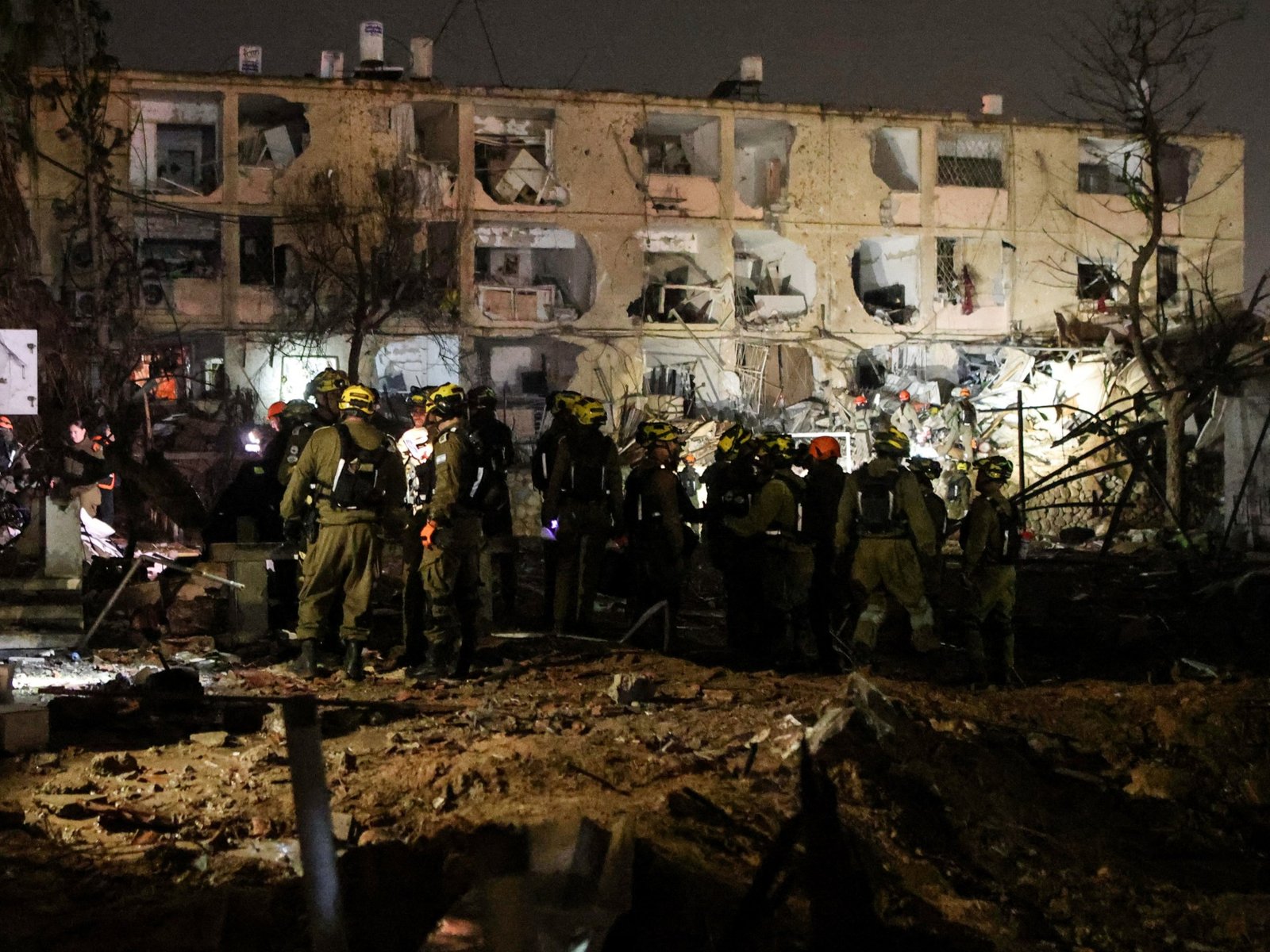
Iranian ballistic missiles struck the southern Israeli towns of Dimona and Arad on the evening of 21 March 2026, injuring close to 200 people according to figures released as casualty counts were revised through the following day. Eleven of the wounded were described as seriously hurt. Israeli air defences engaged the incoming salvo but failed to intercept at least two missiles, which hit built-up areas directly.
Magen David Adom, Israel’s national emergency medical service, treated 88 people in Arad, ten of them seriously, among them a five-year-old girl. In Dimona, dozens more were hurt when a building reported to be a school collapsed under the impact of a munition; a ten-year-old boy was among those in serious condition. Rescue teams worked through the night at both sites, and several residential buildings were left uninhabitable.
Iranian state media said the salvo had been aimed at Israel’s nuclear research centre in the Negev, which lies roughly ten kilometres outside Dimona and about thirty kilometres from Arad, and presented it as retaliation for strikes on the Natanz uranium enrichment plant reported earlier the same day. Iran had accused the United States and Israel of carrying out that attack.
The International Atomic Energy Agency said afterwards that it had detected no damage to the Negev facility and no abnormal radiation readings. The agency had spent much of the war issuing similar statements about installations on both sides, and its director general, Rafael Grossi, repeated his call for military restraint to avoid a nuclear accident.
Prime Minister Benjamin Netanyahu called it a difficult evening for Israel and said the campaign against Iran would continue. He conveyed messages of support to the injured and, in the days that followed, pressed other governments to align with Israel and the United States in confronting Tehran.
The strikes marked a shift in the shape of the war. Until that night, Iranian salvoes had mostly been absorbed by Israel’s layered interception network or had landed in open ground. Two direct hits on populated towns, in an area associated with the country’s nuclear infrastructure, punctured that record and unsettled a public that had been told the defences would hold.
Israeli military officials said the interception systems had been activated as the missiles came in. Firefighters reported that two ballistic missiles reached their targets intact and detonated on impact, which accounts for the concentration of casualties in two locations rather than the wider scattering typical of debris from successful intercepts.
The exchange sat inside a conflict that had begun on 28 February 2026, when the United States and Israel opened a joint air and missile campaign against Iran after negotiations between Washington and Tehran broke down. The American operation was designated Epic Fury. Its declared objectives were to destroy Iran’s ballistic missile arsenal and production capacity, disable its navy, cut its support for allied armed groups, and prevent it from acquiring a nuclear weapon.
Iran’s response had been sustained from the outset. Between 28 February and 4 March, more than ninety attempted strikes on Israel were recorded, with around twenty reaching civilian areas and at least ten people killed. The single heaviest incident before Dimona and Arad came on 1 March, when a strike on a residential neighbourhood in Beit Shemesh killed nine civilians.
The war widened quickly. Hezbollah began firing missiles and drones from Lebanon on 2 March, drawing Israeli air strikes as far north as the southern suburbs of Beirut. A limited Israeli ground operation in southern Lebanon began on 17 March, and on 24 March the Israeli defence minister, Israel Katz, announced a plan for forces to hold ground up to the Litani River.
Yemen was pulled into the same sequence. The Houthi movement launched strikes toward Israel during the conflict, extending a campaign it had run intermittently since 2023, and vessels transiting the Red Sea and the Gulf of Aden operated under elevated threat throughout. The commercial consequence fell heavily on Yemen itself, where higher freight and war-risk insurance costs feed directly into the price of imported food and fuel.
For Israeli civilians the immediate concern was more local. Residents of Arad and Dimona spent the following morning clearing glass and assessing structural damage, and municipal authorities arranged temporary accommodation for families whose homes had been condemned. Both towns are small, and in each case the damage was concentrated in a few streets rather than spread across the built-up area.
Attacks near nuclear installations drew particular attention because of how little margin they leave. The Negev research centre is not a power reactor, but the IAEA has consistently warned that military action in the vicinity of any nuclear facility carries a risk that no side can fully control, and it repeated that position after both the Natanz and Dimona reports.
The fighting ran for more than five weeks in total. The United States and Iran agreed a ceasefire on 7 and 8 April 2026 that also covered Israel, alongside Iranian acceptance of the reopening of the Strait of Hormuz, while the Lebanese front continued to generate incidents well after the formal end of hostilities. Casualty figures from the night of 21 March were still being adjusted at that point, which is why early reports of just over 100 injured were later superseded by the higher total.
About the Author