Missile Debris Starts Three Fires Near Abu Dhabi’s KEZAD Industrial Zone, Injuring Six
 Yemen Herald News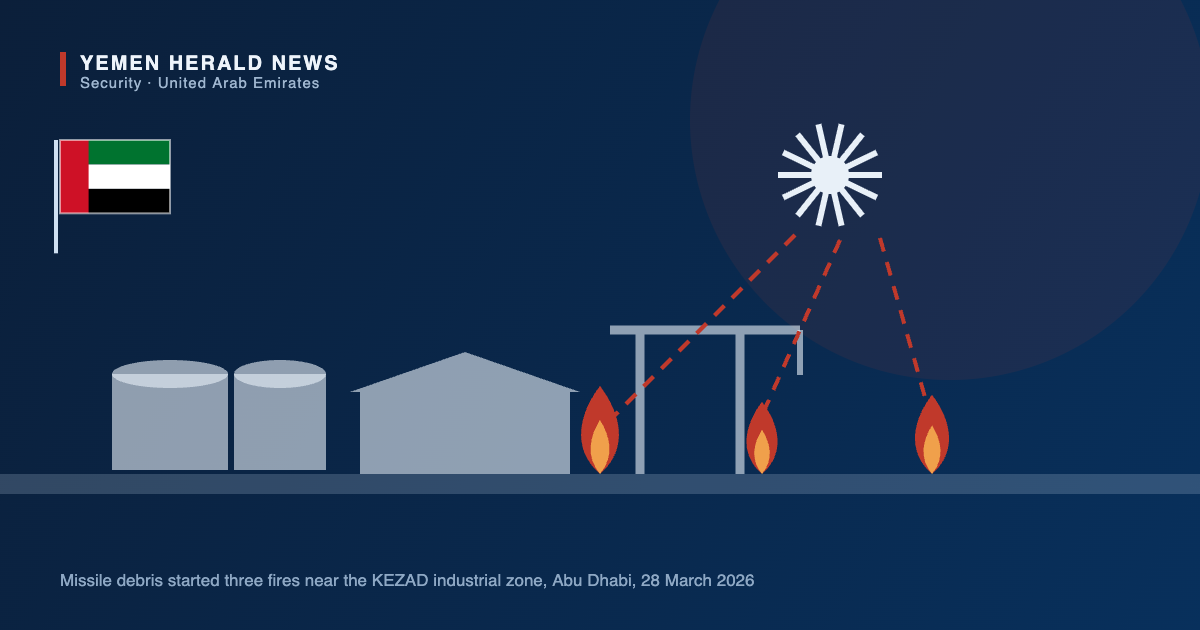
Authorities in Abu Dhabi contained three fires started by debris from an intercepted ballistic missile near the Khalifa Economic Zones Abu Dhabi industrial area on Saturday 28 March 2026, the Abu Dhabi Media Office said, reporting six people injured and no deaths.
The account was revised through the course of the day. Early statements from the media office described two fires and five injuries; a third fire and a sixth casualty were confirmed in a later update. Officials said five of those hurt were Indian nationals and one was a Pakistani national, and that the injuries ranged from minor to moderate. Cooling operations at the fire sites were still under way when the media office issued its final statement of the day.
The debris came down after air defences engaged a ballistic missile over the area. Interception does not remove the hazard on the ground: a missile destroyed in flight breaks into fragments that continue along a ballistic path, and warhead components, motor casings and fuel residue can start fires where they land. Over an industrial zone holding fuel, chemicals and packed warehousing, that risk is considerably higher than over open desert.
The Khalifa Economic Zones Abu Dhabi, generally referred to as KEZAD, is the emirate’s principal integrated industrial and logistics area, operated by AD Ports Group and developed around Khalifa Port. It houses manufacturing, warehousing, petrochemical and processing operations, and represents one of the larger concentrations of industrial employment in the country. Much of its workforce is made up of migrant workers from South Asia, which is reflected in the nationalities of those injured.
The United Arab Emirates has invested heavily in layered air and missile defence over the past two decades. It was the first international buyer of the Terminal High Altitude Area Defense system, agreed in 2011 and delivered in the middle of that decade, and it also operates Patriot batteries alongside shorter-range systems. Those investments were made with precisely this scenario in mind, and by most accounts the interceptors worked as designed during March 2026. What the KEZAD fires demonstrated is the limit of what working interceptors can achieve.
The industrial geography compounded the problem. KEZAD adjoins Khalifa Port, one of the busiest container terminals in the Gulf, at a moment when threats to shipping through the Strait of Hormuz had already begun to disrupt regional maritime traffic. Fires inside a zone of that kind carry consequences beyond the immediate casualties, since warehousing, processing plants and port-adjacent logistics all depend on continuous operation and on insurers willing to price the risk.
The incident fell almost exactly a month into the regional confrontation that began on 28 February 2026, when the United States and Israel launched strikes on Iran and Iran began retaliating against military installations, diplomatic premises and energy infrastructure across the region. The United Arab Emirates was not a party to the initial exchange but hosts United States military facilities and sits within range of Iranian missile and drone systems.
It was not the first such event in the emirate that month. On 26 March, debris from an intercepted ballistic missile fell on Sweihan Street in Abu Dhabi, killing two people and injuring three. Days earlier, on 23 March, Emirati air defences engaged Iranian missiles and drones and falling debris caused a minor injury in the capital. Emirati air defences intercepted further missiles and drones directed at Abu Dhabi on 6 April.
Taken together, those incidents describe a specific pattern of harm. In each case the interception itself was reported as successful, and in each case people on the ground were still hurt or killed by what came down afterwards. Casualty figures from missile defence engagements over populated territory therefore tend to understate the effect of an attack if only direct hits are counted.
The pattern also fell disproportionately on the emirate’s migrant workforce. Foreign nationals make up the overwhelming majority of the United Arab Emirates’ population and almost all of its industrial and construction labour force, concentrated in exactly the kind of zones where debris landed. Workers in those areas generally have less access to hardened shelter than residents of central districts, and shift work in open industrial sites offers little protection during an alert.
The Emirati authorities handled the sequence through the Abu Dhabi Media Office rather than the defence ministry, issuing short factual updates on fires, casualties and containment while saying little about the origin of individual missiles. That approach kept public communication focused on civil protection and avoided attributing specific launches, consistent with the country’s broader effort to avoid being drawn further into the confrontation.
Abu Dhabi restored full diplomatic relations with Tehran in 2022 after a six-year downgrade, and had built substantial trade links with Iran while remaining a close security partner of Washington. That position left the country exposed from both directions once the fighting started, absorbing strikes aimed at United States-linked targets while having no role in the decisions that prompted them.
The confrontation continued into April. A conditional ceasefire was declared on 8 April 2026, by which point the exchanges had disrupted shipping through the Strait of Hormuz and produced casualties in several Gulf states. The Abu Dhabi Media Office did not publish a further revision to the KEZAD casualty figures after its updates of 28 March.
About the Author