Centre on Armed Groups report says armed factions took on environmental duties in Marib and Taiz
 Yemen Herald News
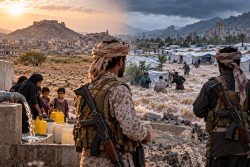
GENEVA, Switzerland — Armed groups in Yemen’s Marib and Taiz governorates have taken on environmental duties once carried out by civilian authorities, a Geneva-registered research organisation said.
The finding appears in a study listed by the Centre on Armed Groups, which describes itself as an independent research body registered in Switzerland.
The centre lists the study on its own website under the title “How armed groups shape climate adaptation efforts in Yemen”, dated 25 October and credited to Ashley Jackson.
The Yemeni news site Yemen Online carried an account of it the same day, giving the release date as 26 October. Yemen Herald found no reporting on the study beyond the centre’s own listing and that account, and no independent assessment of its findings.
The study examines how armed actors in the two governorates have come to regulate water use, respond to floods and shield communities from natural disasters. Civilian administrations handled that work before the war.
The centre published a comparable study on al-Shabaab and climate adaptation in Somalia on 1 October, also credited to Jackson. It published separate work in July on checkpoints along a Yemeni road corridor and how they extract money and control movement.
“Climate adaptation remains possible in Yemen even without a functioning central government,” the centre’s head of policy said in remarks carried by Yemen Online.
The report does not read the trend as progress. It warns that environmental work by armed groups often serves to consolidate authority and legitimacy rather than to reflect a commitment to climate adaptation.
It draws a distinction between the areas it studied.
Groups aligned with the internationally recognised government generally allow domestic and international organisations to carry out adaptation work, according to the report.
In Houthi-controlled areas, it says, distrust of international engagement has sharply restricted those efforts.
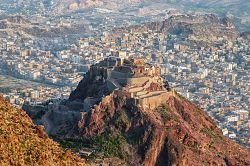
In Taiz, the report identifies water scarcity and flooding as the most serious climate threats.
Houthi forces control key roads in and north of Taiz city and have at times imposed full or partial blockades, the report says. Those blockades have drawn accusations that water has been used as a weapon of war.
Local authorities in the governorate have restricted the irrigation of qat with drinking water and curbed private well drilling, the report says. Wells have been brought under the General Water Corporation, and new drilling requires official authorisation.
Some armed groups monitor water distribution and block sales on the black market at inflated prices, it says.
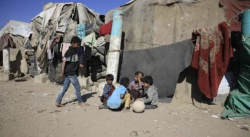
In Marib, the report describes displaced families exposed to floods and sandstorms, partly because camps were built on flood-prone ground.
Camps there have expanded over twelve years, it says, with some settlements laid out along floodwater routes. One respondent described a storm in 2024 that destroyed tents housing displaced families.
Armed groups in the governorate have formed civil defence and rescue teams. They have restricted building in flood-risk zones and imposed fines or imprisonment for unauthorised well drilling.
They also support mine clearance and run environmental awareness work through social media, signage and community meetings, according to the report.
Yemen has lost 60 percent of its per capita water availability since 1990, the centre says.
Yemen is among the countries most vulnerable to climate change, according to the report, which says the conflict has damaged water infrastructure, cut agricultural output and displaced large numbers of people.
The report criticises international climate finance for being state-centred. That approach excludes communities living beyond government control, it says.
It calls for funding mechanisms that reach conflict-affected populations while managing the security, operational and reputational risks of dealing with armed groups.
Its conclusion is qualified. Adaptation is achievable under hybrid governance, the report says, but it remains fragile and vulnerable to military developments.
Both governorates named in the study are under military pressure. Houthi offensives reached the Taiz and Marib fronts after the collapse of the latest truce in July, the report says.
Houthi forces advanced in the Taiz countryside in the first week of October and closed the main road linking Taiz city to Aden, the interim capital.
The UN Office for the Coordination of Humanitarian Affairs said on 24 October that more than 800,000 people in Taiz had been cut off from aid for 20 days. Jens Laerke, an OCHA spokesperson, gave the figure.
Water production in Taiz has fallen by about half because roads are closed and diesel for delivery trucks is scarce, Laerke said. Most residents rely on trucked water, and its cost has roughly tripled.
The World Health Organization said on 22 October that 42 health facilities in the governorate face severe shortages. Christian Lindmeier, a WHO spokesperson, gave that account.
The UN humanitarian needs and response plan published in March put more than 22 million people in Yemen in need of assistance and 18.3 million as acutely food insecure. It counted 5.2 million people displaced inside the country and sought 2.16 billion dollars to reach 12 million of them.
Marib has absorbed large numbers of people displaced from other governorates over the course of the war.
Yemen has been divided between rival administrations since the Houthis took Sanaa in 2014. The internationally recognised government is seated in Aden.
About the Author