Yemen’s planning minister and UNHCR review refugee returns and aid for displaced families
 Yemen Herald News
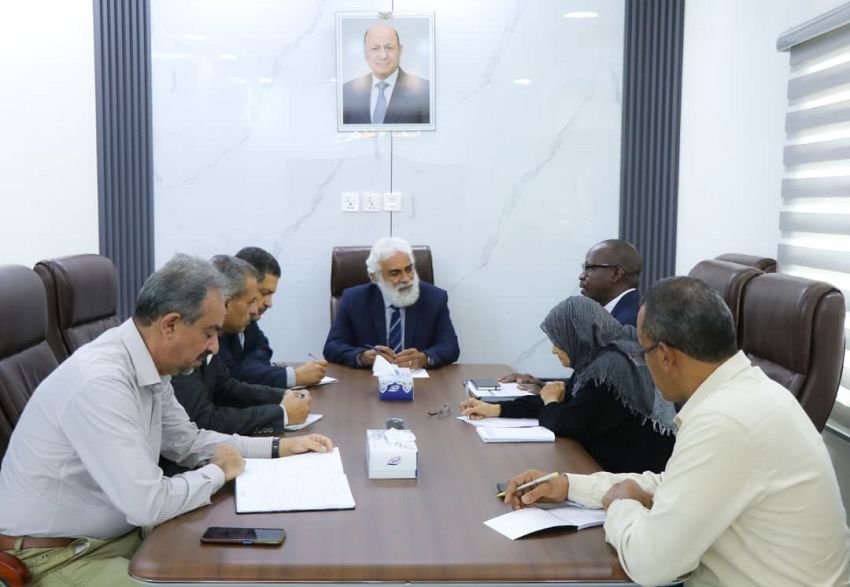
ADEN, Yemen — Yemen’s planning minister has discussed refugee returns and aid for displaced families with the acting head of UNHCR’s programme in the country, the state news agency Saba said.
Mohammed al-Faqmi, the minister of planning and international cooperation, met Moses Kebrunu, acting programme manager for the UN refugee agency in Yemen. Saba carried the report on October 25.
The account of the meeting rests on Saba alone. Yemen Herald found no independent confirmation of it.
The two discussed strengthening cooperation on humanitarian and development projects for refugees and for Yemenis displaced inside the country, the agency said.
They reviewed the agency’s voluntary repatriation project for refugees from the Horn of Africa, according to Saba.
UNHCR calls the scheme its assisted spontaneous return programme.
The meeting also covered ongoing UNHCR interventions, adult education programmes, and food assistance for people displaced from Yemen’s western coast and Taiz governorate.
Al-Faqmi praised the agency’s work and said relief in displacement camps across the country needed to be expanded, Saba reported.
He said the ministry would facilitate UNHCR’s operations and strengthen coordination with it.
UNHCR restated its commitment to work with the Yemeni government on programmes for refugees and displaced people, the agency said.
Saba gave no figures, no timetable and no funding commitments.
Al-Faqmi was appointed in a republican decree issued in Aden on August 25. The decree, numbered 65 of 2026, was issued on the prime minister’s proposal and with the approval of the Presidential Leadership Council.
He has held a series of meetings with UN agencies since taking office.
On September 23 in Aden he met Al-Khader Daloum, the World Food Programme’s country director, Akil Ayar, UNICEF’s acting representative in Yemen, and Dina Zorba, the representative of UN Women, Saba reported at the time.
Those talks covered funding for humanitarian and development work, food security and livelihoods, and needs in displacement camps including food and cash support.
Al-Faqmi called then for closer coordination between the government and its partners on the needs of displaced people.
The UNICEF discussion covered expanding the agency’s multi-sectoral programmes and access to essential services. The UN Women talks dealt with displaced women and girls and their place in development and humanitarian plans.
Returns to the Horn of Africa have continued through Aden in recent months. The Saudi aid agency KSrelief flew 140 Somali refugees home from Aden International Airport with UNHCR, Arab News reported on October 22.
KSrelief sent 154 Somali refugees back by the same route in August.
More than 41,000 Somali refugees and asylum seekers were in Yemen as of August, according to UNHCR figures cited in that report.
Displacement inside Yemen has risen since fighting spread in August. UNHCR said on October 20 that more than 250,000 people had been displaced within the country since then.
The UN Office for the Coordination of Humanitarian Affairs put the figure at almost 260,000 in a report released on October 21. About half of those people took refuge in Taiz.
Aid agencies have reached more than 174,000 displaced people since August with food, hygiene kits and emergency cash, that report said.
That amounted to nearly six in 10 displaced households, the report said.
Shelter was the need most often reported by newly displaced families, followed by food and cash.
Taiz itself has been cut off for about three weeks. The World Food Programme said at a UN briefing in Geneva on October 23 that more than 800,000 people in the city had been cut off from assistance, about 600,000 of them dependent on aid.
Volker Türk, the UN High Commissioner for Human Rights, said on October 20 that he was alarmed at the encirclement of Taiz by what he called the de facto authorities.
Türk said the closure of the only supply route linking Taiz to Aden was placing civilians at grave risk. The Houthis deny imposing a siege.
Türk renewed calls for the de facto authorities to release detained United Nations and non-governmental organisation staff.
He called for relief to be allowed into the city immediately.
He said civilians who wished to leave the city should be allowed to do so.
He also asked the authorities there to disclose the whereabouts of people held incommunicado for prolonged periods.
He urged all parties to avoid using explosive weapons with wide-area effects in populated areas.
UNHCR has declared a Level 1 emergency covering Yemen, Djibouti and Somalia. More than 3,700 people had fled to Djibouti and elsewhere in Africa by late September.
The agency said at that point its Yemen operations for 2026 were 18 percent funded.
The agency said in September that it was planning for more than 10,000 arrivals in Djibouti.
It put the number displaced inside Yemen at more than 130,000 at that stage, and said the total could pass 230,000.
The 2026 response plan seeks 2.16 billion dollars to reach 12 million people.
It estimates that more than 2.2 million children under five are acutely malnourished, 516,157 of them severely.
More than 5.2 million Yemenis were already displaced inside the country before the latest escalation.
Yemen’s humanitarian response plan for 2026 estimates that more than 22 million people need assistance. It puts the number who are acutely food insecure at 18.3 million.
Saba did not report whether the agency raised access to Taiz during the meeting.
Saba did not say whether a further meeting had been scheduled.
About the Author