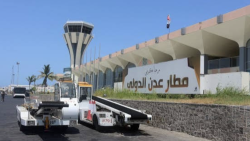
Airstrikes hit Mokha and Dhubab districts near Bab al-Mandab, residents and Houthi media say
 Yemen Herald News
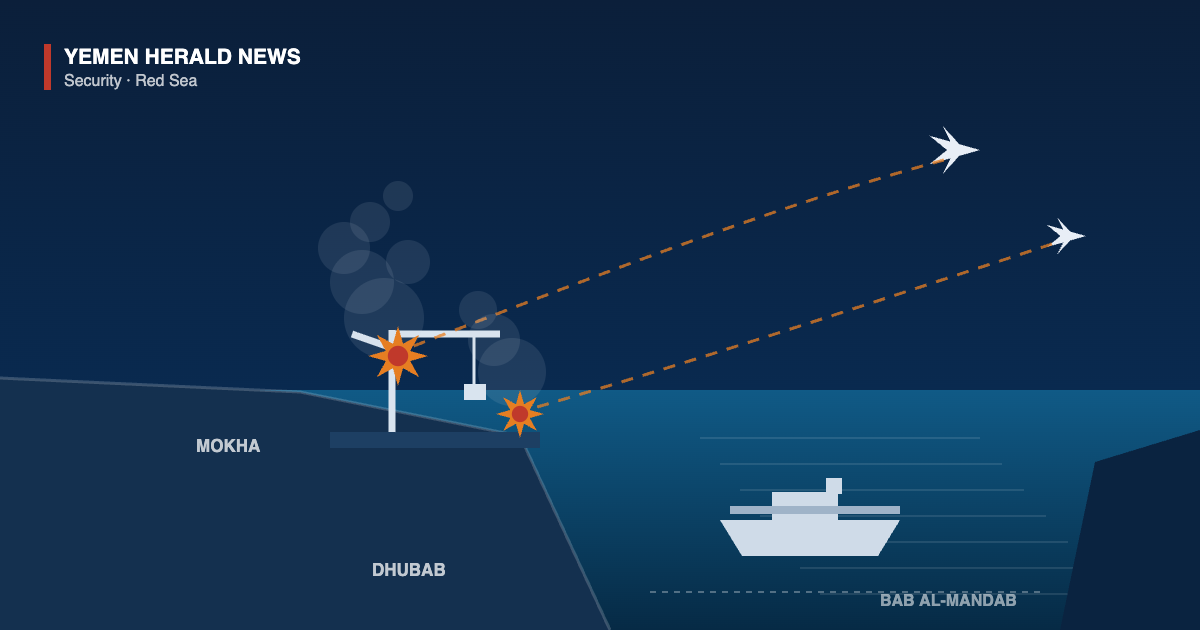
MOKHA, Yemen — Airstrikes struck the Red Sea port of Mokha and the neighbouring Dhubab district early Tuesday, a resident and Houthi-run media said.
A woman in Mokha said she heard two explosions at about 4 a.m. One was near the port. The other was farther inland. She spoke to The Associated Press on condition of anonymity.
Al-Masirah, the Houthi-controlled broadcaster, said government aircraft carried out the raids. It placed them in Mokha and in Dhubab, the district that fronts the Bab al-Mandab Strait.
Houthi media said the strikes were intensive and had continued since the morning. They gave no casualty figures and issued no damage assessment.
The Yemeni military said on X that its forces had launched airstrikes on Houthi positions. It did not name the districts it had hit.
The Associated Press said it could not independently verify the Houthi account of the raids. No party has reported deaths or injuries in either district.
Dhubab sits at Yemen’s south-western tip, where the Red Sea narrows into the Bab al-Mandab. Mokha lies along the coast to the north.
Both districts belong to Taiz governorate. Both have changed hands this year.
The strait they overlook carries a large share of the shipping that moves between the Red Sea and the Gulf of Aden.
The raids came as fighting around Taiz city intensified.
The Houthis have largely encircled the city for weeks and cut supply routes from government-held areas, according to The Associated Press. Government forces have fought back.
Nabil Shamsan, the governor of Taiz, said the city is encircled on all four sides. He said residents had lost access to about 3 million litres of water from wells in Wadi al-Dhubab, which he said Houthi forces now control.
The Associated Press said it could not verify the governor’s account.
Eshraq al-Maqtari, legal affairs minister in the internationally recognised government, said more than 2,000 projectiles and explosive devices fired by the Houthis had struck districts of Taiz city in recent days.
She called for measures to cut off the group’s weapons supplies and funding.
Government officials asked other states to help protect civilians and reopen the roads into the city.
Separately, the Houthi-run health ministry said a strike on a petrol station in Taiz late Monday killed two people and wounded several others.
Anees al-Asbahi, a spokesperson for that ministry, blamed government forces. The Associated Press said it could not verify the account, and the Yemeni military did not address the strike in its own statement.
Taiz has become one of the war’s main battlefronts in recent weeks. The city has taken in about half of Yemen’s displaced population, according to The Associated Press.
Photographs taken near Aden on Oct. 25 showed people displaced by the Taiz fighting in tent camps and at food distribution points.
The fighting widened beyond Yemen this week. Explosions were heard over Riyadh on Tuesday.
Saudi authorities said they destroyed two ballistic missiles fired by the Houthis from Yemen, and three more aimed at the kingdom’s eastern region.
Saudi civil defence said shrapnel from the intercepted missiles fell on Riyadh, damaging a building, a construction site and a vehicle. It later announced alerts in Jeddah and Yanbu.
Brig. Gen. Yahya Saree, the Houthi military spokesperson, said a missile had hit the Saudi defence ministry headquarters in Riyadh. The Associated Press said it could not verify the claim.
The group also said a ballistic missile had struck the Ras Tanura refinery in Saudi Arabia’s east. Saudi Arabia did not comment on that claim.
The two bombed districts changed hands twice in as many months. The Houthis took the Mokha area on Sept. 10 and had reached the Bab al-Mandab and nearby islands by Sept. 11, according to FDD’s Long War Journal, which tracks the conflict.
Rashad al-Alimi, chairman of the Presidential Leadership Council, announced a counteroffensive on Oct. 4.
Col. Majid al-Nuzaili, a spokesperson for the Yemeni armed forces, said the next day that the Southern Giants Brigades and National Shield Forces held the Bab al-Mandab. The Southern Giants Brigades said it controlled Dhubab airport.
The armed forces also claimed Mokha on Oct. 5. Mohammad al-Basha, a Yemen analyst, said at the time that government-aligned forces did not yet hold the city.
The brigades said on Oct. 12 that they had cut the main road linking Mokha with the Bab al-Mandab, Al Jazeera reported. Abd al-Rahman Abu Zaraa al-Muharrami commands the force and sits on the Presidential Leadership Council.
Maj. Gen. Turki al-Maliki, the Saudi-led coalition spokesperson, said the coalition gave full operational support to the Yemeni armed forces during that operation.
The United Nations humanitarian plan for Yemen, issued in March, put more than 22 million people in need of assistance.
It recorded 18.3 million people as acutely food insecure, and counted more than 2.2 million children under five as acutely malnourished, 516,157 of them severely.
The plan recorded 5.2 million internally displaced people. It sought 2.16 billion dollars to reach 12 million of them.
Mokha’s port handles fuel and aid shipments for the western coast.
Houthi-run media reported the last strikes on the port before Tuesday on Saturday.
About the Author