Aden governor and UNICEF discuss water, schools and aid for displaced families
 Yemen Herald News
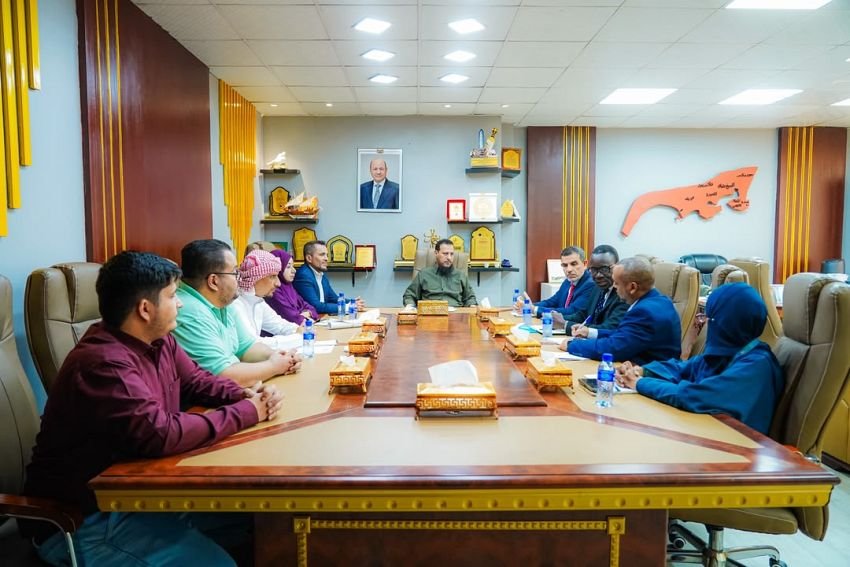
ADEN, Yemen — Aden’s governor and a senior UNICEF official discussed water services, child protection and schooling for displaced families in the city on Tuesday.
Abdulrahman Sheikh, who is also a minister of state, met the agency’s deputy representative in Yemen, named by the state news agency Saba as Obia Ashing.
The account of the meeting rests on that Saba report. Yemen Herald found no readout published by UNICEF, and no independent confirmation of the meeting has been published.
Yemen Herald could not check the spelling of the official’s name against a UNICEF source, and uses the agency’s rendering.
The two discussed humanitarian assistance for displaced people at al-Firdous 2 camp, Saba said.
They also discussed a planned Humanitarian City project, the agency reported.
Both sides agreed to participatory planning and continued coordination, and to approach donors on local priorities, according to Saba.
The agency said UNICEF praised the local authority’s work on children’s education and social integration.
Saba cited no figures, costs or targets for any of the programmes discussed. It did not say when work would begin, or which donors the two sides intended to approach.
Aden is the seat of Yemen’s internationally recognised government and the base for most of its ministries.
UNICEF is seeking 146.3 million dollars for its Yemen programme this year.
The agency aims to reach 5.2 million people, among them 3.5 million children, according to its 2026 humanitarian action appeal.
It counts 10.8 million children among the 19.7 million people it says need assistance in the country.
The appeal sets a target of 1 million people reached with sufficient water for drinking and domestic use, and 750,000 reached with sanitation services.
On schooling, it aims to get 172,138 children into formal or non-formal education, including early learning, and to give individual learning materials to 316,491 children.
It also plans training for 1,200 teachers. UNICEF describes the figures as provisional.
Fighting that began in early September has displaced more than 104,000 people, among them over 57,000 children, the agency said in a statement on Sept. 16.
That statement put the number of UNICEF-supported health facilities disrupted at 26.
It said 243 schools had closed or suspended learning, affecting more than 137,000 students.
Edouard Beigbeder, the agency’s regional director for the Middle East and North Africa, said families had been forced from their homes in two weeks.
At least nine children were killed and 12 injured after an attack on the road from Yemen’s western coast to Aden, according to the same statement. Three others were reported missing.
The agency said it was scaling up to reach up to 231,000 people, with water and sanitation support aimed at more than 200,000.
It said it had redeployed nine mobile health and nutrition teams.
About 3.2 million school-aged children in Yemen are out of school, according to the agency.
In a later statement issued from Aden on Oct. 20, UNICEF said the water systems it supports in Taiz serve an estimated 3 million people, at least 1.6 million of them children.
Akhil Iyer, its country representative in Yemen, set out those figures at a briefing in Geneva.
About 120,000 people have been displaced to Taiz since the September escalation, Iyer said, more than half of all those newly uprooted across the country.
The cost of trucked water has tripled since then, the agency said.
UNICEF screened more than 168,000 children in Taiz this year and found more than 52,000 acutely malnourished, close to one in three.
The World Health Organization reported that suspected cholera cases in Yemen tripled over three weeks, according to the agency.
The United Nations humanitarian needs and response plan for 2026, published in March, says more than 22 million people in Yemen need assistance.
It puts the number of acutely food insecure people at 18.3 million, and counts 5.2 million internally displaced people.
More than 2.2 million children under five are acutely malnourished, according to the plan, with 516,157 of those cases recorded as severe.
The plan seeks 2.16 billion dollars to reach 12 million of those in need.
UNICEF said it had pre-positioned nearly 8,000 cartons of ready-to-use therapeutic food.
The World Food Programme said on Oct. 2 that 74 percent of households in accessible government-held areas could not meet basic food needs, a record for the year.
About 10 million people live in those areas, according to the agency.
Matthew Hollingworth, its assistant executive director for programme operations, said the latest flare-up “threatens to be absolutely devastating” for food security.
The programme said it was scaling up to reach up to 1.5 million people, and that it needed 109 million dollars to do so.
Yemen imports about 90 percent of its food.
More than 3,700 people fleeing the fighting had reached Djibouti across the Bab al-Mandab strait by late September, according to the programme.
The International Organization for Migration has recorded more than 149,000 people displaced inside the country, many of them more than once.
The Green Climate Fund approved a 28 million dollar project this month to develop a climate and water early warning system in Yemen, Saba reported. Yemen Herald found no independent confirmation of the approval.
Saba did not say whether other local officials or agency staff attended Tuesday’s meeting.
About the Author