Saudi-led coalition says it downed three ballistic missiles and four Houthi drones
 Yemen Herald News
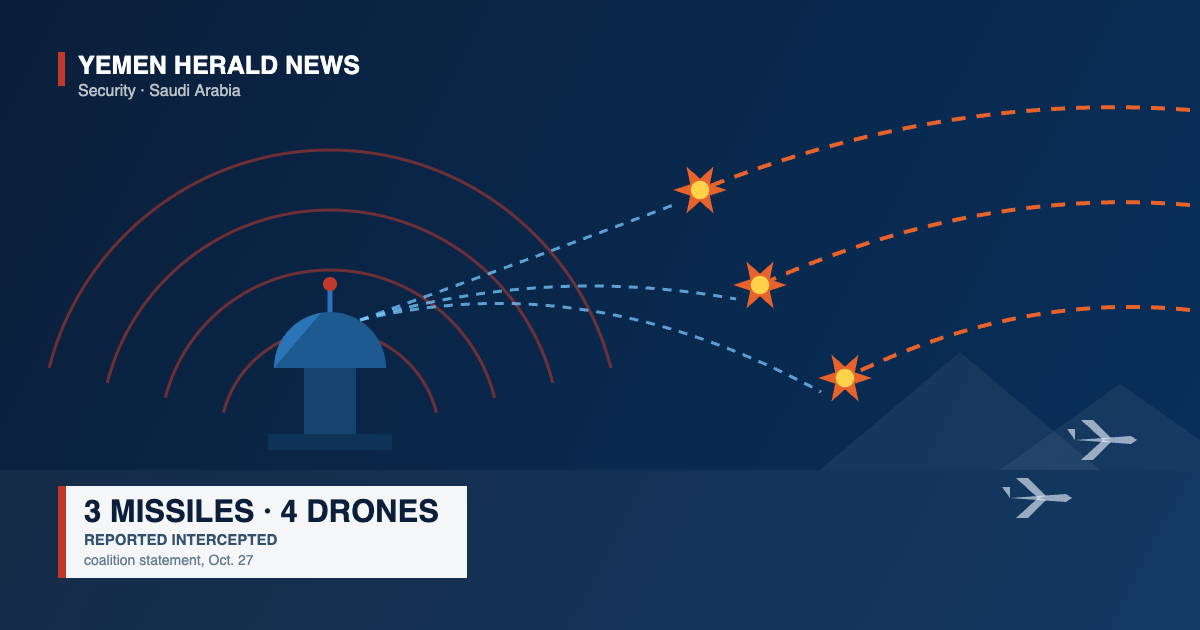
RIYADH, Saudi Arabia — The Saudi-led coalition said it intercepted three ballistic missiles and four drones launched by the Houthis toward Saudi Arabia on Tuesday.
Maj. Gen. Turki al-Maliki, the coalition’s spokesman, said the missiles were aimed at the Eastern Province. He said they caused no casualties.
The four drones were headed toward the kingdom’s southern regions, al-Maliki said.
The account of the interceptions rests on the coalition’s own statement. No independent confirmation has been published, and Yemen Herald found no second origin for it.
The Houthis did not immediately comment on the claim.
Saudi Arabia’s Civil Defence issued emergency alerts in the Eastern Province and in Al Kharj governorate before the interceptions. It lifted the alerts afterwards.
The agency told residents to stay away from crowds, not to film, and to call 911 in an emergency.
The coalition said it had intercepted and destroyed three further drones over the Riyadh and southern regions on Monday evening.
The Houthis said on Monday that they had struck Riyadh airport again and hit crude oil pumping stations in western and eastern Saudi Arabia. The coalition said those missiles were intercepted and destroyed.
Neither side’s account of Monday’s exchange has been independently verified.
Al-Maliki said on Monday that the coalition had destroyed five tunnels used to store Houthi ballistic missiles, four launchers and a missile depot. He said the operation was meant to cut the group’s supply lines between areas it controls.
He did not say where Tuesday’s drones were brought down, or whether debris fell in populated areas.
An attack on King Khalid International Airport in Riyadh on Oct. 10 killed at least 13 people and wounded more than 300.
The Saudi General Authority of Civil Aviation put the toll on the day of that attack at 12 dead and at least 309 wounded. It said those killed included four Saudi citizens, two Bangladeshis and one national each from the United States, Jordan, Palestine, Syria, Sudan and Egypt.
The head of the Houthi media office wrote on X afterwards that the group had shut down Riyadh international airport. The coalition described the attack as a war crime.
Saudi Arabia opened an investigation into how its air defences failed to stop that barrage, two regional officials told The Associated Press on condition of anonymity. One said the inquiry was also examining why the defences gave no earlier warning.
The missiles and drones covered more than 1,000 kilometres to reach Riyadh. An initial finding indicated the Houthis had fired drones first to clear a path for cruise and ballistic missiles, the officials said.
The Houthis field ballistic missiles with warheads that can change direction in flight, which complicate Patriot interceptors and other Saudi systems, according to the account of those initial findings.
Riyadh airport was still shut two days after the attack. Workers in the capital’s financial district were told to work from home.
Saudi state media said at the time that the military was responding to a fresh drone and cruise missile attack. It gave no details.
“Our response must be equally serious,” Saudi Energy Minister Prince Abdul Aziz bin Salman told the World Petroleum Energy Congress.
Esmail Baghaei, the Iranian foreign ministry spokesman, said Tehran was “severely concerned” about developments on the Arabian Peninsula and offered to use its good offices. Iranian Foreign Minister Abbas Araghchi and Saudi Foreign Minister Prince Faisal bin Farhan spoke by telephone that weekend.
Anwar Gargash, diplomatic adviser to the UAE’s rulers, called for joint Gulf action against attacks by Iran and allied groups.
President Donald Trump said on Oct. 10 that he was considering American strikes on the Houthis. The United States has shared intelligence, identified targets and helped plan the Saudi-led offensive without striking the group directly.
Senior officials from Saudi Arabia, Turkiye and Pakistan met Iranian counterparts in Tehran this week.
Saudi Arabia said the meeting was meant to open channels and prevent a return to military escalation. The four governments said in a joint statement that they would continue the dialogue.
Egypt’s Parliament voted on Monday to authorise the Egyptian military to help defend Saudi Arabia.
The regional war began in February, when the United States and Israel launched strikes on Iran. Pakistan and Qatar mediated an interim agreement between Washington and Tehran in June. Fighting resumed after it.
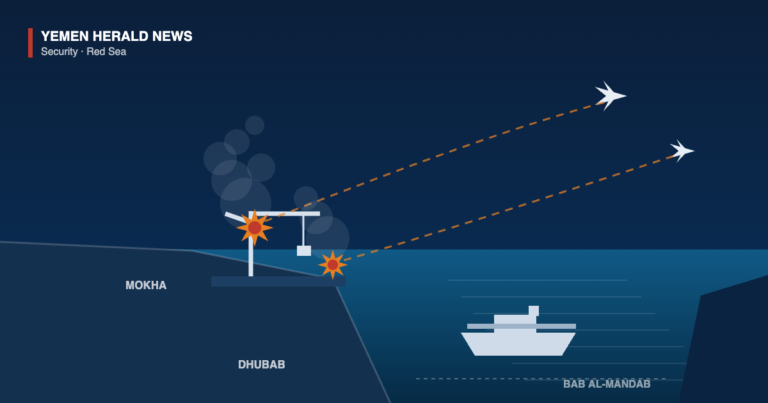
Yemen was drawn back into the conflict. The Houthis took areas along the Bab al-Mandab Strait and on Yemen’s Red Sea coast from Saudi-backed government forces last month, and Saudi Arabia has increased its strikes on the group since then.
Shipping through the Strait of Hormuz has been restricted since the fighting resumed. Oil and petrol prices have risen.
The coalition has fought the Houthis in Yemen since March 2015. The group holds Sanaa and much of the north, while the internationally recognised government is based in Aden.
Yemen’s humanitarian plan for 2026 recorded more than 22 million people in need of assistance and 18.3 million as acutely food insecure. It counted 5.2 million people displaced inside the country.
The plan recorded more than 2.2 million children under five as acutely malnourished, 516,157 of them severely. It sought 2.16 billion dollars to reach 12 million people.
Al-Maliki gave no figure for how many missiles or drones the coalition says it has intercepted this month.
About the Author