Yemen’s prime minister inspects electricity ministry and al-Mansoura power station in Aden
 Yemen Herald News
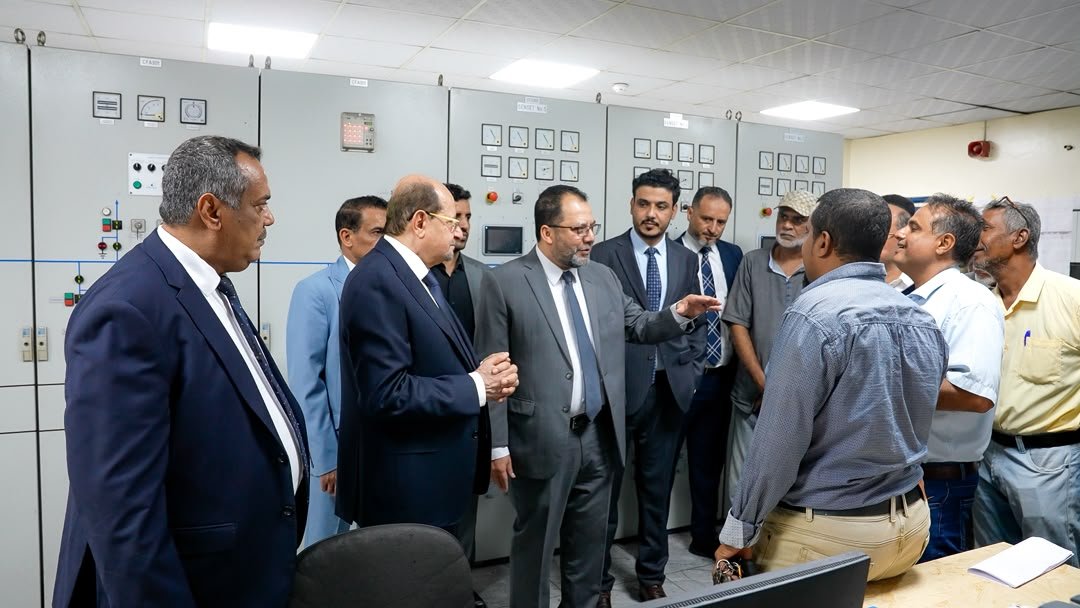
ADEN, Yemen — Yemen’s prime minister inspected the Ministry of Electricity and Energy in Aden on Tuesday and visited the al-Mansoura power station.
Prime Minister Shaya al-Zindani met the ministry’s leadership at its headquarters in the temporary capital, the state news agency Saba reported.
The meeting dealt with efforts to manage the problems facing the electricity network.
Minister of Electricity and Energy Adnan al-Kaf briefed the prime minister on the ministry’s plans and priorities, Saba said.
The agency said the briefing covered technical, managerial and financing problems the ministry wants addressed.
Al-Zindani said the government was seeking to improve the electricity service and was committed to finding lasting solutions.
“It is time to move from temporary solutions to the sustainable ones,” he said, according to Saba.
The prime minister and the minister then went to the al-Mansoura station. Saba said the visit was to establish the plant’s generating capacity and what it needs to run more efficiently.
Al-Zindani said the government had allocated the financial credits needed to maintain and upgrade generating facilities, Yemen Monitor reported the same day.
That outlet said his directives covered generation and transformer stations as well as transmission and distribution networks, without naming sites beyond al-Mansoura.
It said he referred to expanding renewable energy and moving to lower-cost fuels. Neither he nor the ministry gave figures for either.
The account of the visit rests on Saba, the government’s own news agency, and on Yemen Monitor’s report of the same statements. No independent confirmation has been published.
Saba gave no figures for generating capacity, fuel stocks, funding or maintenance costs.
Aden has run short of power for years. The city draws on ageing thermal plants and on fuel paid for largely through Saudi grants.
Yemen signed a $150 million Saudi fuel grant in May 2026 covering diesel and mazut for more than 70 power stations.
Al-Kaf signed that agreement with the Saudi ambassador, Mohammed bin Saeed Al Jaber, with al-Zindani present, Sheba Intelligence reported.
The same account listed earlier Saudi fuel support of $180 million in 2018, $422 million in 2021 and $200 million in 2022.
It put a January 2026 package at $81.2 million, together with 339 million litres of diesel and mazut.
The same account said the interruption of Yemen’s oil exports since late 2022 had weakened the government’s ability to finance fuel imports. It gave no figure for that effect.
Al-Zindani was appointed prime minister under Republican Decree No. 3 of 2026, issued on Feb. 6 by the chairman of the Presidential Leadership Council, Rashad al-Alimi.
That decree formed the government and named its members. Al-Kaf was appointed to the electricity portfolio in it.
South24 reported in June that Aden’s generating capacity did not exceed 250 megawatts against demand above 600 megawatts. On those figures the city meets about 35 percent of its need.
The same report put outages in Aden at around 16 hours a day. It said Hadramout was running two hours of supply for every four hours without.
Official data cited in that report put government spending on electricity at about $1.2 billion a year, or roughly $100 million a month.
It put revenues covering that spending at about $50 million a month.
Al-Kaf has also revived a proposal to link Yemen’s grid to Saudi Arabia’s. He said the ministry had resubmitted the project to Saudi authorities after years of suspension.
The proposal dates to 2017, when the ministry signed a memorandum of understanding with the Gulf Cooperation Council Interconnection Authority in Riyadh.
Al-Kaf put the first phase’s potential capacity at 500 to 1,000 megawatts, covering Hadramout, Shabwa and al-Mahra.
He said linking those three governorates would free fuel now burned there for use in Aden, and would improve supply across seven governorates.
Global South Utilities, a company based in the United Arab Emirates, handed over a 120-megawatt solar plant at Aden and a 53-megawatt plant in Shabwa to Yemen’s Public Electricity Corporation in January.
Al-Zindani also held the foreign affairs portfolio at that point.
Afrah al-Zouba was appointed minister of foreign affairs and expatriates on July 23 in a limited reshuffle, on al-Zindani’s proposal.
Aden has served as the seat of the internationally recognised government since it left Sanaa.
Power cuts in Aden have reached into hospital wards. Al Jazeera published photographs in October of Yemeni hospitals working through outages.
Xinhua reported in October 2025 that a power failure had halted supply across Aden after fuel ran out.
Cuts in Aden reached about 20 hours a day in June as temperatures rose, The New Arab reported. Residents held night protests in al-Mualla, Sirah and Crater.
The al-Hiswa power station went out of service during that period. Authorities attributed the failure to a strike on the network.
The electricity ministry said at the time that the May grant would keep plants running to the end of 2026 and would cut outage time.
Mohammed Jamal al-Shuaibi, an economist at the University of Aden, said the summer breakdown was what he had warned would follow any disruption to fuel supply.
Abdul Ghani Jaghman, a geologist, said state power stations were ageing and near the end of their working lives. He said solar power had so far made little difference.
The ministry has not published a schedule for the maintenance al-Zindani referred to.
Saba did not say how long the prime minister spent at the station.
About the Author


 Adel Haddad