Guantanamo jury selection in USS Cole bombing trial seats one juror in three days
 Yemen Herald News
GUANTANAMO BAY, Cuba — Jury selection in the trial of the man accused of planning the USS Cole bombing has seated one juror in three days at Guantanamo Bay.
An Air Force colonel was accepted for the panel by Tuesday night, the legal outlet Just Security reported.
Three other officers were excused. One left for a family emergency, and two were released by agreement between prosecution and defence lawyers without individual questioning.
That left 14 potential jurors on the base at the close of court on Wednesday.
Col. Matthew Fitzgerald, the Army judge, was weighing whether to accept an Air Force major who was questioned for much of Wednesday. Defence lawyers opposed him and prosecutors wanted him.
Thirteen officers from all five services are still to be questioned individually.
Selection began on Monday afternoon, Ronald Flesvig, a spokesperson for the Office of Military Commissions, told Agence France-Presse.
Abd al-Rahim al-Nashiri, a Saudi prisoner, is 61. He pleaded not guilty at the start of proceedings.
He was charged in April 2011 with offences including murder in violation of the law of war and terrorism.
Several of the charges can carry the death penalty, according to AFP.
It is the first capital case tried by the military commission at Guantanamo Bay, Just Security reported.
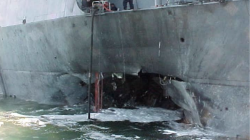
Seventeen US sailors were killed when two attackers came alongside the destroyer in a skiff laden with explosives on Oct. 12, 2000.
The warship was on a refuelling stop in Aden harbour at the time.
Thirty-seven other sailors on the 312-member crew were injured.
Fitzgerald said his goal was to pick 20 members, from whom a panel of 12 jurors and six alternates would be drawn.
Once 20 are chosen, each side may excuse one member without having to justify it.
The 18 officers questioned this week are the first of up to 200 who could be flown in from US bases around the world.
The next group of 18 is now due on the weekend of Nov. 14, after an earlier timetable slipped.
The court recesses on Wednesday next week for Veterans Day, leaving four days for selection that week.
Just Security reported that selection is likely to stretch past Thanksgiving.
Fitzgerald told the first candidates the trial could last four to six months or longer, with recesses for the Thanksgiving and Christmas holidays.
Ten of the first group signalled to the judge that they would have difficulty with the time commitment.
One naval officer said he was morally or religiously opposed to the death penalty.
Allison Miller, al-Nashiri’s capital defender, questioned officers on Wednesday about their attitudes to capital punishment and what they knew of the case.
Navy Cmdr. Clayton Trivett Jr. is the lead prosecutor. Navy Cmdr. Brandon Sargent raised objections during Wednesday’s questioning, which Casey Secor answered for the defence.
Richard Burns, the chief of the Justice Department’s capital case section, watched by video from a courtroom annex in Crystal City, Virginia.
Proceedings opened late on Monday after Miller objected to several materials, including the judge’s script.
The dispute turned on whether a defendant is presumed innocent until or unless guilt is established beyond a reasonable doubt.
Fitzgerald agreed to use the word unless, then read the old wording to the panel by mistake and said he would cure the error.
Miller told the court she was not ready.
“I am not prepared. I am stipulating that I will be ineffective,” she said.
She described herself as at a crossroads and said she planned to consult an ethics expert through the Florida Bar before opening arguments.
Selection follows a ruling on Oct. 30 that al-Nashiri is competent to stand trial.
“The commission finds the defense failed to overcome the presumption of competence,” Fitzgerald wrote in a two-page interim ruling.
The court heard evidence and arguments on the question from Oct. 19 to Oct. 26.
Defence lawyers had told the court that two Pentagon-funded civilian experts found al-Nashiri unfit, citing his treatment in CIA custody.
Maj. Anthony Ralston, an Army psychiatrist, agreed with earlier diagnoses of depression and post-traumatic stress disorder but found him able to understand the proceedings and assist his lawyers.
Al-Nashiri was captured in Dubai in 2002, AFP reported. He was held in secret CIA prisons for about four years before being transferred to Guantanamo Bay.
A US Senate report published in 2014 found he was subjected to what it called enhanced interrogation techniques on at least four occasions.
The report described a session in December 2002 in which a CIA officer blindfolded him, held a pistol near his head and operated a cordless drill close to his body.
A military judge ruled in August 2023 that a confession he made was tainted by years of abuse by the CIA and the FBI and could not be used as evidence.
AFP describes al-Nashiri as having been considered close to Osama bin Laden, the late al-Qaeda leader.
Al-Nashiri wore a grey sports jacket over a white shirt and trousers in court.
His defence team comprises two military lawyers and three civilian lawyers with Florida capital defence experience who were hired by the Pentagon.
The destroyer was carried back to the United States on a Norwegian ship for repairs.
Aden lies on Yemen’s southern coast at the entrance to the Red Sea.
About the Author


 Adel Haddad