Security Council hears annual briefing on Yemen sanctions committee days before renewal vote
 Yemen Herald News
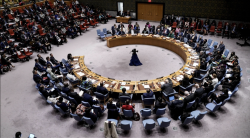
NEW YORK, United States — The UN Security Council has received its annual briefing on the committee that oversees Yemen sanctions, nine days before the measures are due to expire.
The briefing was delivered on Thursday night in a closed session, according to the account published of the meeting.
Latvia’s representative presented the committee’s periodic report on behalf of its chair. Latvia holds the Council’s rotating presidency for November.
The report covered the committee’s work between Nov. 6, 2025 and Nov. 5, 2026.
Yemen Herald could not obtain an independent account of the session. It was closed to reporters, and no record of the discussion has been published beyond the readout of the committee’s report.
The committee held three informal consultations during the year, on May 8, Aug. 31 and Oct. 22, and carried out the rest of its work through written procedures.
Written procedures allow the committee to take decisions without meeting in person.
At the May meeting it received a presentation from the panel of experts on its midterm update and reviewed two recommendations in that report. It then agreed follow-up measures on both.
At the August consultation the committee examined two special reports the panel had prepared under Resolution 2801.
The first dealt with dual-use materials and precursor chemicals. The second addressed information-sharing practices and the capacity of flag states to monitor vessels registered to them and meet their international obligations.
Members reviewed several recommendations in the two reports and agreed to keep considering what action to take.
At the October meeting the committee was briefed on the panel’s final report and discussed eight recommendations in it. Follow-up on those remains under consideration.
The Council was told the Yemen sanctions list currently holds 10 individuals and one entity.
The committee was established under Resolution 2140, adopted in 2014. It oversees the asset freeze and travel ban imposed on those listed, and monitors compliance through the panel of experts.
Resolution 2140 created the Yemen sanctions regime in 2014, during the political transition that followed the uprising of 2011.
The asset freeze requires member states to freeze funds held by those on the list. The travel ban requires them to stop listed individuals entering or passing through their territory.
The Council renewed the measures a year ago in Resolution 2801, adopted on Nov. 14, 2025 by 13 votes to none, with two abstentions.
The resolution was adopted under Chapter VII of the UN Charter, at the Council’s 10044th meeting.
That text rolled the asset freeze and travel ban over until Nov. 14 this year, and extended the panel’s mandate until Dec. 15.
Panel members are appointed by the secretary-general in consultation with the committee.
It also reaffirmed provisions of Resolution 2216, adopted in 2015, which imposed a targeted arms embargo on named Houthi figures.
The Council said at the time that it intended to review the panel’s mandate and act on a further extension no later than Nov. 14.
Resolution 2801 set the deadlines the committee worked to during the year. It asked the panel to report by April 15 on dual-use components and precursor chemicals, including an assessment of their sale, supply or transfer to Yemen.
It asked for a second report by the same date on improving information sharing and flag state capacity, with the aim of preventing vessels suspected of carrying arms from reaching Yemen.
The resolution also required a midterm update to the committee by April 15 and a final report to the Council by Oct. 15.
Resolution 2801 encouraged capacity building for the Yemeni coast guard and called for action against the smuggling of weapons and weapons components by land and sea.
It allows the committee to grant exemptions from the measures case by case.
The panel’s most recent report cited in the resolution was issued in 2025.
The review comes as fighting in Yemen has intensified.
Houthi forces have advanced to within 80 kilometres of Aden, the Yemeni government’s temporary capital, Reuters reported on Nov. 2, citing four military sources. That is closer than at any point since the early months of the war that began in 2015.
The advance threatens positions on the main road linking Aden with Taiz, a city of about one million people.
Houthi units moved down the Red Sea coast from September and took territory near the Bab al-Mandab strait.
The escalation has broken a truce the United Nations brokered in 2022.
Tom Fletcher, the UN humanitarian affairs chief, said nearly 300,000 people have been displaced since August. He said food prices in Taiz have risen by at least 50 percent and water production in the city has halved.
“Open the roads and let them through,” Fletcher said. “Civilians cannot be held hostage by the fighting.”
Fletcher also said 70 UN staff members remain in detention, and condemned the death in Houthi custody of a UN employee, Mohammad El Shami.
Houthi forces have attacked shipping in the Red Sea and the Gulf of Aden since late 2023, prompting naval deployments by the United States and the European Union.
The group has rejected the sanctions regime and describes the listings as politically motivated.
The panel of experts’ current mandate runs to Dec. 15.
About the Author


 Adel Haddad