Yemen presents third climate plan update at COP31 as full submission remains set for 2026
 Adel Haddad
ANTALYA, Turkey — Yemen’s water and environment minister presented the third update of the country’s national climate plan at COP31 on Nov. 11, Yemen’s state news agency said.
Tawfiq al-Sharjabi launched the document, known as NDC 3.0, at the Water for Climate Pavilion on the sidelines of the UN climate conference, according to the agency, Saba.
Saba said the launch was a joint event with UN-Habitat and that the agency’s executive director took part.
The agency rendered the UN official’s name as “Anna Rojasbach.” UN-Habitat lists its executive director and UN under-secretary-general as Anacláudia Rossbach.
Al-Sharjabi described the update as a framework placing climate action within Yemen’s economic recovery and reconstruction planning, Saba reported.
Yemen Herald found no independent account of the ceremony. The account of the launch itself rests on Saba, and no second origin for it has been published.
The Water for Climate Pavilion’s published schedule lists one Yemen session that Wednesday, from 10:30 to 12:00, organised by the UN Development Programme and titled “Financing Climate Resilience and Human Development in Crisis-Affected Yemen.” Its description does not mention an NDC launch.
The UNFCCC’s COP31 page for third-party press releases, covering 9 to 12 November, carries no Yemen entry.
A document titled “Yemen’s NDC 3.0 Vision” is hosted on the UNFCCC website and sets out what the update contains.
The Vision names the Ministry of Water and Environment, through its Climate Change Unit and the Environment Protection Authority, as the main coordinating body for the plan.
It sets a target of at least a 35 percent renewable energy share in total generation by 2035. A separate passage states an aim of a 50 percent share of renewables in total generation capacity, without giving a year.
The document carries no new economy-wide emissions reduction figure for the third update.
The only such percentage it records belongs to Yemen’s first intended contribution, filed in 2015: a cut of 14 percent below business-as-usual emissions by 2030, of which 1 percent was unconditional and 13 percent conditional on outside support.
That earlier submission used a baseline of 24 million tonnes of carbon dioxide equivalent for the year 2000, and projected 43.8 million tonnes by 2030 without action.
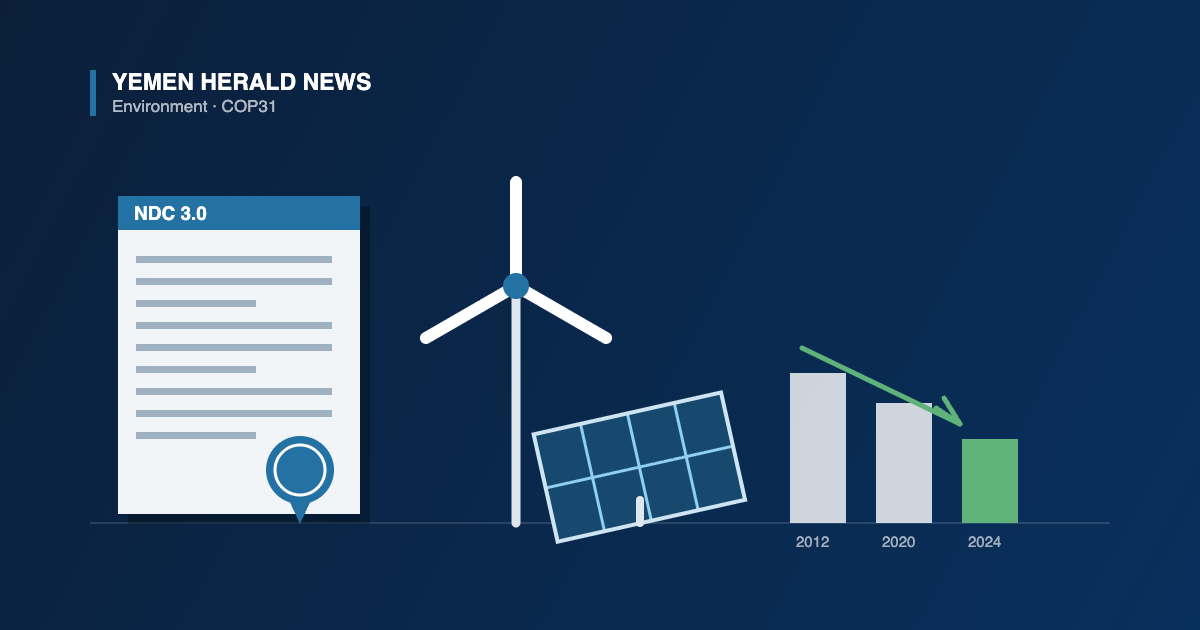
Yemen’s emissions fell from 36.7 million tonnes of carbon dioxide equivalent in 2012 to 25.3 million tonnes in 2024, the Vision states. It puts the country’s share of global emissions at about 0.1 percent.
The document records a rise in mean temperature of 0.42 degrees Celsius per decade between 1971 and 2020, and projects a further increase of up to 1.69 degrees by 2050 under a high-emissions scenario.
It projects sea level rise of 0.2 to 0.4 metres by 2050.
Renewable water available per person would fall from 65 cubic metres in 2020 to 54 cubic metres by 2050, according to the document.
The Vision estimates that unchecked climate impacts could cut Yemen’s gross domestic product by 3 to 4 percent a year by 2040, and that acting on them could instead yield an annual gain of 1.5 percent.
The document also describes an economy leaning on money sent home. It puts remittances at about 6 billion dollars a year and foreign reserves at 1.3 billion dollars.
It puts excess health costs at between 120 million and 156 million dollars for the period 2040 to 2050, and cumulative costs from malaria and dengue above 5 billion dollars. It gives a health burden exceeding 5.3 billion dollars by 2040.
It attaches no total cost or investment figure to the third update, saying only that Yemen will draw on domestic and international finance.
Mitigation under the plan covers energy, industry, transport, waste, and agriculture and livestock, the document says.
Its adaptation priorities are water, agriculture and food security and fisheries, coastal management and resilient infrastructure, climate-resilient health, ecosystems and biodiversity, loss and damage, and climate information and disaster risk management.
The Vision lists an adaptation-first approach among its five guiding principles, and names urban planning and land use as a crosscutting area.
The Vision is a roadmap rather than a final submission. It is written in the future tense and records no filing with the UNFCCC.
Its fifth section lists submission in 2026 as the step of finalising and submitting Yemen’s third NDC to the UNFCCC, and its executive summary says the completed NDC 3.0 is to be submitted by 2026.
Whether that full submission has been lodged is not stated by the document, by Saba, or by the UNFCCC pages reviewed.
Climate Change Laws of the World, a database run by the Grantham Research Institute at the London School of Economics and by Climate Policy Radar, catalogues the same document and records its year as 2025. The database says the file was downloaded from the UNFCCC website.
Parties to the Paris Agreement file nationally determined contributions setting out their emissions and adaptation commitments, and are expected to update them periodically.
Al-Sharjabi returned to the question of money the next day. He told a COP31 roundtable on the second decade of the Paris Agreement that access to international funding should be eased for countries that are vulnerable and affected by conflict, Saba reported.
He called the launch of the third update a step towards strengthening climate action, the agency said.
About the Author