Two Yemeni rights groups report Taiz civilian casualties over periods that do not match
 Adel Haddad
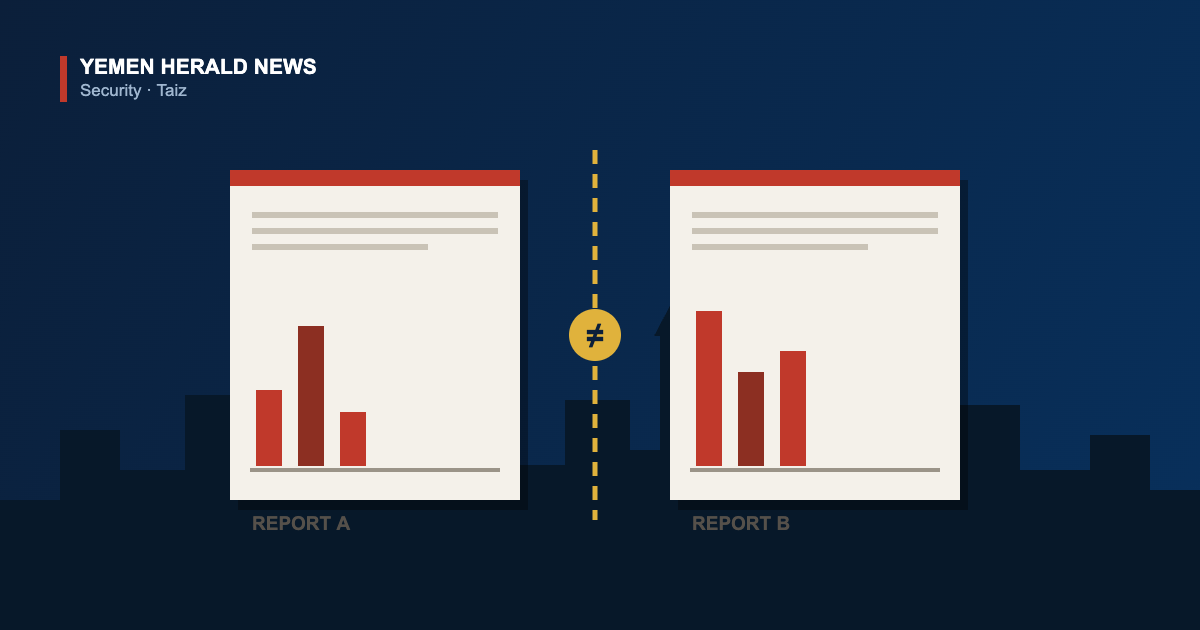
TAIZ, Yemen — Two Yemeni rights organizations have published separate counts of civilian casualties in Taiz, covering different periods and reaching totals that cannot be compared.
The Taiz Human Rights Center said it documented 51 civilians killed and 85 injured in the province between Nov. 1 and Nov. 12.
Thirteen children and three women were among the dead, according to the center. Thirty children and 16 women were among the injured.
The center put the combined figure at 136, including 43 children and 19 women. It released the report on Nov. 14.
The Yemeni Muwasat Organization for Rights and Freedoms gave a separate series. In a report released Nov. 16, it said it recorded 114 incidents against civilians in Taiz province between Sept. 1 and Nov. 14.
Muwasat said 85 civilians were killed in that period, including 36 children, 19 women and a fetus. It said 234 others were wounded, among them 91 children and 57 women.
One count covers 12 days. The other covers 75. Neither organization cites the other, and the two sets of figures cannot be added together.
The two groups also counted different things. The center’s report covers dead and wounded over 12 days in November. Muwasat’s covers 114 separate incidents across 10 weeks and sets abductions and executions alongside the casualty figures.
Muwasat said its numbers reflect only the cases its field teams were able to monitor, and that the real toll is higher.
The Taiz Human Rights Center attributed the November casualties to ballistic missiles, artillery shelling, sniper fire, gunfire and landmines, according to its statement as reported by the Anadolu agency.
It said three attacks accounted for much of the toll: on al-Najd market in al-Misrakh, on al-Athawer village in Hayfan, and on al-Hadara market in al-Wazi’iyah. Those three killed 43 civilians and wounded 30 between them, the center said.
By district, the center recorded 12 people killed and 34 injured in al-Misrakh, 30 killed and eight injured in al-Wazi’iyah, and three killed and 19 injured in Saber al-Mawadim.
The Houthis issued no immediate comment on the center’s figures, Anadolu reported. The group denies that it is besieging the city.
Muwasat reported five field executions, one of them of a child, and said five bodies were mutilated in al-Sarari. It said at least 52 civilians were abducted over the same period.
The organization said five people were killed in attacks affecting the health sector, including a girl, and that a doctor and several paramedics were wounded.
Local authorities said on Nov. 15 that about 246,000 people had been deprived of basic health services and that 12 hospitals were at risk, according to the same report.
Taysir al-Samie, a health information official in Taiz governorate, told the outlet Yemen Monitor that 80% of the city’s health care capacity had stopped operating.
Bashir al-Makhmari, a human rights activist, told Yemen Monitor that restrictions on the city had run for 11 years. Amer al-Maqbali, a resident, told the same outlet that the closures had added to residents’ difficulties.
The Taiz Human Rights Center also said 525 civilians were held at Houthi checkpoints on Nov. 14 alone.
United Nations agencies described conditions in the city in the weeks before either report appeared. Jens Laerke, a spokesperson for the UN Office for the Coordination of Humanitarian Affairs, told a briefing on Oct. 23 that Taiz had been isolated for 20 days since Oct. 3.
Citing World Food Programme figures, the office said more than 800,000 people had been cut off from food assistance. About 600,000 depend on aid, among them 200,000 women and children.
The UN humanitarian coordinator in Yemen said on Oct. 20 that the city’s health system was close to collapse, and that shortages of fuel and oxygen threatened hundreds of patients. He called on the Houthis to open safe corridors.
Human Rights Watch said on Oct. 29 that the Houthis had restricted the roads around Taiz since 2015, limiting civilian movement. In a statement on Oct. 26 it said the bombing of the Hija al-Abd road on Oct. 18 was deliberate and may amount to a war crime.
Amnesty International said on Oct. 22 that the Houthis had tightened restrictions around Taiz as clashes intensified, and called for the roads to be reopened.
UNICEF has said access restrictions were making it harder for children in the area to reach health care. It gave no figures.
None of those bodies published a casualty count for November. Yemen Herald found no international organization that has verified either tally, and neither group has published its method.
Both counting windows close before this week. The center’s ends Nov. 12 and Muwasat’s Nov. 14, so neither covers casualties reported in the province since.
Taiz city has a population of more than one million and has been divided by front lines since 2015.
Government forces launched an offensive they call Operation Dawn of Yemen on Oct. 5. Rashad al-Alimi, head of the Presidential Leadership Council, said its aims were to restore state institutions and retake Sanaa.
The Taiz Human Rights Center is based in the government-held part of the province. Muwasat gave Aden as the place of its report’s release.
About the Author