Al-Alimi and Djibouti’s President Deepen Yemen-Djibouti Ties
 Yemen Herald News
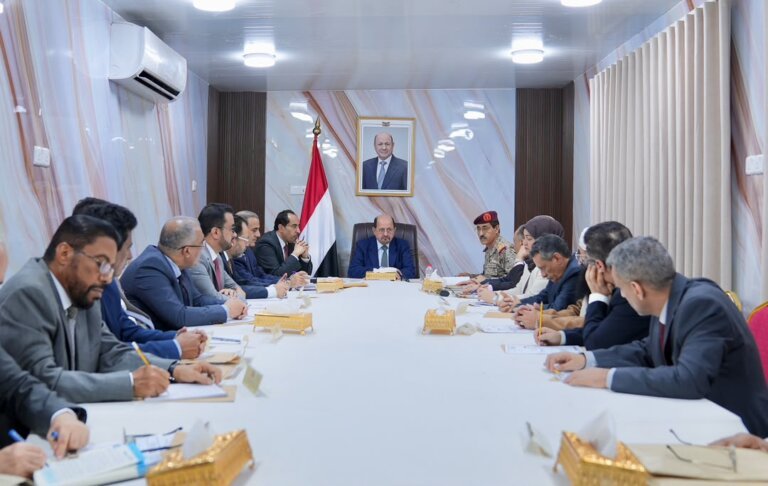
Yemen’s al-Alimi and Djibouti’s president have met to strengthen ties across the Red Sea, in talks that underscored the close relationship between the two neighbours and their shared interest in the stability of a strategically vital region. The meeting between the Chairman of Yemen’s Presidential Leadership Council, Dr. Rashad al-Alimi, and Djibouti’s President, Ismail Omar Guelleh, highlighted both the depth of the bilateral relationship and a broader effort to navigate the complexities of regional security and economic stability.
The Horn of Africa, of which Djibouti is part, has long been a region marked by instability, and Yemen’s conflict, across the water, has been closely bound up with the wider dynamics of the area. The two shores of the Bab al-Mandab strait, separated by a narrow stretch of sea, are connected by geography, history and a common stake in the security of the waters between them.
Djibouti, situated at the southern entrance to the Red Sea, occupies a position of considerable strategic importance. Its location has made it a significant player in regional diplomacy and a hub of international interest, and it has leveraged its position to foster dialogue and cooperation among neighbouring states, playing a role that belies its small size.
The historical ties between Yemen and Djibouti are significant, rooted in shared cultural and economic interests and in the long history of exchange across the Red Sea. These connections provide a foundation for the contemporary relationship, lending it a depth that extends beyond the immediate concerns of the present and reflecting centuries of interaction between the two shores.
Djibouti has also played a role as a host for various international mechanisms concerned with Yemen, reflecting its function as a venue for diplomacy related to the conflict. Its stability and its position have made it a convenient location for engagement on Yemeni affairs, adding to its significance in the diplomacy surrounding the country’s war.
The strategic waters that separate and connect the two countries are central to their shared concerns. The Bab al-Mandab strait is one of the world’s most important shipping corridors, and its security is a matter of common interest to Yemen and Djibouti alike, as well as to the wider international community, giving their cooperation a significance that extends beyond bilateral matters.
The meeting reflected an effort to navigate the security challenges facing the region. Instability in Yemen and in the Horn of Africa carries implications for both countries, and cooperation between them can contribute to addressing shared concerns and to fostering the stability on which their interests, and those of the wider region, depend.
Economic stability, another focus of the dialogue, reflects the shared interest of the two countries in the prosperity of the region. Trade and economic connections across the Red Sea have long linked Yemen and Djibouti, and cooperation on economic matters can support the interests of both, complementing their engagement on questions of security.
Djibouti’s role in hosting international engagement on Yemen reflects the broader involvement of regional states in the country’s affairs. The conflict has drawn in a range of regional and international actors, and Djibouti’s position and stability have allowed it to contribute to diplomacy and to the hosting of mechanisms related to the search for a resolution.
The relationship between the two countries also has a humanitarian dimension. Djibouti has received people fleeing the conflict in Yemen, hosting refugees who have crossed the water in search of safety, and this has added a further dimension to the ties between the two shores, reflecting the human consequences of the war.
The cultivation of relationships with neighbouring states forms part of Yemen’s broader diplomatic effort. Maintaining and strengthening ties with countries such as Djibouti helps the government sustain its regional relationships and advance its interests, and engagement at the level of heads of state and leadership underscores the importance attached to these ties.
The Horn of Africa’s significance in global affairs has grown in recent years, reflecting its strategic location and the interest of major powers in the region. The presence of international actors and the importance of the region’s waterways have heightened its prominence, and the stability of the area, including Yemen across the strait, is a matter of wide concern.
The dialogue between al-Alimi and Guelleh reflected the shared interest of two neighbours in navigating a complex and consequential regional environment. Their cooperation, grounded in geography, history and common concerns, represents an element of the broader web of relationships that shape the diplomacy and security of the Red Sea region.
The prospects for cooperation between the two countries will depend on the evolving situation in Yemen and in the region, as well as on the priorities of both governments. Diplomatic engagement of this kind lays a foundation for cooperation, though its fruits typically emerge over time as relationships are sustained and developed.
For now, the meeting between the Yemeni and Djiboutian leaders reaffirmed the close ties between the two countries and their shared interest in regional stability. As the Red Sea region continues to occupy a place of strategic importance, the relationship between its two shores remains significant, both for the two countries and for the broader dynamics of a critical region.
About the Author