Al-Arada Meets Defense Minister in Marib to Review Yemen’s Military Readiness
 Yemen Herald News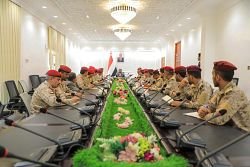
Sultan al-Arada, a member of Yemen’s Presidential Leadership Council, has held talks in Marib with Defense Minister Lieutenant General Taher al-Aqili to review the country’s military and security situation and the Ministry of Defense’s efforts to raise combat readiness. The meeting brought senior political and military figures together at a moment when the internationally recognised government is working to strengthen its armed forces and improve the institutional performance of a military stretched across multiple fronts after years of conflict.
Following the bilateral discussion, al-Arada chaired an expanded military meeting that gathered the leadership of the Ministry of Defense, several heads of military authorities, directors of military departments and a number of field commanders. The session reviewed developments on the ground, the level of implementation of military plans and programmes, and the principal challenges facing the armed forces, along with proposals for addressing them. The format reflected an effort to coordinate strategy between the political leadership and the military command rather than to settle a single operational matter.
Marib, where the meeting was held, carries particular significance in the wider conflict. It has been one of the most contested and strategically important governorates of the war, serving as a stronghold of the recognised government and the focus of repeated offensives in recent years. Convening senior leadership there carries symbolic weight, signalling the government’s intention to project authority and a measure of stability in a region central to its presence in the country’s north.
In his remarks, al-Arada emphasised the importance of discipline, combat efficiency and close cooperation among the various components of the armed forces. He described the military as a foundational element in safeguarding the state and stressed that a capable, unified army is essential to protecting national sovereignty and restoring order. His comments pointed to a recurring theme for the government: the need to weld disparate units and formations into a coherent force capable of responding consistently to threats.
At the centre of this effort sits the Presidential Leadership Council, chaired by President Dr. Rashad al-Alimi, who also serves as Supreme Commander of the Armed Forces. The council was established in April 2022, when authority was transferred to an eight-member body intended to unify the government’s political and military factions and present a more effective front against the Houthi movement. Directing military policy and providing the support the armed forces require has remained among the council’s central responsibilities throughout the period since its formation.
The Defense Minister and the wider military leadership are likewise key stakeholders in the process. The armed forces, comprising numerous units and formations drawn from different fronts, ultimately determine the extent to which political directives can be carried out. Their readiness, training and ability to coordinate across regions shape the practical outcome of the government’s plans, making the alignment between political decisions and military execution a decisive factor in the broader struggle for stability.
The backdrop to these discussions is a war that has run since 2015, when the Houthis advanced on the capital Sanaa and forced the internationally recognised government to relocate, prompting a Saudi-led coalition that included the United Arab Emirates to intervene the following spring. The fighting has produced one of the world’s most severe humanitarian crises, with more than 18 million people estimated to need humanitarian assistance and around 4.5 million displaced from their homes, while outbreaks of diseases such as cholera have compounded the strain on a battered health system.
The state of Yemen’s military framework also has implications well beyond its borders. Continued support from the Saudi-led coalition has underscored the country’s geopolitical importance, particularly given its position near the Bab al-Mandab strait, a narrow corridor at the southern entrance to the Red Sea through which a substantial share of global shipping passes. Instability there carries risks for international trade, which helps explain the sustained external interest in the capabilities and cohesion of the government’s forces.
The drive to raise readiness fits a longer pattern. Since its formation, the recognised government has repeatedly stated its aim of building a national army under unified command, integrating forces that emerged from different regions and factions during the war. Progress has been uneven, and periodic tensions among allied groups have at times complicated the effort, but officials continue to present the consolidation of military institutions as a prerequisite for both lasting security and any eventual political settlement in the country.
Analysts caution that improving readiness will depend on more than meetings and declarations. Long-standing divisions within Yemen’s military and political institutions complicate unified action, and durable progress will require external support, including funding and training from international partners, if planning is to translate into tangible gains on the ground. Addressing those internal and external dynamics together is likely to be essential if the leadership is to convert stated objectives into measurable improvements in performance.
For now, the emphasis on discipline, coordination and readiness signals intent at a difficult juncture. A more capable and orderly military that can maintain security would, in principle, help create the conditions in which humanitarian assistance can move more freely and basic services can be restored. The path ahead remains fraught with obstacles, but officials present the renewed focus on military reform as an opportunity to shore up the government’s institutions and to strengthen its position as Yemen navigates both the immediate pressures of the conflict and the broader currents shaping the region.
About the Author