
Yemen and the Friedrich Ebert Foundation Discuss Deeper Partnership on Development and Recovery
 Yemen Herald News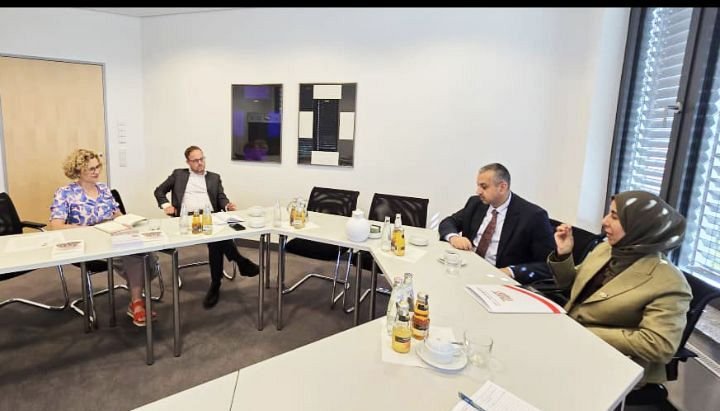
Yemen’s Minister of Planning and International Cooperation, Dr. Afrah Abdulaziz Al-Zouba, has held talks in Berlin with representatives of the Friedrich Ebert Foundation aimed at deepening a long-standing partnership and widening cooperation on social and economic policy. The meeting, held on Thursday, brought the minister together with the foundation’s Richard Probst and its Yemen relations officer, Irela Gross, to map out how the two sides can work more closely on the country’s development, reform and recovery agenda.
The Friedrich Ebert Foundation is a German political foundation with a long record of supporting research, dialogue and policy work in developing and conflict-affected countries. Its continued engagement in Yemen, the minister noted, has become an important source of support for national institutions at a time when the government is trying to rebuild capacity after nearly a decade of war.
Founded in 1925 and named after Germany’s first democratically elected president, the foundation is rooted in the German social democratic tradition and operates in more than a hundred countries. In fragile states it typically concentrates on strengthening civil society, encouraging dialogue between political and social actors, and supporting the kind of inclusive policy debate that Yemeni officials say the country badly needs as it plans for its recovery.
According to accounts of the meeting, the discussion centred on strengthening peacebuilding efforts and improving the effectiveness of aid so that it aligns with the Yemeni government’s own priorities for development and reform. Both sides examined ways to expand cooperation in areas such as social protection, community dialogue and economic policy, and stressed the value of relationships that help communities take part in shaping the decisions that affect them.
A central theme was the need to move beyond emergency relief toward longer-term recovery and sustainable development. Years of conflict have left Yemen dependent on humanitarian assistance, and officials increasingly argue that a durable improvement in living conditions will require a shift in strategy: from keeping people alive in the short term to rebuilding the institutions, services and economic foundations that can support them over time.
The two sides also discussed the importance of applied research in guiding that transition. Evidence-based policymaking, they agreed, depends on reliable data and analysis, and supporting local research capacity was identified as a practical way to improve the quality of public policy. Strengthening coordination among the many development partners active in Yemen was another priority, with both parties agreeing that fragmented efforts achieve far less than coordinated ones.
Yemen’s ambassador to Germany, Louay Al-Iryani, attended the talks, underscoring the diplomatic weight the government attaches to its relationships with European partners. Both sides reaffirmed a commitment to maintain close coordination and to expand the areas in which they work together, describing the partnership as a durable one geared toward supporting the government’s development goals.
Dr. Al-Zouba used the meeting to express gratitude for the foundation’s sustained presence in Yemen, and in particular for its decision to keep operating from the interim capital, Aden. That choice, she said, reflects a commitment to working alongside national institutions rather than at a distance, and is seen in Aden as a meaningful signal of confidence in the government’s recovery efforts.
Aden has served as the interim seat of Yemen’s internationally recognised government since it was forced from the capital, Sanaa, early in the conflict. Rebuilding a functioning administration there has been slow and difficult, and the government leans heavily on international partners for technical support and for the financing that keeps core public services running. Decisions by foreign organisations to base staff in the city are therefore watched closely as signals of confidence in its stability.
The backdrop to the talks remains stark. Yemen has been mired in conflict since 2015, when fighting escalated between the internationally recognised government and the Houthi movement, drawing in regional powers and displacing millions of people. The war has shattered the economy, hollowed out public services and left much of the population reliant on outside help simply to meet basic needs.
The humanitarian toll continues to shape every policy conversation. Large numbers of Yemenis remain in acute need of food, water and medical care, and the country has faced recurring outbreaks of preventable diseases such as cholera and measles that strain an already fragile health system. These pressures are precisely what officials hope a shift toward recovery and resilient institutions can eventually ease.
Yemen’s geography adds a further layer of significance to its stability. The country sits alongside the Bab al-Mandab Strait, one of the world’s busiest and most strategically sensitive shipping lanes, which makes effective governance and functioning infrastructure a concern well beyond its borders. That strategic weight has long drawn international attention to Yemen’s internal politics and to the involvement of regional actors in its conflict.
For the government, engagements such as the Berlin meeting are part of a broader effort to rebuild partnerships that can help reshape the country’s economic and social landscape. Officials frame cooperation with organisations like the Friedrich Ebert Foundation as a way to combine international expertise with local priorities, and to lay the groundwork for reforms that could gradually move Yemen from crisis management toward a more stable and self-sustaining future. Whether that ambition can be realised will depend heavily on the trajectory of the wider conflict, but the renewed commitment on both sides suggests a shared determination to keep working toward it.
About the Author




