Geneva Art Exhibition Puts Yemen’s Humanitarian Crisis Before UN Delegates
 Yemen Herald News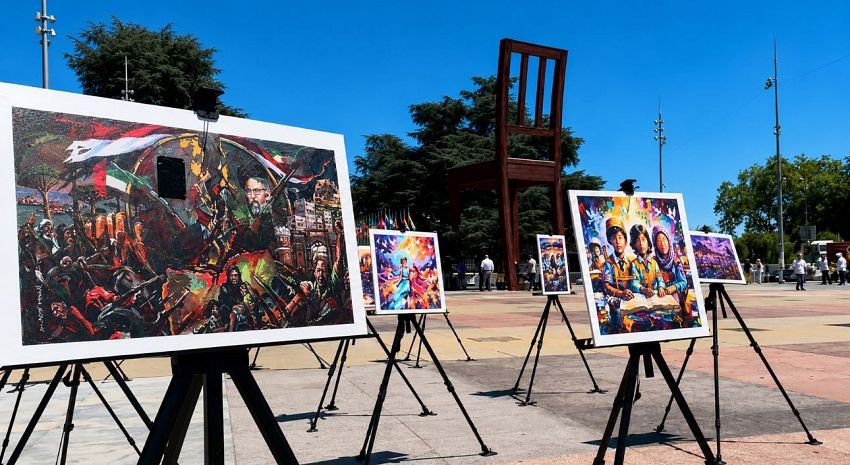
An international art exhibition has transformed a public plaza in Geneva into a stark visual record of Yemen’s humanitarian emergency, staged deliberately within sight of the diplomats and delegates gathered for a major United Nations rights meeting. Titled “Mirrors of the Shadow: The Unseen,” the exhibition opened on Saturday at United Nations Square and was organized by the Humanitarian League for Rights in cooperation with the Cultural and Humanitarian Arts Caravan. Its timing was no accident: it coincided with the 62nd regular session of the United Nations Human Rights Council, convened in Geneva, placing Yemen’s plight directly in the path of an international audience.
The organizers designed the display as a form of advocacy, using art to document what they describe as violations committed against Yemeni civilians during more than a decade of conflict, which they attribute to the Iran-backed Houthi movement. Rather than presenting a single tableau, the exhibition unfolds in sequential sections, each building on the last. Visitors are guided from the political fracture that first opened the conflict toward the everyday consequences now borne by ordinary families, a structure intended to make an abstract and distant crisis feel immediate and human.
Several sections examine the disruption of state institutions and the assault on vital sectors such as education, healthcare and the broader economy. Others turn to the social and environmental damage wrought by years of instability, offering a fuller portrait of how the war has reshaped daily life across the country. By moving from causes to consequences, the exhibition attempts to convey not only the scale of suffering but also the mechanisms through which a prolonged conflict hollows out a society.
One of the most striking elements, described as “The Stolen Memory,” focuses on the erosion of Yemen’s cultural identity and the damage inflicted on its historical heritage. It is a dimension of the war that rarely features in emergency appeals, which tend to foreground hunger and displacement, yet the organizers consider it central to the country’s long-term recovery. Yemen’s ancient cities and architectural treasures, several of them recognized internationally, have suffered amid the fighting, and their loss represents a wound to national identity that outlasts any single battle.
At the close of the opening ceremony, the organizers issued a pointed appeal, calling for stronger international accountability mechanisms and an end to impunity. They warned that continued international silence has contributed to the deepening of the crisis, framing indifference itself as a factor in Yemen’s suffering. The choice to mount the exhibition alongside the Human Rights Council session reflected a calculated effort to convert artistic testimony into political pressure, reminding member states of commitments they have made but not always honoured.
The backdrop to the exhibition is a humanitarian catastrophe of staggering proportions. According to the United Nations, more than 22 million people in Yemen will require humanitarian assistance and protection in 2026, a figure that includes millions of women and girls. Around 5.2 million people remain internally displaced from their homes, unable to return because of insecurity, destroyed infrastructure or the threat of mines. These numbers place Yemen among the largest humanitarian emergencies in the world, even as global attention has repeatedly drifted toward other crises.
Food insecurity is among the most acute manifestations of the disaster. United Nations analysis indicates that some 18.3 million people are acutely food insecure, with certain districts sliding from crisis into emergency conditions and pockets of the population facing catastrophic levels of hunger. Malnutrition remains critically high, with more than two million children under the age of five acutely malnourished, hundreds of thousands of them severely so. Recurring outbreaks of cholera and measles compound the emergency, straining a health system that has been battered by years of war and underfunding.
The conflict that produced this suffering began as an internal power struggle but soon drew in regional rivals, becoming entangled in a broader contest between Gulf states and Iran, which many governments accuse of arming and supporting the Houthis. Repeated rounds of peace negotiations have failed to produce a durable settlement, and the war has persisted in various forms ever since, mutating rather than ending. Each stalled initiative has deepened the sense among Yemenis that the outside world has grown accustomed to their crisis.
To meet the needs of 2026, aid agencies have appealed for 2.16 billion US dollars, a sum intended to fund life-saving interventions for the most vulnerable. Humanitarian funding for Yemen has fallen short in recent years, forcing agencies to cut rations and scale back programmes even as needs have grown. It is precisely this gap between requirement and resource that the Geneva exhibition sought to address, using visual storytelling to rekindle the empathy and political will on which any meaningful response ultimately depends.
For its organizers, the works on display in Geneva are meant to serve as both a record and a summons, testimony to present violations and a call to future action. Whether the exhibition shifts the calculations of the diplomats passing through United Nations Square is impossible to know. But by insisting that Yemen’s unseen suffering be made visible at the heart of the international human rights system, the organizers made their argument plain: that awareness is the first step toward accountability, and that art can carry a message where statistics alone have failed.
About the Author