
Al-Alimi Urges Yemeni Parties to Unite Against Iranian Interference and Houthi Escalation
 Yemen Herald News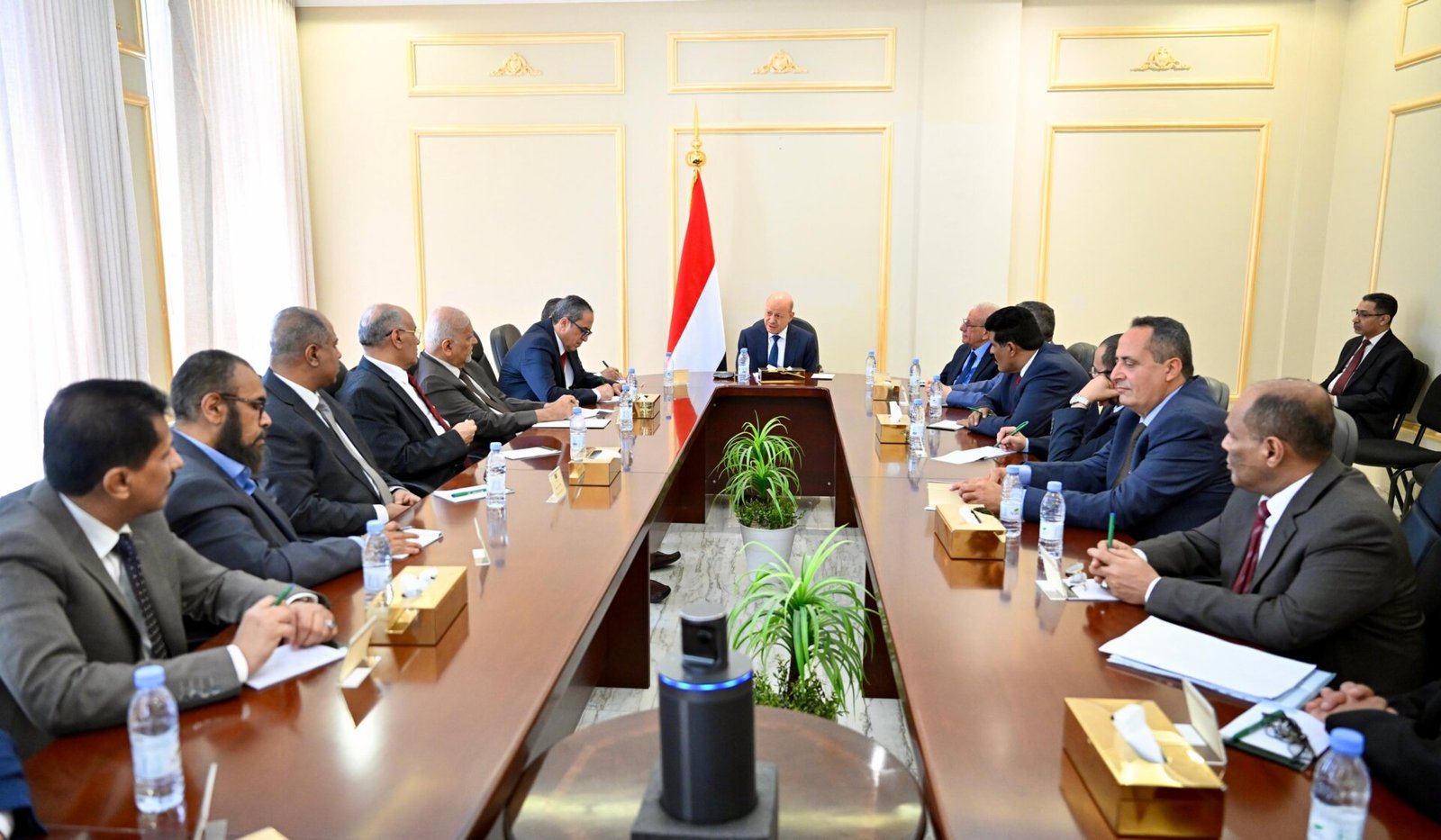
Yemen’s President Rashad al-Alimi, chairman of the Presidential Leadership Council, has urged the country’s political parties to unite behind a national proposal, arguing that a cohesive internal front is essential to counter what he described as Iranian interference and a renewed Houthi escalation. He made the appeal during a meeting in Aden with the National Coalition of Political Parties and Components, a grouping chaired by Ahmed Obaid bin Dagher, who also serves as Speaker of the Shura Council.
Al-Alimi told the coalition’s leaders that political parties are a vital component of the state and must play a central role in shaping public opinion, a task he said mattered as much as the military effort. He called on the parties to rally behind shared national goals, to strengthen their support for the armed forces, and to help rebuild public confidence in government institutions after years of division and war. The president cast the moment as one that demanded discipline and common purpose rather than the factional rivalries that have often weakened the anti-Houthi camp.
Central to his remarks was an allegation that Iran has deepened its involvement in the conflict. The president said Tehran had flown experts and military-use technology into territory held by the Houthis, describing the move as a violation of Yemeni sovereignty and of United Nations Security Council resolutions. The government has previously pointed to what it says was a Revolutionary Guard aircraft that landed at Sana’a airport carrying specialists and equipment. Iran has consistently denied arming the Houthis, and the claims could not be independently verified; al-Alimi presented them as evidence that the group answers to outside sponsors rather than to a Yemeni constituency.
The president reiterated that his government remained committed to seeking peace, but insisted that any settlement must not come at the expense of Yemen’s sovereignty or the security and dignity of its people. He warned that if the Houthis pressed ahead with their escalation and failed to honour their commitments, the government would be prepared to defend the country and its institutions. The message combined an appeal for negotiation with a caution that patience would not extend to accepting terms he considered a threat to the state.
For their part, the coalition’s leaders reaffirmed their rejection of any unilateral steps that could weaken state institutions or undermine the partnership among the national forces opposed to the Houthis, echoing the president’s emphasis on preserving a common front. Their response underlined a shared awareness that visible divisions among the government’s allies can be exploited by its adversaries, both militarily and in the contest for public legitimacy.
The appeal for cohesion carries particular weight after a turbulent period for the Presidential Leadership Council. The body, formed in 2022 to bring the government’s disparate factions under one roof, was shaken in early 2026 by a confrontation with the Southern Transitional Council over control of resource-rich provinces in the south and east. Forces aligned with the council and its regional backers eventually contained the crisis, but it exposed the fragility of the alliance that al-Alimi now hopes to consolidate into a more durable partnership.
The wider war has ground on for more than a decade since the Houthis seized the capital, Sana’a, in 2014 and the internationally recognised government relocated to Aden. Successive rounds of fighting, blockade and economic collapse have produced one of the world’s worst humanitarian emergencies, with United Nations agencies estimating that more than 22 million people will require assistance and protection during 2026. Aid organisations have appealed for billions of dollars to reach the most vulnerable, and persistent funding shortfalls continue to limit what they can deliver.
The conflict’s consequences reach well beyond Yemen’s borders. The country sits alongside the Bab al-Mandab Strait and the southern approaches to the Red Sea, among the world’s busiest shipping lanes, and instability there has repeatedly threatened commercial traffic and energy cargoes bound for the Suez Canal. That geography has drawn in regional and global powers and raised the stakes of any escalation, giving Yemen’s neighbours a direct interest in how its war is ultimately resolved.
For al-Alimi, the immediate challenge is to translate calls for unity into practical cooperation among parties that have frequently pulled in different directions. Analysts note that the Presidential Leadership Council’s authority depends heavily on the cohesion of its constituent groups and on sustained backing from Saudi Arabia and other partners. Stronger political alignment, the president argued, could improve governance, bolster the war effort and present a more credible front in any future negotiations with the Houthis. He also linked internal unity to the confidence of external partners, suggesting that a more disciplined political front would make it easier to secure the diplomatic and financial support on which the government continues to rely.
Whether the appeal produces lasting results remains uncertain. The government’s coalition has weathered repeated strains, and the underlying disputes over power, resources and the shape of a future Yemeni state have not disappeared. Yet with the Houthis pressing their campaign and the regional environment growing more volatile, al-Alimi’s message reflected a calculation that the cost of continued fragmentation has become too high. For a leadership seeking to hold together a fractious alliance, the drive for unity may prove as decisive as any development on the battlefield.
About the Author




