UKMTO warns of possible pirate activity after suspicious boats approach ships in Gulf of Aden
 Yemen Herald News
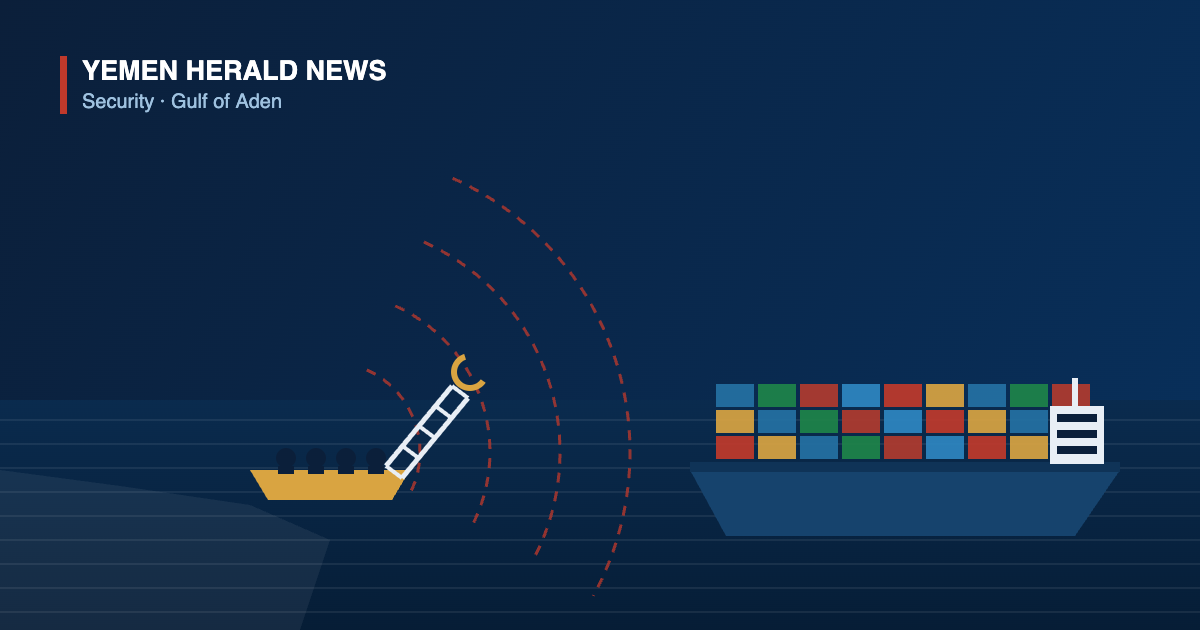
ADEN, Yemen — The United Kingdom Maritime Trade Operations warned on Wednesday of suspicious small boats approaching merchant ships in the Gulf of Aden, saying the activity could indicate a pirate group.
The British naval body issued the alert on Oct. 28 in a statement posted on X. It said it had received reports from several sources of small craft operating close to merchant vessels.
One report described a green and blue boat carrying nine people. The boat was equipped with two ladders and a hook, UKMTO said.
The organisation advised transiting vessels to exercise caution and to report anything suspicious. It said authorities were investigating.
The account of the alert rests on UKMTO’s own statement. No independent confirmation that the boats belong to a pirate group has been published, and the organisation did not say where the reports came from. Anadolu Agency carried the warning the same day.
UKMTO is run by the Royal Navy and acts as the main channel between merchant shipping and naval forces in the region. It logs incidents reported by crews and passes warnings to vessels in the area.
The Gulf of Aden runs along Yemen’s southern coast and links the Red Sea to the Arabian Sea. It carries a large share of the traffic moving between Europe and Asia.
Ladders and grappling hooks are the equipment used to board a moving ship from a skiff. Naval forces treat their presence as an indicator of intent rather than proof of it.
The warning follows a rise in piracy off the Horn of Africa this year.
The European Union naval mission Atalanta recorded 25 incidents off the Horn of Africa by mid-September, according to the Soufan Center. The centre said International Maritime Organization data placed piracy at its highest level since 2013.
Six commercial vessels have been seized since late April, four remain in pirate hands and more than 60 seafarers are held, Christopher Hockey wrote in a commentary published by the Royal United Services Institute on Sept. 23. Four of the six were tankers.
Only three commercial vessels were hijacked off the Horn of Africa between 2012 and early 2026, Hockey wrote, citing the maritime data firm Windward.
Three of the six ships taken this year were seized on the Yemeni side of the Gulf of Aden or near the Yemeni coast, according to the commentary.
The Eureka was taken on May 2 at an anchorage near Qana in Shabwa governorate, Sheba Intelligence reported. The Asana was seized on July 17 after leaving Mukalla.
The other ships seized this year include the Honour 25, taken on April 21 off Hafun in Somalia, and the Sward, taken on April 26 near Garacad in Puntland, according to Sheba Intelligence.
Puntland officials have alleged that Houthi-linked individuals were involved in the Eureka hijacking, Hockey wrote. He described the evidence linking the Houthis to piracy as circumstantial.
The Houthis have not commented on the allegation.
Pirate action groups have reportedly launched from Yemeni settlements and have included Yemeni nationals, the commentary said, citing the Global Initiative Against Transnational Organized Crime.
Hockey attributed the increase to a smaller international warship presence since 2021 and to further redeployment this year from the Somali coast toward the Strait of Hormuz and Bab al-Mandab. He also cited heavier commercial traffic, calm sea conditions and the lifting of the Indian Ocean High Risk Area designation in January 2023.
None of the vessels hijacked this year carried armed security teams, he wrote.
The Soufan Center said the increase followed the movement of United States and European warships to the Red Sea and the Strait of Hormuz, which it said removed a layer of deterrence.
Captured dhows and commercial ships have been used as motherships to extend the range of attacks, Sheba Intelligence reported. It recorded at least 19 piracy-related incidents in Somali waters and the Gulf of Aden since the start of the year.
At least two pirate action groups have operated at the same time, supported by land-based supply networks in Puntland, Sheba Intelligence reported. Four vessels were reported held by Somali groups as of Aug. 16.
In September, pirates boarded the merchant ship Glamor in the Gulf of Aden and the crew locked themselves in the vessel’s citadel, the Soufan Center said. Atalanta, a Japanese patrol aircraft and the Indian Navy responded, and the boarders left.
The Sward, seized in April, was released after 138 days and had been used as a mothership, according to the centre.
Accounts of the Lutuf differ. The Somali federal government and the Turkish navy said the ship was retaken by force. Puntland authorities said a ransom of 2.5 million dollars was paid.
The Lutuf was a Cameroon-flagged cargo vessel boarded by eight armed men about four nautical miles south of Mareeyo, Sheba Intelligence reported. UKMTO classified the seizure as a hijacking.
Between 2005 and 2011, more than 1,000 vessels were attacked and more than 200 hijacked off the Horn of Africa, Hockey wrote. He said current activity remains below that level.
Several African and Gulf states, along with France, have backed a proposal for a new counter-piracy task force, the Soufan Center said.
The Baltic and International Maritime Council has assessed that the south-west monsoon suppresses piracy between June and August, the Soufan Center said.
UKMTO did not give coordinates for Wednesday’s reports.
About the Author