Yemen’s Human Rights Ministry and IOM Discuss Reviving National Anti-Trafficking Committee
 Yemen Herald News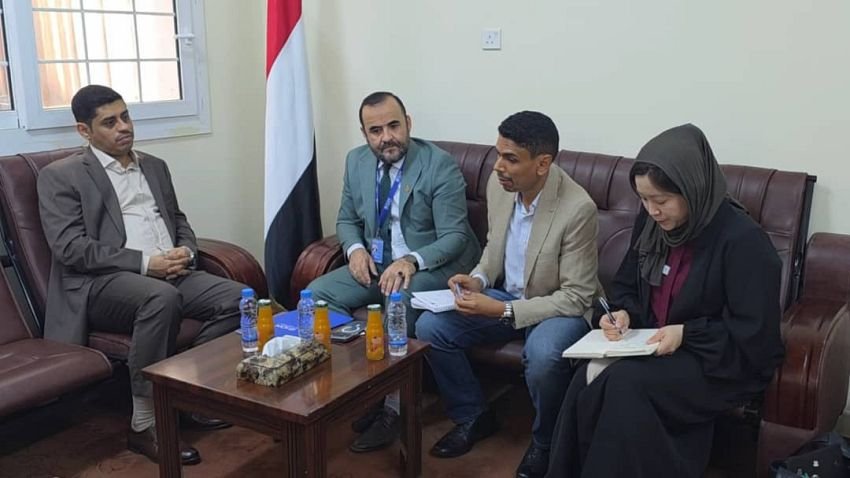
Yemen’s Minister of Human Rights, Mishdal Omar, met the head of the International Organization for Migration mission in Yemen, Abdul Sattar Esayev, in Aden on Wednesday to discuss closer cooperation against human trafficking. IOM’s senior protection programme coordinator, Hyojung Yoo, also attended. According to the state news agency Saba, the two sides concentrated on tightening the coordination mechanisms that protect the groups most exposed to exploitation, above all the migrants who transit Yemen in large numbers. The timing was deliberate: the meeting fell one day before the World Day Against Trafficking in Persons, observed each year on 30 July.
The participants reviewed recent national and international anti-trafficking efforts alongside the pressures bearing on both migrants and the Yemeni communities that host them. The clearest priority to emerge for the next phase was the reactivation of the National Committee to Combat Human Trafficking, the inter-ministerial body intended to coordinate policy across government agencies. Its work has been intermittent through more than a decade of conflict and institutional fragmentation. Restoring it would give Yemen a single forum in which police, prosecutors, immigration officials and protection agencies could align responses that currently run largely in parallel.
Omar underlined the value of deepening the ministry’s partnership with IOM on human rights protection, framing it around the organisation’s mandate, the ministry’s own priorities and the resources realistically available. That last qualification reflects the acute funding and staffing limits facing almost every institution of the internationally recognised government. He praised IOM’s role in supporting protection work, building institutional capacity and responding to humanitarian needs. The IOM representatives reaffirmed the organisation’s commitment to continued cooperation with the ministry and to backing national efforts to shield vulnerable groups and strengthen the wider humanitarian response.
The scale of the movement through Yemen explains why the file is urgent. IOM tracking recorded 83,835 African migrants arriving in the country between the start of 2026 and mid-June, the majority of them Ethiopian. Monthly figures show 14,834 arrivals in April alone, while more than 21,000 were tracked in January, entering mainly through the coastal districts of Lahj and Shabwah. Those numbers describe a steady flow rather than a seasonal spike, and they arrive in a country that has limited capacity to register, shelter or screen the people concerned.
Yemen sits on what humanitarian agencies call the Eastern Route, the corridor running from Ethiopia and Somalia across the Gulf of Aden and the Red Sea and onward towards the Gulf states. It is among the busiest and most dangerous migration routes in the world. Most crossings are made in overcrowded boats operated by smuggling networks, after which migrants attempt an overland journey north towards the Saudi border. The line between smuggling and trafficking is thin on this route, because people who arrive without money, documents or legal status are readily coerced into debt bondage, forced labour or sexual exploitation. IOM and its partners have appealed for funding under a regional migrant response plan covering roughly 1.2 million migrants and host community members across the Horn of Africa, Yemen and Southern Africa.
The domestic backdrop is equally difficult. The UN humanitarian office’s 2026 Humanitarian Needs and Response Plan estimates that more than 22 million people in Yemen require assistance and protection this year, a figure that includes 5.2 million internally displaced people, some 329,000 migrants and about 63,000 refugees and asylum seekers. Roughly 18.3 million people are acutely food insecure, and more than 2.2 million children under five are acutely malnourished, including 516,157 with severe acute malnutrition. The plan seeks 2.16 billion dollars to reach 12 million people. Chronic underfunding of appeals of this kind has repeatedly forced agencies to narrow their programmes mid-year.
Those conditions matter for trafficking because destitution is the mechanism that traffickers exploit. Migrants competing for scarce food, water and shelter with equally strained host communities, and lacking any legal status, have little recourse when employers withhold wages or when armed groups and criminal networks demand payment for onward passage. Protection agencies have also documented arbitrary detention of migrants in various parts of the country, which limits their access to assistance and to any complaint mechanism.
Geography compounds the problem. Yemen’s position on the Red Sea and the Bab al-Mandab Strait places it beside one of the world’s most heavily used shipping lanes, and the country’s territory has been divided between rival authorities since 2014 and 2015. There is no single national law enforcement or judicial structure covering the whole coastline, so any reactivated committee would in practice operate only in areas under the internationally recognised government’s control. That constraint does not make the effort pointless, but it does bound what it can achieve.
Neither the ministry nor IOM announced funding, a timeline or specific programmes at the meeting, and no formal agreement was reported. The practical test will be whether the National Committee actually convenes, whether it is resourced well enough to identify victims and refer them to services, and whether prosecutions follow. Until then, Wednesday’s discussion registers as a statement of intent between a ministry with limited means and an agency whose own operations in Yemen depend on donor money that has become harder to secure.
About the Author