Yemen’s Ambassador and Japanese Lawmaker Discuss Wider Development and Maritime Cooperation
 Yemen Herald News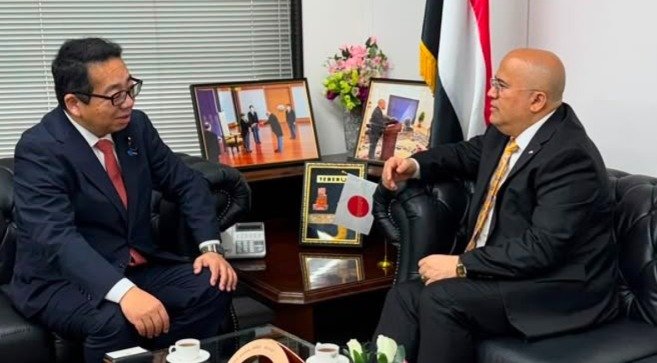
Yemen’s Ambassador to Japan, Adel al-Sunaini, met Japanese lawmaker Tanaka Masashi in Tokyo on Monday for talks on widening political, economic, development and parliamentary cooperation between the two countries, and on the latest developments inside Yemen. The meeting was reported by the state news agency Saba, which identified Tanaka as a member of Japan’s House of Representatives who serves on the International Bureau of the governing Liberal Democratic Party, the party arm that handles contacts with foreign parties and parliaments.
According to the Saba readout, al-Sunaini praised Japan’s long record of support for Yemen and pointed to the depth of relations between the two countries, saying his government intends to broaden its strategic partnership with Tokyo. He briefed the Japanese lawmaker on Yemen’s political, economic and humanitarian situation, and on the efforts of the Presidential Leadership Council and the government to rebuild state institutions and stabilise conditions in the areas they control.
That appeal lands against a humanitarian picture that has not eased. The United Nations Office for the Coordination of Humanitarian Affairs estimates that more than 22 million Yemenis will need humanitarian assistance or protection during 2026, among them 5.2 million people displaced inside the country. Some 18.3 million are acutely food insecure, and the 2026 response plan seeks $2.16 billion to reach a targeted 12 million people. Funding has lagged well behind that request, and aid agencies have warned repeatedly this year that the shortfall is forcing them to cut programmes rather than expand them.
Al-Sunaini asked for continued Japanese and international backing for Yemen’s development and reconstruction programmes. Japan has been among the steadier donors to Yemen through the war, channelling much of its assistance through United Nations agencies because the security situation has limited what Japanese personnel can implement directly on the ground. Its technical and grant assistance abroad is administered largely by the Japan International Cooperation Agency, known as JICA.
The Tokyo meeting followed a separate exchange a day earlier at a more senior level. Yemen’s Foreign Minister, Dr Afrah al-Zouba, met Japan’s Ambassador to Yemen, Yoichi Nakashima, and told him the government wants a wider JICA role in development and reconstruction work. Al-Zouba also conveyed condolences over the earthquake that struck Kumamoto Prefecture on 28 July, a shallow magnitude 6.8 tremor, measured at 7.1 by Japan’s own meteorological agency, that killed dozens of people and forced mass evacuations across southern Japan.
Maritime security formed the other substantial item on the agenda. Al-Sunaini pressed for closer cooperation on protecting shipping lanes, citing what the Yemeni government describes as threats from the Iranian-backed Houthi movement to international shipping and to global supply chains in the Red Sea and the Bab al-Mandab Strait. The Houthis reject that characterisation of their campaign. The commercial consequences, however, are not in dispute: carriers have rerouted vessels around southern Africa rather than transit the corridor, lengthening voyages between Asia and Europe and pushing up freight and insurance costs.
For Japan the question is more than diplomatic. As a resource-importing trading economy dependent on sea lanes running through the Indian Ocean and the Suez route, it feels disruption at Bab al-Mandab directly in shipping costs and energy logistics. Japan also occupies an unusual position among Group of Seven members in retaining working channels with Tehran, and its ambassador to Yemen has said publicly that Tokyo used those channels to urge restraint over escalation in the Red Sea.
Tanaka, for his part, reaffirmed Japan’s support for Yemen’s unity, sovereignty, stability and territorial integrity, and its continued backing for the Yemeni government and people, Saba reported. He also restated Japanese support for regional and international efforts aimed at a comprehensive and lasting peace, an end to the suffering of Yemeni civilians, and the restoration of security across the wider region.
Japan has kept diplomatic relations with Yemen intact throughout the conflict, though the practical shape of that engagement has changed. The Riyadh dateline on Sunday’s readout of Ambassador Nakashima’s meeting with the foreign minister is a reminder that much Yemeni diplomacy is now conducted outside the country, with ministries and foreign missions working from the Saudi capital or from Aden rather than Sanaa. Embassy work in Tokyo, by contrast, has continued uninterrupted, and the ambassador’s contacts there carry weight in Aden.
The parliamentary strand of the discussion reflects a line the ambassador has been working for some time. Al-Sunaini has previously sought the creation of a Yemeni-Japanese parliamentary committee to give the relationship a legislative channel alongside the executive one, and has held talks with Japanese legislators including Takagi Kei, who chairs the Liberal Democratic Party’s foreign affairs committee. He has also met officials on the government side, among them Keiichi Iwamoto, the assistant foreign minister who heads the Middle East and Africa Bureau at Japan’s foreign ministry, in talks on 1 July.
No new commitments, funding decisions or agreements were announced on Monday, and the readout carried none of the specifics, such as project names, sums or timelines, that would signal a shift in Japanese policy. Its value to Aden lies mainly in visibility. With donor attention stretched across several concurrent crises, a government that depends heavily on external financing has an obvious interest in keeping its file in front of legislators in capitals that still fund it. Whether the parliamentary committee al-Sunaini has pushed for actually materialises will be a firmer test of how far that effort has travelled.
About the Author