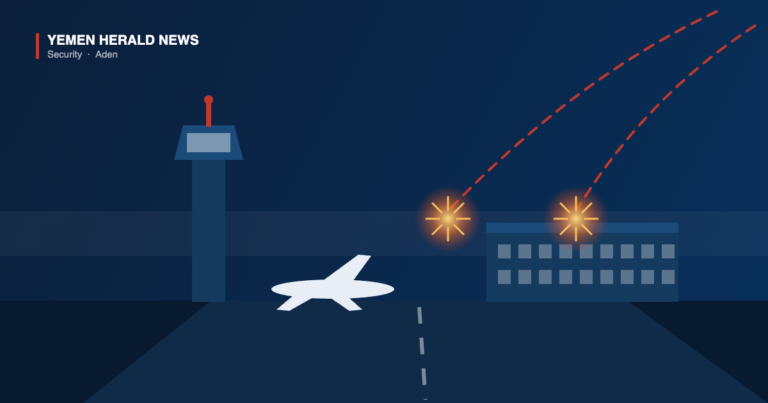
Debris from Air Defence Operation Strikes Building Facade in Central Dubai
 Yemen Herald News
Debris from an air defence operation struck the facade of a building in central Dubai, Emirati authorities said on Friday, describing the incident as minor with no reported injuries. Emergency teams attended the site and the surrounding area was secured while the damage was assessed.
Incidents of this kind are a direct by-product of successful interception rather than of a strike reaching its target. When an interceptor destroys an incoming missile or drone, the fragments of both do not disappear; they continue on a ballistic path and fall to the ground. Over open desert that is largely inconsequential. Over a dense urban centre of high-rise towers it means pieces of metal arriving at speed in an area with a high concentration of people, glass and vehicles.
Dubai’s built environment makes the problem more visible than it would be elsewhere. The city centre is dominated by tall glass-clad towers, and facades of that construction are vulnerable to impact damage in a way that masonry is not. A fragment that would leave a dent in a concrete wall can crack or dislodge a cladding panel, which then creates a secondary hazard at street level below. Cordoning the pavement beneath an affected facade is consequently a standard first response, ahead of any assessment of the damage itself.
Emirati authorities have adopted a practice of confirming such incidents promptly and characterising their severity. The approach serves a purpose in a city where residents can see and hear engagements overhead and where footage circulates on social media within minutes: an early official account, even a brief one, reduces the space in which unverified claims about casualties or the scale of damage can take hold.
The Ministry of Defence has reported engaging large numbers of incoming munitions since the escalation began, with cumulative totals reaching 438 ballistic missiles, 19 cruise missiles and 2,012 drones by early April 2026. Interceptions on that scale over populated territory make debris incidents a statistical near-certainty rather than an aberration, and civil defence bodies across the Gulf have issued public guidance on sheltering during engagements for precisely this reason.
That guidance generally advises residents to remain indoors and away from windows during an alert rather than moving outside to watch, a habit that became common in the early phase of the campaign before the risks were widely understood. Authorities have also asked the public not to approach or handle fallen debris, which may be unstable or contain unexploded components, and to report its location instead. Recovery of fragments also has an investigative purpose, since examination of wreckage is one of the few reliable ways of establishing what type of munition was involved and where it originated.
The wider crisis dates to 28 February 2026, when confrontation over the Strait of Hormuz drew in Iran, the United States, Israel and international shipping. A United States-led aerial campaign against Iranian targets followed, alongside a naval blockade of Iran, and disruption to energy shipments through the strait has produced a global fuel crisis. Gulf states that are not belligerents have had their airspace crossed and their defences engaged repeatedly.
For Dubai the stakes extend beyond the physical damage. The emirate’s economy rests on aviation, tourism, trade, property and financial services, all of which depend on a perception of safety. Its population is overwhelmingly expatriate, and residents can leave more readily than citizens of a country with deeper roots. The government’s interest is therefore in demonstrating both that the defences work and that incidents are handled competently, which is reflected in the speed and tone of its public statements. Understatement is a deliberate choice in that context, though it also means the published account of an incident is rarely the fullest one available.
Airspace closures have compounded the disruption. Emirates and flydubai operate hub-and-spoke networks that depend on continuous access to the airspace above the Gulf, and repeated suspensions have forced diversions, cancellations and long re-routings. Residents have been stranded abroad in sufficient numbers that the Federal Authority for Identity, Citizenship, Customs and Port Security allowed those whose residency permits expired while they were outside the country to return without a fresh entry visa. That administrative concession, applying from 28 February 2026, gives some measure of how many people were caught outside the country by the closures.
The Emirates has continued to call for de-escalation while maintaining that it will defend its territory. Iran has framed its operations as retaliation for strikes against its own territory and has warned that states hosting foreign military facilities may see those facilities treated as targets. The Emirates hosts United States military personnel, including at al-Dhafra air base, which places it within the scope of that warning regardless of its declared position.
Authorities did not identify the building affected or say what was intercepted over the city, and did not indicate whether repairs would be required. Damage described as minor typically means cosmetic harm to an exterior surface without structural consequence, though assessments of cladding damage are sometimes revised once engineers have examined the panels and their fixings at close range. No timeline was given for that inspection, and the authorities did not say whether the building remained occupied.
About the Author