Yemen’s Foreign Minister Afrah al-Zouba Praises China’s Support for Yemeni Sovereignty
 Yemen Herald News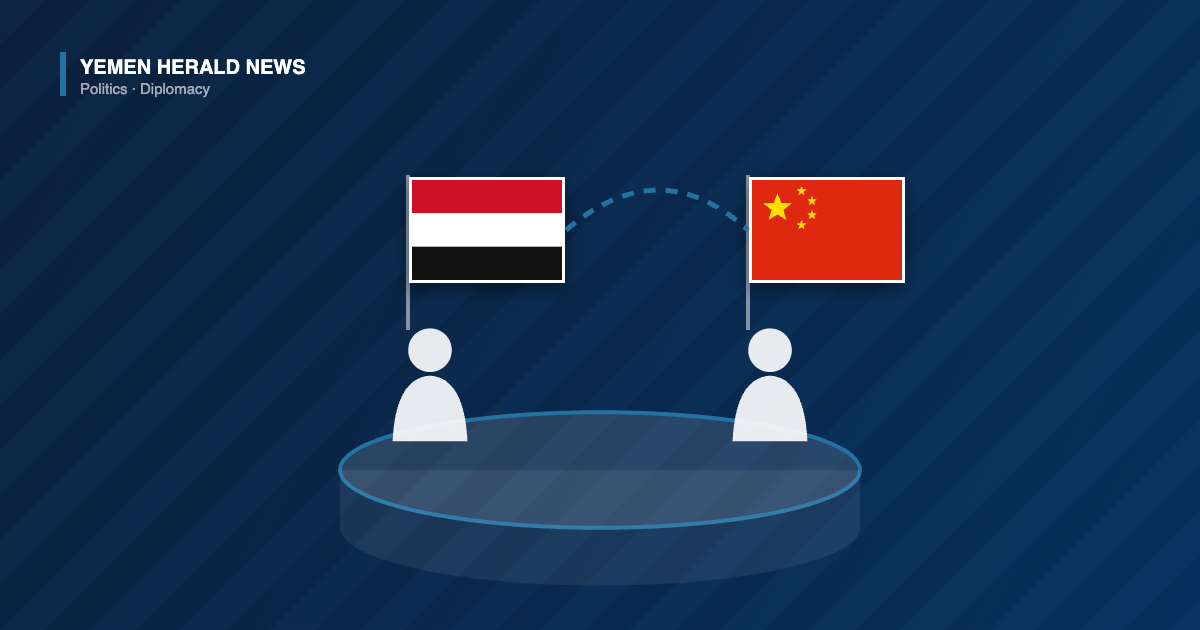
Yemen’s foreign minister has thanked China for what she described as its consistent support for Yemen’s unity, sovereignty, security and stability. The state news agency Saba reported that Afrah al-Zouba, Minister of Foreign Affairs and Expatriates, made the remarks in Riyadh on Tuesday during talks with Zhao Cheng, the chargé d’affaires of the Chinese embassy to Yemen.
“We’re grateful to the People’s Republic of China for its support for the unity, sovereignty, security and stability of the Republic of Yemen,” the minister said, according to the agency.
Al-Zouba used the meeting to mark the longevity of the relationship between the two countries, describing seven decades of ties running from 1956 to 2026 as constructive, robust and fruitful. Yemen was among the earliest Arab states to establish diplomatic relations with the People’s Republic, and Chinese engagement has since spanned infrastructure, health and technical cooperation. Relations survived Yemen’s unification in 1990 and have been maintained with the internationally recognised government throughout the current conflict, even as Beijing has kept a deliberately low political profile on the war itself.
The talks covered developments in the Yemeni national arena, with particular focus on what the government describes as threats to international navigation in the Red Sea and Bab al-Mandab posed by Iranian-backed Houthi militias. The characterisation of the group as Iranian-backed is the position of the internationally recognised government and of several Western states; the Houthi leadership denies acting on Tehran’s instructions. Zhao reaffirmed Beijing’s support for Yemen’s unity, sovereignty and territorial integrity. Saba did not report any specific new commitment arising from the meeting.
The meeting was one of al-Zouba’s first substantial diplomatic engagements since taking office. She was appointed Minister of Foreign Affairs and Expatriates by presidential decree on 23 July 2026, issued by Presidential Leadership Council chairman Rashad al-Alimi, succeeding Shaya al-Zindani. Her appointment made her the first woman to hold the foreign affairs portfolio in Yemen’s modern political history.
Al-Zouba came to the role from a career spent largely outside conventional diplomacy. She worked for more than 25 years in development and peacebuilding before moving into government, and served as first deputy secretary-general of the National Dialogue Conference between 2013 and 2015, helping oversee the technical and organisational side of that process. She was appointed minister of planning and international cooperation in February 2026, a post she held for roughly five months before the foreign affairs brief.
Much of the Yemeni government’s diplomatic machinery operates from Riyadh, and the minister spent Tuesday working through a series of engagements in the Saudi capital. Saba reported that she also reviewed operations at Yemen’s embassy in Riyadh and met the Italian ambassador for talks on strengthening bilateral relations and cooperation.
The emphasis on maritime security reflects immediate events as much as long-term policy. On Tuesday an India-flagged mechanised sailing vessel, the Faize Noore Oliya, sank in the Red Sea after being struck near the Bab al-Mandab Strait, roughly 13 nautical miles south of the Houthi-controlled port of Hodeidah. All 14 crew, 13 of them Indian nationals, were rescued by the Yemeni coast guard and taken to the port of Mokha. Yemen’s government attributed the attack to Houthi forces and said a remotely operated explosive-laden boat was used; no group had claimed responsibility at the time. India’s shipping minister, Sarbananda Sonowal, said the vessel had been hit by a projectile near Yemeni waters and condemned the attack.
China has a considerable commercial stake in the corridor. As the world’s largest trading nation by volume, it relies heavily on the Red Sea and Suez route for exports to Europe, and the sustained disruption of that lane since late 2023 has pushed a substantial share of container traffic onto the longer passage around the Cape of Good Hope, raising costs and lengthening delivery times. Beijing has consistently called for de-escalation and for the protection of freedom of navigation while avoiding direct participation in Western-led naval operations.
That position places China in an unusual role on the Yemen file. It is a permanent member of the United Nations Security Council, where the United Kingdom holds the pen on Yemen, and in July the Council adopted resolution 2826, extending for six months the requirement that the Secretary-General report on Houthi attacks in the Red Sea. Beijing maintains relations with the internationally recognised government while preserving channels that Western capitals do not have.
Regional efforts to secure the waterway have meanwhile become more formal. On 30 July, Saudi Arabia, Yemen and a dozen other regional stakeholders and Red Sea littoral states announced the creation of a Multinational Maritime Defence Alliance, a defensive coalition whose stated purpose is protecting freedom of navigation through Bab al-Mandab, the Red Sea and the Gulf of Aden. Yemeni officials have repeatedly argued that durable maritime security depends on restoring the authority of the state on land rather than on naval patrols alone.
Chinese development assistance to Yemen has continued through the conflict, delivered largely through economic and technical cooperation agreements signed with the internationally recognised government and through contributions to humanitarian channels. Yemeni officials have publicly welcomed that support on several occasions over the past two years, and Tuesday’s meeting followed that pattern, pairing an expression of thanks with a request that Beijing keep Yemen’s territorial integrity at the centre of its regional policy.
About the Author