Yemen’s Ambassador in Tokyo Discusses Expanding JICA Projects with Agency Director-General
 Yemen Herald News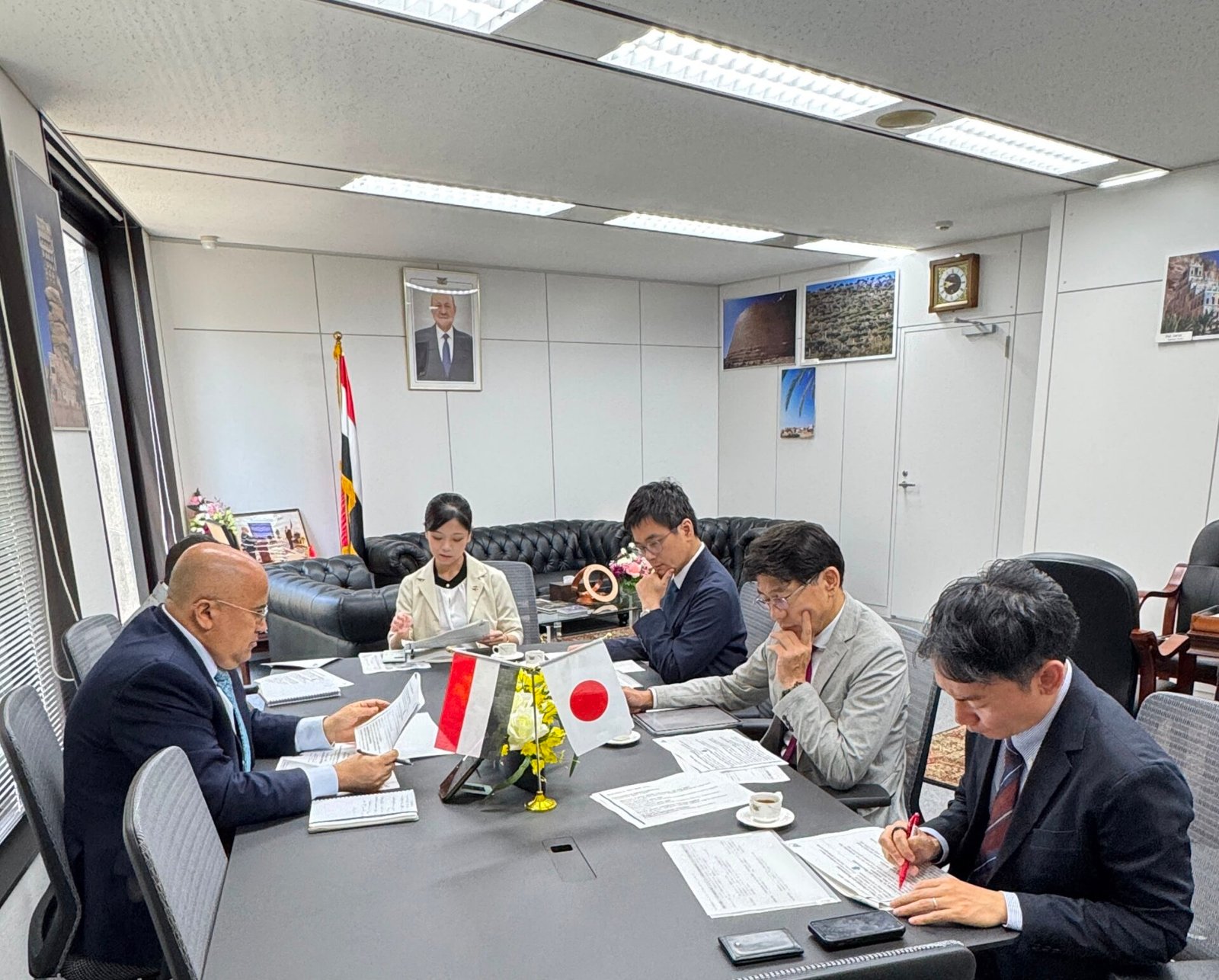
Yemen’s Ambassador to Japan, Adel Ali Ahmed al-Sunaini, met in Tokyo with Toyama Kei, Director-General for the Middle East and Europe at the Japan International Cooperation Agency, for talks on expanding the agency’s project portfolio in Yemen and deepening technical and economic cooperation between the two countries.
The two sides reviewed the programmes JICA currently runs in Yemen and discussed how coordination between the agency and Yemeni institutions could be strengthened. The embassy said the discussion was framed around supporting the government’s programme to normalise conditions in areas under its control, and around aligning JICA’s development work with Japan’s broader stated objective of supporting stability in Yemen through economic projects, training and capacity building.
Al-Sunaini set out the economic pressures the country is under and the scale of external assistance required to meet its development objectives. He said the Yemeni government wants to draw on Japanese expertise in the sectors most relevant to reconstruction, and noted Japan’s sustained engagement in food security, education and health. Those three areas account for a large share of the assistance Tokyo has directed to Yemen during the conflict, much of it aimed at keeping basic services running rather than at new construction.
JICA is Japan’s principal bilateral aid agency, responsible for implementing the country’s official development assistance through technical cooperation, concessional loans and grant aid. Its model places particular weight on training and institutional development rather than on infrastructure spending alone, which shapes the kind of partnership on offer. For a government whose administrative capacity has been eroded by more than a decade of conflict, capacity building is arguably the more consequential half of that package.
Japan has channelled much of its recent assistance to Yemen through United Nations agencies, including the World Food Programme, UNICEF and the United Nations Development Programme, an approach that allows delivery in areas where bilateral access is limited. Direct agency operations inside Yemen have been constrained by security conditions since the escalation of the conflict, and international staff presence has been reduced for extended periods. Any expansion of JICA’s project portfolio would have to work within those constraints, which in practice means relying on Yemeni staff and local partners to implement what Japanese specialists design and supervise remotely.
The need the ambassador described is well documented. The United Nations Office for the Coordination of Humanitarian Affairs estimates that 22.3 million people in Yemen require humanitarian assistance and protection in 2026, more than two thirds of the population, including 5.2 million internally displaced people. Some 18.3 million people are acutely food insecure and more than 2.2 million children under five are acutely malnourished. The United Nations and its partners have appealed for 2.16 billion dollars to reach 12 million people this year.
Yemen’s macroeconomic position has improved from its recent trough without becoming comfortable. The rial, which fell to roughly 2,900 to the United States dollar in government-controlled areas, has recovered to around 1,400 to 1,500 after measures that institutionalised import financing and curbed currency speculation. Even so, residents of Aden and other government-held cities have reported severe shortages of physical banknotes, and the country continues to operate with two effective currencies after authorities in the north banned the newer notes issued by the central bank in Aden.
That divergence matters for development programming. Projects budgeted in one currency zone cannot be straightforwardly costed or audited in the other, and agencies working across the front lines have to manage parallel exchange rates that differ by close to a factor of three. It is one reason donors have favoured working through multilateral partners with established country systems, and one reason bilateral agencies have been cautious about committing to large standalone projects.
Al-Sunaini has been Yemen’s ambassador in Tokyo for several years and has maintained a steady schedule of engagements with Japanese ministries, parliamentarians and development bodies. The embassy’s recent activity has concentrated on development cooperation and on briefing Japanese counterparts on political and security developments in Yemen. Japan, for its part, has consistently backed United Nations-led efforts toward a negotiated settlement and has an interest in the security of shipping through the Red Sea and the Bab al-Mandab strait, a corridor central to trade between Asia and Europe.
Neither the embassy nor JICA announced new projects, funding commitments or a timetable following the meeting, and the discussion was described as a review of existing cooperation together with an exploration of where it might be extended. Expansion of a bilateral aid portfolio typically follows a longer process of assessment and budget allocation rather than a single meeting between an ambassador and a department head.
The talks nonetheless fit a pattern of Yemeni diplomatic activity aimed at converting international sympathy into programmed assistance at a point when humanitarian appeals are chronically underfunded and agencies have repeatedly cut services mid-year for lack of money. Development cooperation of the sort JICA offers, delivered over multi-year cycles, is less exposed to that annual volatility than emergency humanitarian funding, which is part of its appeal to a government trying to plan beyond the next appeal round. Whether that ambition is realised will depend less on the warmth of the meetings than on Japanese budget decisions and on whether conditions inside Yemen allow projects to be supervised to the standard JICA requires of its own programmes.
About the Author