Yemen’s foreign minister thanks Norway for humanitarian support and warns on Red Sea attacks
 Yemen Herald News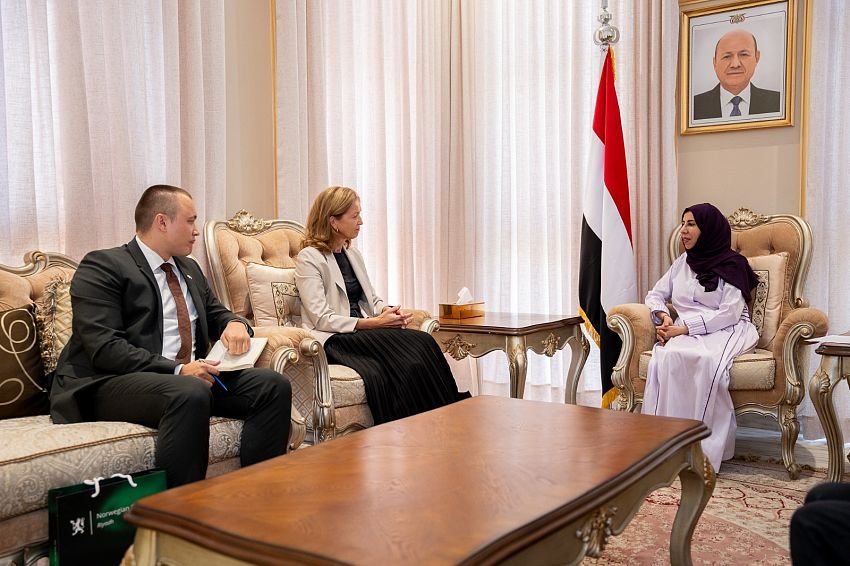
Yemen’s foreign minister has thanked Norway for its humanitarian support to the country and pressed for sustained international engagement, in a meeting with Oslo’s non-resident ambassador that also covered the deteriorating security picture in the Red Sea.
Dr Afrah al-Zouba, who became Minister of Foreign Affairs and Expatriates in late July and is the first woman to hold the post in Yemen, received Kjersti Tromsdal, Norway’s non-resident ambassador to Yemen, on Wednesday. According to the ministry’s account of the meeting, the two reviewed the state of bilateral relations and discussed ways of deepening cooperation, with Norway’s humanitarian contribution the central theme.
Al-Zouba was appointed on 23 July as part of a wider reshuffle, having previously served as Minister of Planning and International Cooperation — a portfolio that put her in regular contact with donor governments and United Nations agencies. She has said since taking office that she intends to reactivate Yemeni diplomacy, and has held a rapid series of contacts with counterparts in Egypt, Sudan and Djibouti, much of it focused on Red Sea security.
Tromsdal presented her credentials to President Rashad al-Alimi, chairman of the Presidential Leadership Council, earlier this year, alongside several other newly accredited envoys. Like most diplomats assigned to Yemen, she is based outside the country; the security situation has kept the great majority of foreign missions operating remotely or from neighbouring states since they left Sanaa.
The ministry said al-Zouba expressed appreciation for Norway’s role in the humanitarian response and underlined the need for continued backing from international partners. She also raised the maritime threat in the Red Sea, warning that attacks on commercial shipping endanger the safety of navigation and the trade routes that carry Yemen’s own imports. The ambassador, according to the readout, reaffirmed Norway’s commitment to supporting Yemen.
The timing gives the exchange more weight than a routine diplomatic call would normally carry. An India-flagged cargo vessel, the MSV Faize Noore Oliya, was struck by a projectile and sank in the Red Sea off Hodeidah on Tuesday; its fourteen crew, thirteen of them Indian nationals, were rescued by the Yemeni Coast Guard and brought to the Port of Mokha. Yemen’s foreign ministry blamed the Houthis for that attack, which the group has not publicly addressed.
That incident followed the maritime blockade the Houthis announced on 20 July, under which they said they would prevent Saudi Arabian shipping from transiting the Bab al-Mandab Strait. Saudi Arabia rejected the group’s justification and said it would take all necessary measures to protect its vessels. Several cargo ships bound for Saudi ports have since reversed course, and at least two Saudi tankers have been struck.
The humanitarian numbers behind the conversation are stark. The United Nations estimates that more than 22 million people in Yemen will need humanitarian assistance and protection during 2026, among them almost 11 million women and girls, 5.2 million internally displaced people and some 329,000 migrants. Around 18.3 million people are acutely food insecure, and more than 2.2 million children under five are acutely malnourished, including roughly 516,000 with severe acute malnutrition.
Against that need, the 2026 Humanitarian Needs and Response Plan seeks 2.16 billion dollars, of which 1.6 billion is earmarked for prioritised life-saving work. Aid agencies are aiming to reach 12 million people, with 9.4 million prioritised on the basis of severity — a gap between need and target that reflects funding constraints rather than any judgement that the remainder are secure.
Norway has been among the more consistent European contributors to that response and to broader Nordic funding for displaced Yemenis channelled through agencies such as UNHCR. Oslo has budgeted close to 6 billion kroner for humanitarian assistance worldwide in 2026, spread across a long list of crises; the share directed to Yemen has not been published separately.
Yemeni officials have argued repeatedly that humanitarian funding alone cannot stabilise the country while its revenue base remains cut off. Attacks on oil export terminals have deprived the government in Aden of the earnings it uses to pay public sector salaries, and the currency in government-held areas has lost much of its value against the dollar over the past two years, pushing the cost of imported food and fuel beyond the reach of many households.
The war that began when the Houthis took control of Sanaa in September 2014, and escalated with the Saudi-led intervention in March 2015, has now passed its eleventh year. Formal negotiations have been stalled for an extended period, and the widening confrontation in the Red Sea has drawn attention away from the political track. For Yemeni diplomats, meetings such as Wednesday’s are part of an effort to keep donor governments engaged at a moment when competing emergencies elsewhere are drawing on the same limited pool of money.
Norway’s engagement with Yemen has run largely through multilateral and non-governmental channels rather than a permanent presence on the ground. Nordic contributions have supported shelter, cash assistance and protection work for displaced families through UNHCR, while the Norwegian Refugee Council has maintained relief operations inside Yemen across front lines for much of the war.
What Yemeni officials say they most want from partners such as Norway is predictability. Short funding cycles force agencies to suspend and restart programmes, and Aden has repeatedly asked donors for multi-year commitments alongside direct support for the central bank, arguing that stabilising the exchange rate would ease food insecurity more durably than any single relief pipeline.
About the Author